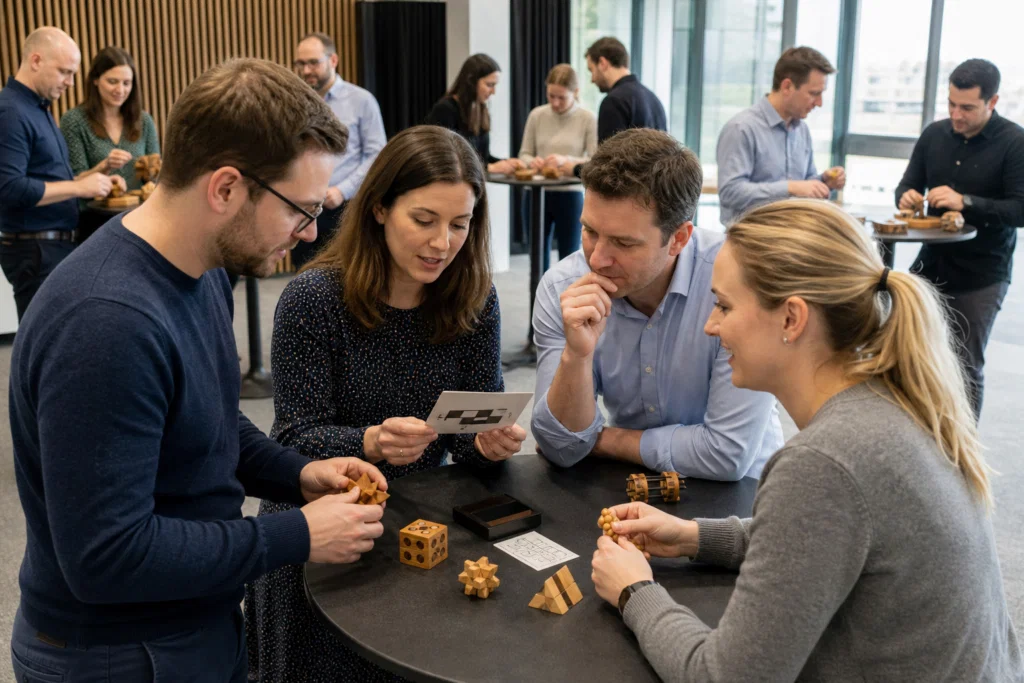
Team building brain teasers are short problem-solving challenges that ask people to think, talk and make decisions together. Used well, they can warm up a meeting, add structure to an away day or form the basis of a longer puzzle-led event.
The best brain teasers for work are not trick questions designed to embarrass people. They give teams a shared problem, a clear time limit and enough space for different thinking styles. That makes them useful for HR teams, managers and event planners who want an activity that feels lively without needing heavy physical equipment.
If you are planning a broader team day, brain teasers work well alongside team building activities and more structured problem solving team building events.
Why brain teasers work for team building
Brain teasers create a simple test of how a team listens, shares ideas and handles uncertainty. A puzzle usually has one answer, but the route to that answer can involve trial, disagreement, pattern spotting and a few wrong turns. That is useful territory for workplace groups.
They also reduce the barrier to taking part. People do not need sporting ability, performance skills or specialist knowledge. A good facilitator can draw quieter colleagues into the discussion by asking how they approached the problem, rather than asking who shouted the answer first.
For a company event, the value is in the conversation around the puzzle. Who frames the problem? Who checks assumptions? Who notices the missing detail? Who keeps the group moving when the first idea fails? Those behaviours are often more useful than the answer itself.
How to run brain teasers without making them feel like an exam
Set the tone before the first puzzle. Tell people that the aim is to solve as a team, not to prove who is the cleverest person in the room. That one sentence changes the energy.
Keep groups small enough for everyone to speak. Teams of four to six usually work better than large groups because people can hear each other and test ideas quickly. Use a visible timer, but avoid cutting people off every few seconds. A little pressure helps, too much pressure turns the activity into noise.
Give each team a way to record their thinking. Flip charts, answer sheets, tablets or puzzle envelopes can all work, depending on the venue. Ask teams to write down assumptions as well as answers. During the debrief, that gives you something practical to discuss: where the group rushed, where it listened and where it changed direction.
Mix puzzle types. If every challenge relies on wordplay, the same people may dominate. Use logic, observation, lateral thinking, sequencing, memory and spatial puzzles so different colleagues get chances to lead.
30 team building brain teasers to use at work
Use these as short rounds, table challenges or stations in a puzzle circuit. For a formal event, appoint a facilitator to read each answer and ask one follow-up question about how the team reached it.
- The three switches. A team can enter a room once to check one light bulb. Outside the room are three switches. The answer is to turn one switch on for several minutes, turn it off, turn a second switch on, then enter. The lit bulb belongs to the second switch, the warm unlit bulb belongs to the first and the cold unlit bulb belongs to the third.
- The river crossing. A colleague must take a fox, a chicken and a bag of grain across a river, carrying only one at a time. The fox cannot be left with the chicken and the chicken cannot be left with the grain. The safe sequence is chicken over, return alone, fox over, chicken back, grain over, return alone, chicken over.
- The bridge and torch. Four people cross a bridge at night with one torch. Their crossing times are 1, 2, 7 and 10 minutes, and only two can cross at once. The fastest total is 17 minutes: 1 and 2 cross, 1 returns, 7 and 10 cross, 2 returns, 1 and 2 cross.
- The missing pound. Three people pay £30 for a room. They receive £5 back, keep £3 between them and tip £2. The trick is in the wording. They paid £27 in total, which includes the £2 tip and £25 room cost. There is no missing pound.
- The two doors. One door leads to success and one to failure. One guard always tells the truth and one always lies. Ask either guard: If I asked the other guard which door leads to success, what would they say? Then choose the opposite door.
- The counterfeit coin. You have nine coins and one is lighter. With a balance scale and two weighings, weigh three coins against three. If they balance, the lighter coin is among the remaining three. If not, it is in the lighter group. Then weigh one coin against one from the suspect group to identify it.
- The calendar clue. Yesterday, tomorrow was Wednesday. What day is today? If yesterday’s tomorrow was Wednesday, then today is Wednesday.
- The word ladder. Change COLD to WARM by changing one letter at a time, making a real word each time. One route is COLD, CORD, WORD, WARD, WARM. Give teams a harder pair once they understand the rule.
- The silent order. Without speaking, a team must line up by birthday month and day. The puzzle is not the order itself, but how the team creates a shared communication system using gestures, notes or positioning.
- The office lift. A person takes the lift to the tenth floor each morning but only to the seventh floor on the way home, then walks. On rainy days they go to the tenth. The person is short and can reach the tenth-floor button only with an umbrella.
- The password pattern. The host says: Six equals three, twelve equals six, eight equals five. What does ten equal? The answer is three, because the pattern is the number of letters in the word.
- The full glass. A glass is filled to the brim with water. How can you add more without spilling any? Add ice, if the brief allows a change of state, or challenge teams to spot that the wording does not say the added item must be liquid.
- The meeting room code. The code is 2, 3, 5, 8, 12, 17. What comes next? Add 1, then 2, then 3, then 4, then 5. The next number is 23.
- The odd one out. Present the words apple, pear, peach, carrot and plum. The simple answer is carrot because it is not usually a fruit. The team point is to ask whether there could be another valid rule before agreeing.
- The locked box. A box has three labels: pens, notepads, mixed. All labels are wrong. You may take one item from one box. Take from the box labelled mixed. If it contains a pen, that box is pens, the box labelled notepads must be mixed and the box labelled pens must be notepads. Reverse the logic if you draw a notepad.
- The chair circle. Five chairs are in a row. Move two chairs to make them alternate facing forward and backward. The answer depends on the starting layout, so this works best as a physical puzzle where teams must test moves rather than debate in theory.
- The five-minute estimate. Ask teams how many seconds there are in five minutes, then add a follow-up: how many working seconds are there if two people work at the same time for five minutes? The first answer is 300. The second is 600 person-seconds.
- The rope around the earth. Imagine a rope tight around the earth. Add one metre to its length and raise it evenly all around. How much higher does it sit? The answer is about 16 centimetres, because the extra radius is the added length divided by 2π.
- The turned-around word. What common workplace word becomes another word when read backwards: drawer. The answer is reward. This is a quick warm-up for observation and patience.
- The hotel floors. A hotel has floors numbered 1 to 20, but no floor 13. How many floor numbers contain the digit 1? Count 1, 10, 11, 12, 14, 15, 16, 17, 18 and 19. There are 10.
- The team initials. Give each team a set of initials from job titles or departments and ask them to create a sentence where each word starts with the same letters. This tests shared knowledge and creative constraint, not general knowledge.
- The four-card rule. Cards show A, D, 4 and 7. Test the rule: if a card has a vowel on one side, it has an even number on the other. Teams must turn A and 7. A checks the vowel condition, and 7 checks whether an odd number has a vowel on the reverse.
- The clock hands. How many times do the minute and hour hands overlap in 12 hours? The answer is 11, because the first and last positions are not counted twice.
- The three statements. Three colleagues make statements. Alex says Blake is lying. Blake says Casey is lying. Casey says Alex and Blake are both lying. If only one person tells the truth, Casey is telling the truth. Teams need to test each option rather than guess.
- The paper fold. How many layers are made by folding a sheet of paper in half five times? The answer is 32 layers. It is a simple way to expose how quickly doubling grows.
- The client brief. A client asks for an event that is cheap, premium, outdoors, weatherproof, quiet and high energy. Which requirement should the team question first? There is no single mathematical answer. The useful response is to identify contradictions and ask the client to prioritise.
- The map route. A person walks one mile south, one mile east and one mile north, ending where they started. Where are they? The common answer is the North Pole. Accept other advanced answers only if the team can explain them clearly.
- The email subject. Which is shorter: writing a long unclear email or writing a short clear one? The trick is that the short clear email often takes longer to prepare. Use this to discuss planning before action.
- The shared drawing. One person sees a simple diagram and describes it while the rest draw without asking yes-or-no questions. The puzzle tests precision, listening and assumptions. Compare drawings at the end.
- The final clue. Give teams this instruction: Write down the answer to this puzzle before you read the next sentence. The answer is the word answer. It is a neat closing puzzle because it rewards careful reading over speed.
Choosing the right brain teasers for your team
Start with the audience, not the puzzle. Senior leadership groups may enjoy complex strategy problems, but a mixed company away day often needs shorter challenges with quick wins. New starters may benefit from communication puzzles because they help people speak to colleagues they do not yet know.
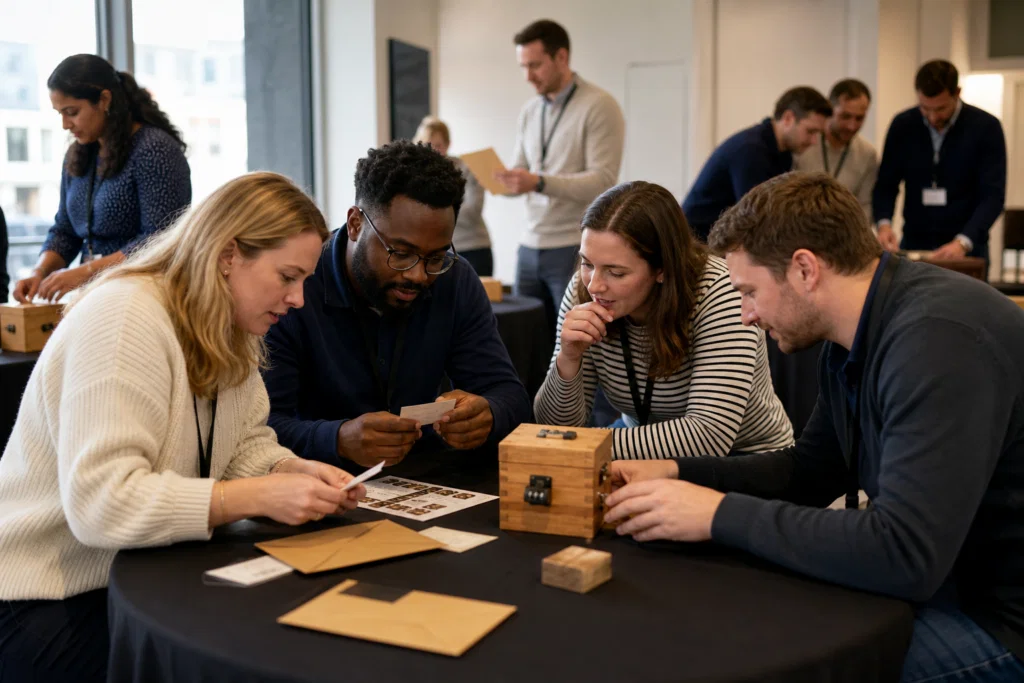
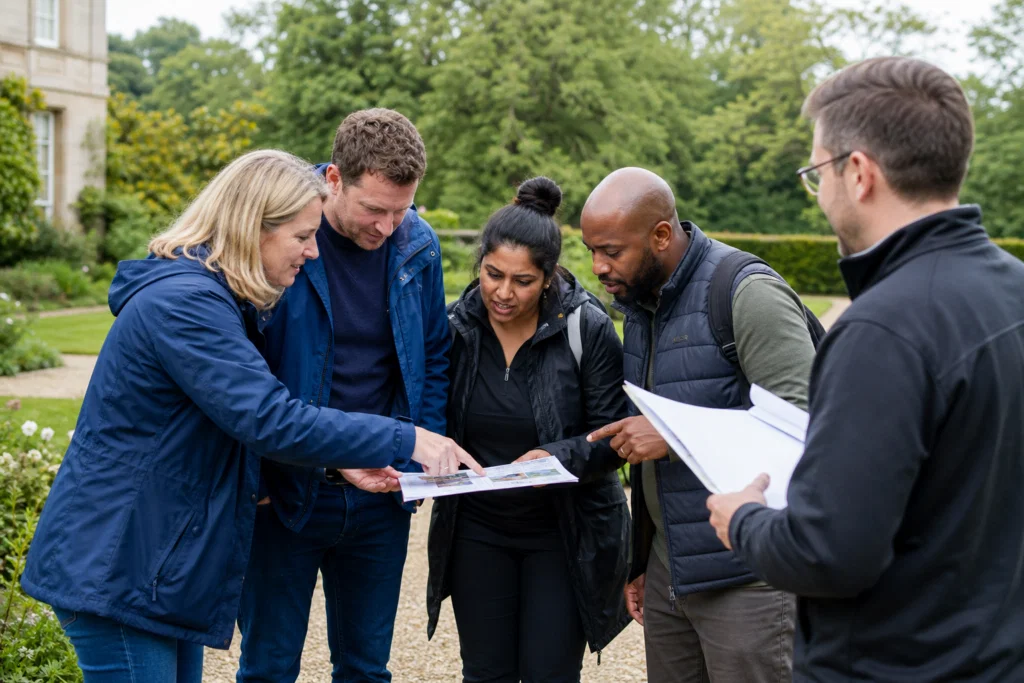
Think about the setting too. Indoor venues suit written clues, tabletop puzzle boxes, timed stations and screen-based quiz rounds. Outdoor venues suit trail-based clues, observation tasks and map-style challenges. If the venue choice is still open, this guide to choosing a team building venue can help you match the activity to the room, weather plan and group size.
For competitive teams, keep scoring clear and varied. Award points for correct answers, but consider bonus points for explaining the method, spotting a false assumption or supporting another group. That keeps the activity focused on teamwork rather than speed alone.
Making puzzle activities inclusive and low pressure
Brain teasers can go wrong when they reward the loudest person or rely too heavily on one skill. Avoid that by setting rules that make collaboration visible. Rotate the person who gives the final answer. Ask teams to record more than one possible route. Give people the option to write or draw rather than speak first.
Check accessibility before the event. Avoid puzzles that depend only on colour, tiny print, fast reading, cultural references or hearing a clue once in a noisy room. If you use physical puzzle stations, leave enough space for wheelchair users and avoid placing clues where only tall participants can reach them.
Workplace wellbeing data shows why tone matters. Stress and poor colleague relationships remain serious issues for UK employers, so a team activity should reduce tension rather than add to it. The aim is a fair, well-run challenge where people can contribute without feeling singled out.
Turning puzzle answers into useful workplace learning
A short debrief makes the difference between a fun puzzle session and a useful team building activity. Keep it practical. Ask what helped the team move forward, what slowed it down and what it would repeat in normal work.
Do not overanalyse every answer. Choose two or three moments that people actually noticed: a quiet person spotting the pattern, a group changing plan after new information, or a team losing time because it assumed the first idea was right. Those examples are easier to remember than abstract lessons about communication.
For HR teams and managers, brain teasers work best when they sit inside a clear event plan. Decide whether the purpose is ice-breaking, problem solving, leadership observation, morale or cross-department mixing. Then choose puzzles that support that purpose, rather than filling an agenda with random challenges.
How NewWave Events can shape a puzzle-led team activity
A good brain teaser session needs more than a list of riddles. NewWave Events can build the activity around your audience, timings, venue and event aims, so the puzzles feel purposeful rather than bolted on.
Define the purpose
We start with the reason for the activity, such as ice-breaking, collaboration, communication, leadership or problem solving. That choice shapes the puzzle style and the debrief.
Choose the format
Brain teasers can run as a short energiser, a hosted challenge, a puzzle trail, a table-based competition or part of a wider away day.
Match the venue
We consider room layout, group size, access, noise, weather plans and AV needs before recommending indoor, outdoor or hybrid puzzle formats.
Facilitate the session
A facilitator keeps the pace fair, explains the rules, supports quieter teams and makes sure the activity stays enjoyable rather than stressful.
Close with useful reflection
The debrief turns puzzle moments into simple workplace observations about listening, assumptions, decision making and shared problem solving.
Plan a team building event with the right level of challenge
If you want team building brain teasers as part of an away day, conference, leadership session or company event, NewWave Events can help you choose a format that fits your team and venue.
Tell us your group size, location, timings and aims, and we will suggest practical options that keep people involved without making the activity feel forced.