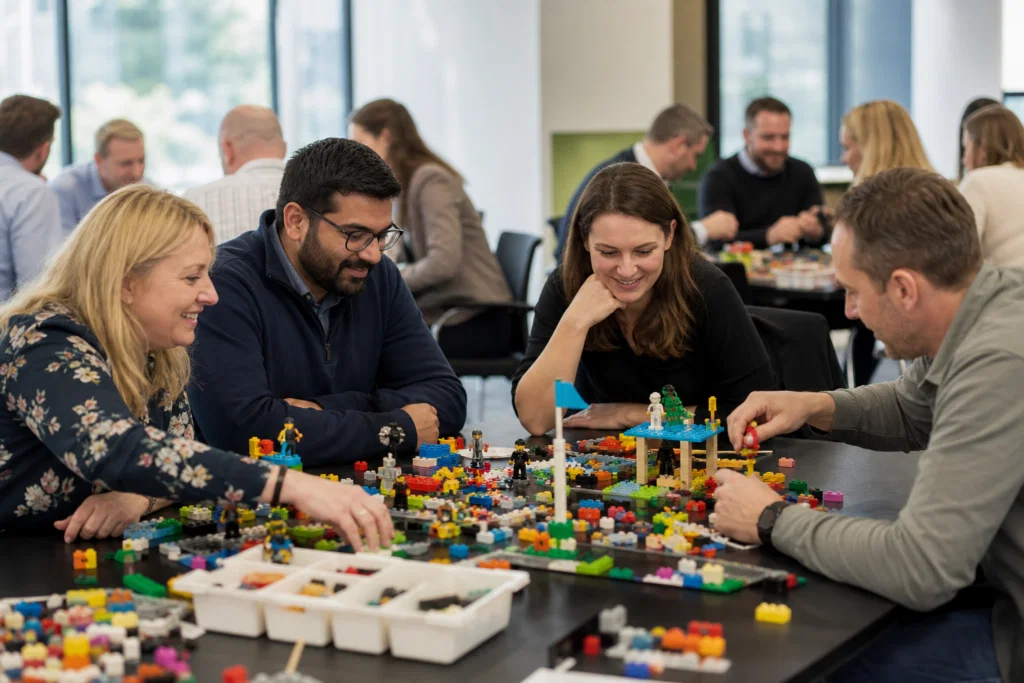
Lego team building activities work best when they are treated as structured workplace exercises, not a novelty break with bricks. The value comes from asking a clear question, giving everyone time to build a response, then using each model to support discussion, reflection and decision-making.
For HR teams and managers planning an away day, the format is useful because it gives quieter colleagues a visible way to contribute and gives senior voices less room to dominate by habit. The brick model becomes a shared object on the table, so people can talk about ideas, blockers and relationships without making the conversation feel personal too quickly.
Below are 10 serious play ideas that can be adapted for team development, leadership sessions, project kick-offs and corporate events. Some suit a short energiser. Others need a longer facilitated workshop with clear outputs.
What Lego team building is useful for
Lego team building suits teams that need to make thinking visible. That might mean exploring how a team works now, what is blocking progress, what a future goal looks like, or how different departments depend on each other.
The method behind LEGO® Serious Play® was designed for guided workshops with adults, using brick models to prompt dialogue, reflection, problem-solving and imagination. In a workplace setting, the bricks are not the point. The model is a way to turn an abstract answer into something people can point to, question and build on.
It can work well for leadership groups, project teams, new teams, cross-functional groups and departments going through change. It is less suitable when the real need is a formal decision already made elsewhere, a lecture-style briefing, or an entertainment-only activity where nobody expects meaningful discussion.
If you are comparing formats for a wider team day, it can sit alongside other team building activities, especially when the event needs a quieter, more reflective session before or after a more active challenge.
Need the activity to support a real team objective?
If your session needs to address communication, change or project alignment, plan the questions before you plan the bricks.
How to set up a serious play session
A strong session starts with the right question. Avoid vague prompts such as “build teamwork”. Ask something specific, such as “build the thing that currently slows this project down” or “build what success should feel like for our team by December”.
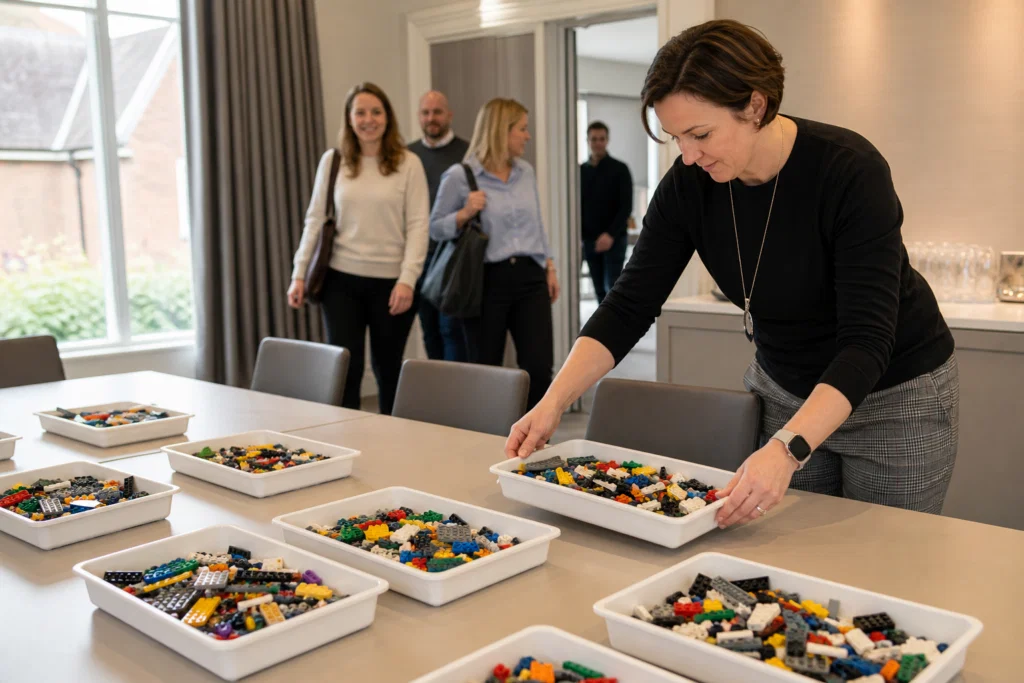
Give each person their own small selection of bricks so nobody has to fight for pieces. Set a time limit, usually five to ten minutes for a simple build and longer for shared models. The facilitator should explain that the model does not need to look realistic. It only needs to carry meaning for the person who built it.
After building, every participant explains their own model. Other people can ask clarifying questions, but they should not reinterpret it for them. This is where the format earns its place: each person owns their answer, and the team can see where perceptions match or differ.
For corporate groups, it is worth deciding in advance what the session should produce. That could be a set of agreed behaviours, a risk map, a project vision, a list of practical actions, or a photo record of shared models to return to after the event.
10 Lego team building activities for serious play
These Lego team building activities are designed for adult workplace groups. They can be run as standalone exercises, combined into a longer workshop, or used as part of a wider away day.
- Build your role in the team. Ask each person to build a model that represents the part they play in the team at its best. This is a useful opener because it moves beyond job titles and helps colleagues explain the value they think they bring, the support they offer and the pressures they carry.
- Build the team at its best. Each participant builds a model of the team when it is working well. The group then compares the models and looks for shared themes. This can reveal whether people define success through speed, trust, creativity, accuracy, customer impact or calm delivery.
- Build the hidden blocker. Ask everyone to build one obstacle that makes good work harder than it should be. The model gives people a safer way to discuss awkward issues such as unclear priorities, poor handovers, duplicated work or slow decisions. Finish by choosing which blockers the team can act on first.
- Build our customer or stakeholder. Teams build a model of the person, group or organisation they serve. This works well for departments that have become internally focused. It helps people discuss what stakeholders actually need, what they find frustrating and what the team may be assuming without evidence.
- Build the communication bridge. Split the group into pairs or small teams. Each group builds a bridge between two departments, roles or project stages, then labels what must travel across it. The discussion usually exposes missing information, unclear ownership and points where work gets delayed.
- Build a decision-making machine. Ask participants to represent how decisions are really made in the team now. The model might show bottlenecks, loops, missing voices or approval layers. The group can then rebuild the machine to show a better route for common decisions.
- Build the future headline. Each person builds a model of a positive future result, then gives it a headline as if it has already happened. This works for strategy days because it turns broad ambition into visible outcomes. The facilitator should push for concrete details, not slogans.
- Build the trust battery. Participants build something that charges trust in the team and something that drains it. This exercise needs careful facilitation, but it can be very practical. It helps teams name everyday behaviours, such as keeping commitments, sharing context early or challenging respectfully.
- Build the project risk map. Small groups build the project as a landscape, placing risks, dependencies and pressure points into the scene. Once the risks are visible, the team can discuss which ones need prevention, which need monitoring and who owns the next step.
- Build one thing we will change. End the session by asking each person or group to build one action they will take back to work. Keep it small enough to be done. Photograph the models and record the actions so the session does not end as an interesting conversation with no follow-through.
Choosing the right format for your group
The right format depends on group size, purpose and the level of conversation you want. A 30-minute Lego exercise can work as an energiser or icebreaker, but it will not solve a complex team issue. A half-day or full-day session gives the group time to move from individual models into shared models, reflection and agreed actions.
For small leadership teams, the best sessions usually involve fewer activities and more discussion. A senior group may only need three carefully chosen builds: current reality, future direction and the system that sits between them. Trying to cram in too many exercises can make the session feel busy rather than useful.
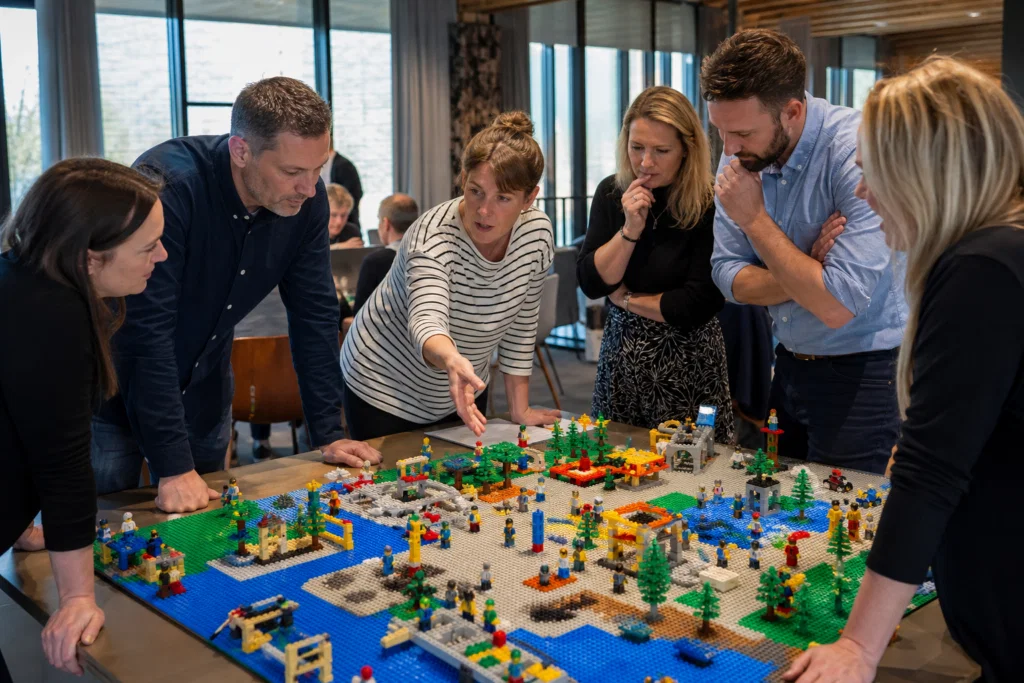
For larger company away days, Lego activities can run in table teams with a facilitator or host keeping the structure tight. This format works well when the aim is participation, shared language and practical ideas rather than deep organisational development work.
Venue choice also matters. Teams need enough table space for building, good lighting, easy movement around models and a room where discussion will not be drowned out. If you are still deciding where to hold the day, NewWave’s guide to choosing team building venues may help you avoid common planning problems.
Choosing a room for hands-on collaboration?
Lego-based workshops need table space, good sound and enough room for people to move around models without crowding the group.
Facilitation details that make the difference
The facilitator’s job is to protect the process. They should keep prompts clear, manage time, invite every person to share, and stop the group from drifting into ordinary debate before the models have done their work.
One common mistake is letting confident participants explain what someone else’s model means. The builder should always speak first and have the final say on interpretation. Other people can ask questions such as “what does that piece represent?” or “what happens if that connection breaks?”, but they should not take ownership of the story.
Another mistake is over-designing the kit. Corporate teams do not need perfect sets or identical showpieces. They need enough varied bricks, figures, wheels, connectors, base plates and unusual pieces to express ideas quickly. Too much choice can slow people down, so the kit should match the time available.
Accessibility also needs thought. Some people may have limited dexterity, visual impairments, neurodivergent preferences or anxiety about creative tasks. Offer alternative ways to contribute, allow people to describe a model built with support if needed, and make it clear that artistic skill is irrelevant.
Turning the activity into workplace action
The most useful Lego team building activities end with a decision about what happens next. Before the session closes, capture the main themes, photograph shared models, record agreed actions and assign owners. If the outputs are vague, the team will struggle to use them afterwards.
A simple follow-up rhythm helps. Send a short summary within a few working days, revisit the actions in the next team meeting, and ask what has changed after four to six weeks. For leadership or change sessions, the models can also become reference points for later decisions.
It is also worth being honest about what a one-off activity can and cannot do. A well-run session can improve understanding, open up discussion and create practical commitments. It cannot compensate for poor management, unclear strategy or issues that need formal consultation. Treat it as a useful event design tool, not a cure-all.
If you want a creative workshop to sit within a broader event, Lego-based serious play can combine well with other creative events, problem-solving tasks, wellbeing sessions or an evening social, depending on the tone of the day.
A simple serious play workshop flow
A Lego-based session needs structure. These five stages keep the activity purposeful without making it feel over-controlled.
Set the challenge
Start with a focused question linked to a real team issue, project goal or event outcome.
Build individually
Give everyone time to create their own model before group discussion begins.
Share the story
Each builder explains what their model means while others listen and ask clarifying questions.
Build shared meaning
The group connects ideas, spots patterns and creates a shared model or agreed view where useful.
Capture actions
Photograph models, record decisions and agree what will happen after the event.
Plan a creative team building event with NewWave
NewWave Events designs and delivers team building activities and corporate events for UK organisations. If you want a creative, structured session that fits your team’s objectives, we can help shape the right format, venue plan and event flow.