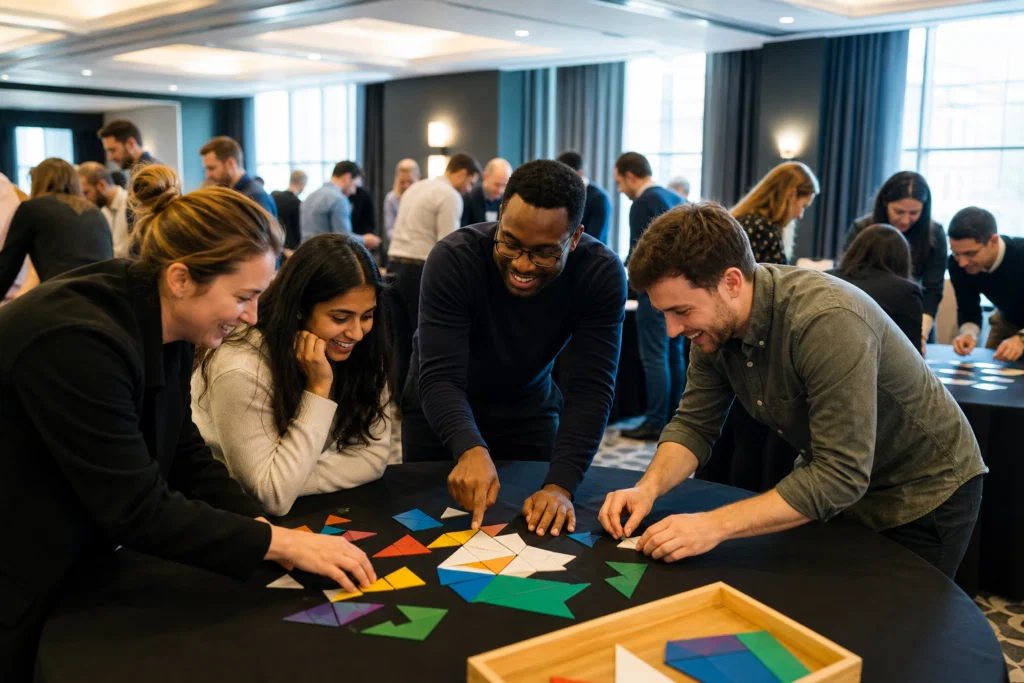
Indoor team building activities work best when they give people a shared task, a clear reason to talk and enough structure to stop the loudest voices taking over. They do not need to involve trust falls, awkward icebreakers or forced vulnerability.
For UK companies, indoor formats are also practical. They are easier to run alongside meetings, conferences and away days, and they are less exposed to weather, daylight and travel disruption. A well-planned indoor session can help hybrid teams reconnect, give new colleagues a way into the group and create a break from normal working patterns without losing the day to logistics.
This guide gives you 35 indoor ideas, then explains how to choose the right format for your numbers, venue and team objective. If you already know you need a fully managed option, NewWave Events has a dedicated range of indoor events that can be shaped around your brief.
Why indoor team building works for modern UK teams
Indoor team building suits workplaces where time together is now less routine. Hybrid patterns mean some teams only gather in person for planned meetings, so the day needs to justify the commute and the calendar space. A good indoor activity gives that time a clear purpose.
It also removes some of the common barriers to participation. People do not need specialist clothing, outdoor fitness, good weather or a spare change of shoes. That makes indoor activities useful for mixed departments, senior teams, graduate cohorts, contact centres and company-wide events where confidence levels vary.
The format still matters. An indoor event should not feel like another meeting with a game bolted on. The best sessions change the energy in the room. They get people standing up, solving something, making something or competing in a way that feels fair. People should leave with a few useful conversations they would not have had at their desks.
There is a wellbeing reason to take this seriously too. Recent UK workplace data shows that stress, absence and health are still live concerns for employers. Team building will not fix workload or poor management, but it can support connection when it is planned as part of a wider people strategy rather than as a one-off morale patch.
How to choose activities people will actually join in
Start with the purpose. If the team is new, choose a format with easy conversation and low pressure. If the team is established but siloed, use a challenge that mixes departments and gives people different roles. If the group has had a hard quarter, do not make the day too worthy. Choose something social, light and well hosted.
The next question is energy. Some teams want movement and competition. Others will get more from a creative workshop, tasting experience or puzzle-based format. A finance team, sales team and senior leadership team may all enjoy the same activity, but the tone, pace and scoring need to be adjusted.
Think about accessibility before you book. Ask about mobility, hearing, dietary needs, neurodiversity, religious considerations and shift patterns early enough to adapt the plan. Indoor events give you more control over seating, sound, lighting, breaks and food, so use that advantage.
Finally, avoid making attendance feel like a test of personality. The activity should invite people in. Brief the session around the business reason for being together, then let the facilitator handle the game, challenge or workshop. If you are comparing formats for a wider away day, this guide to corporate away day ideas for UK teams may help you frame the day.
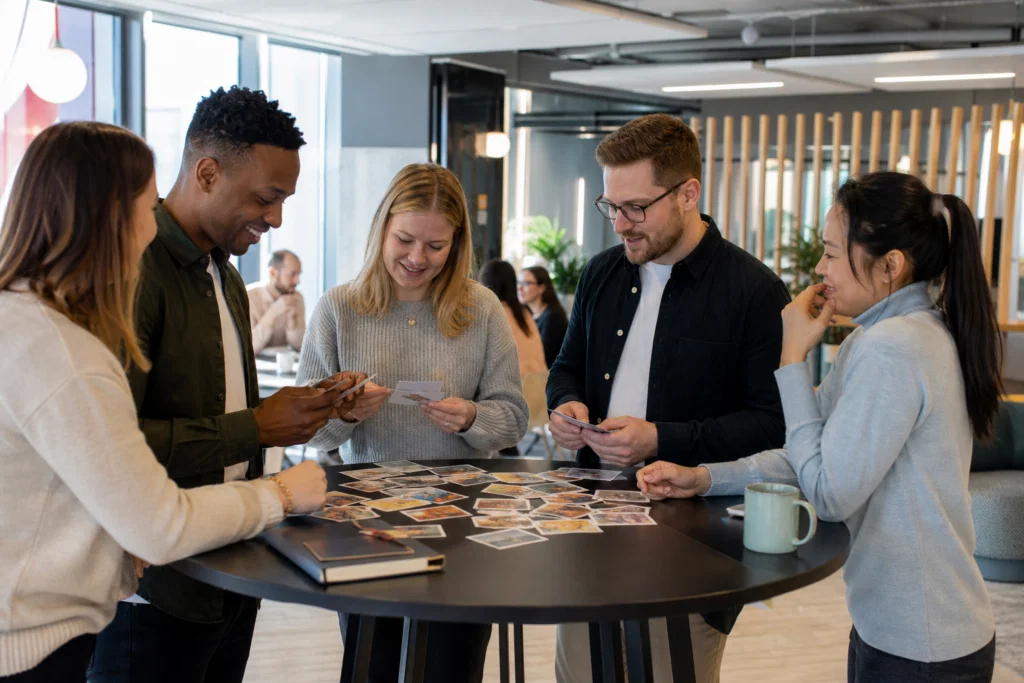
Need an indoor format that suits mixed confidence levels?
If your team includes new starters, senior leaders and quieter colleagues, NewWave can recommend indoor activities with varied roles so everyone has a fair way to take part.
35 indoor team building activities that beat trust falls
Use these ideas as a shortlist rather than a shopping list. The right choice depends on your group size, venue, timing, budget and what you want people to practise together.
- Murder mystery: Colleagues work through clues, character briefs and red herrings to solve a staged crime. It suits evening events, conferences and mixed groups because people can contribute through listening, questioning and deduction rather than physical confidence.
- Corporate gameshow: Teams compete through quiz rounds, quick-fire challenges and buzzer moments. A strong host keeps the pace moving, which makes this a safe choice for large groups who need immediate energy after presentations.
- Escape room-style challenge: Portable puzzle stations bring the logic of an escape room into a meeting space or hotel suite. Teams have to divide tasks, share information and stay calm as the clock runs down.
- Under Pressure challenge: This works well when you want structured problem solving with a competitive edge. Teams take on timed tasks, prioritise quickly and learn who naturally plans, checks detail or keeps morale steady.
- Apprentice-style business challenge: Groups create a product, campaign or pitch, then present it to a judging panel. It is useful for sales, marketing and leadership groups because it combines creativity, commercial thinking and presentation skills.
- Charity bike build: Teams assemble bikes or similar items for donation through a charity partner. The activity adds a practical shared purpose, while still requiring communication, quality checks and role allocation.
- Care kit assembly: Colleagues pack useful care kits for a chosen cause. It is calm, inclusive and suited to organisations that want a CSR element without turning the session into a lecture.
- Bee hotel sustainability workshop: Teams build bee hotels or small habitat items while learning about simple environmental action. It works for indoor wellbeing weeks, sustainability days and quieter teams that prefer hands-on making.
- Chocolate making: A guided chocolate workshop gives people a relaxed, sensory task with a finished product to take away. It is social without being too loud and works well for reward events.
- Cocktail or mocktail making: A bartender-led session gives teams recipes, techniques and tasting rounds. Include non-alcoholic options as standard so the activity is welcoming and not centred on drinking.
- Cooking challenge: Teams prepare dishes within time, ingredient and presentation limits. It works because roles form naturally, with planners, makers, tasters and presenters all having something to do.
- Indoor bake-off: Groups decorate cakes, build dessert displays or tackle simple bakes where the venue allows it. It is competitive, visual and easy to adapt for dietary requirements if planned early.
- Pizza making: A lighter food format where teams design, make and name their pizzas before judging. It is good for informal socials because people can talk while working.
- Wine, cheese or soft drink tasting: A guided tasting gives structure to conversation and works well after a conference day. Keep the focus on flavour, story and preference rather than who knows the most.
- Casino night: Fun casino tables create a sociable evening format without real gambling. People can move between tables, learn simple games and enjoy light competition at their own pace.
- Corporate race night: Teams cheer on filmed races, study form cards and compete for points. It suits dinners and awards evenings because the rounds can be spaced between food and speeches.
- Indoor scavenger hunt: Teams solve clues around a venue, conference floor or office building. It adds movement without needing outdoor space and helps people discover the setting together.
- Photo mission challenge: Teams complete a list of staged photo tasks using agreed devices and privacy rules. The activity encourages creativity, but it needs clear boundaries around personal data and where images will be used.
- Office treasure trail: A lower-tech version of a scavenger hunt using envelopes, props and clues. It is useful when you want a simple activity that can run in a familiar workplace.
- Pub-style quiz: A quiz still works when the rounds are varied and inclusive. Mix general knowledge with picture rounds, music clips, company-safe trivia and team tasks so it does not reward only one type of knowledge.
- Music bingo: Players mark off songs, artists or themes as clips are played. It is quick to understand, lively and easy to run before dinner or as a conference energiser.
- Drumming workshop: A facilitated drumming session gets the whole room working to one rhythm. It is loud, physical and memorable, so it suits groups that need a lift rather than quiet reflection.
- Choir or harmony session: Teams learn a simple arrangement and perform together at the end. It can feel exposing at first, so the facilitator needs warmth and a clear build-up that starts gently.
- Creative mural workshop: Teams contribute panels to a shared artwork based on a theme such as values, customers or future plans. The result can be displayed afterwards, which gives the session a longer life.
- Collaborative LEGO build: Groups use bricks to model a process, customer journey or future workplace. It is useful because abstract work topics become physical and easier to discuss.
- Bridge build challenge: Teams design and construct a bridge from supplied materials, then test it against weight or distance criteria. It is simple to understand and good for showing how planning affects delivery.
- Tower build challenge: A classic construction task can still work when materials are varied and scoring is fair. Give points for height, stability, design and teamwork rather than height alone.
- Chain reaction build: Teams create sections of a larger contraption that must connect into one final movement. It requires local teamwork and whole-room coordination, which makes it useful for departments that rarely rely on each other.
- Marble run challenge: Groups design a route that keeps a marble moving for the longest time or reaches a target. It rewards testing, iteration and patient problem solving.
- Indoor mini golf build: Teams design holes using props and obstacles, then play the course. It combines making, competition and light movement, which works well for informal socials.
- Robot or coding challenge: Teams programme small robots or solve simple coding tasks. It suits technical groups, but the briefing should make space for non-coders through roles such as testing, mapping and communication.
- Strategy simulation: Teams run a fictional business, expedition or crisis scenario and make decisions across rounds. This is better for leadership groups than pure entertainment because choices have consequences.
- Negotiation game: Teams represent different stakeholders and have to reach an agreement under time pressure. It helps people practise listening, trade-offs and clear communication without using real internal disputes.
- Indoor wellbeing circuit: Colleagues rotate through short activities such as stretching, breathing, desk posture, nutrition or mindfulness. Keep it practical and optional in tone, not preachy.
- Awards and recognition lab: Teams create peer nominations, appreciation cards or light-hearted awards linked to real behaviours. It works best at the end of a project, quarter or away day when people need to mark effort properly.
How to run the room so the activity lands well
The best idea can fall flat if the room is set up badly. Check sightlines, sound, movement space, ventilation, lighting and where people will put coats and bags. If teams need to rotate between stations, leave more space than you think. A crowded room makes a fun activity feel like admin.
Brief the event properly. People should know why they are there, how long the session will last, what is expected of them and what is optional. If competition is involved, explain the scoring before the first round. If the event includes food, alcohol, photos or charity partners, be clear about those details in advance.
Facilitation matters. A good facilitator notices when one table is drifting, when a quieter group needs help and when the room needs a break. They keep the tone adult, not school-trip. They also prevent the same confident people from dominating every task.
Health and safety still applies indoors. Match the activity to the venue, manage cables and trip hazards, and agree emergency arrangements with the venue or event team. For physical or build-based tasks, use appropriate equipment and supervision. The aim is a lively session, not unnecessary risk.
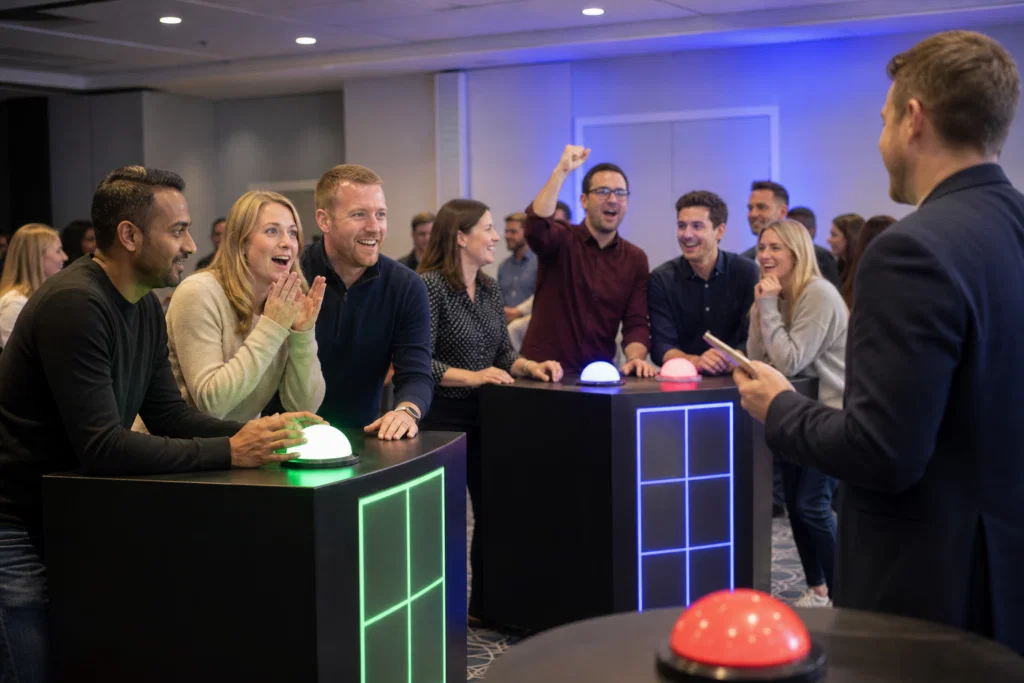
Planning around a fixed venue or conference agenda?
Share your room layout, timings and guest numbers with NewWave and we can suggest activities that fit the space rather than forcing the space to fit the idea.
Matching indoor formats to group size, time and venue
For groups of 10 to 30, choose formats where everyone has a visible role. Murder mysteries, cooking challenges, creative workshops, escape-style puzzles and facilitated leadership simulations all work well because smaller teams can talk properly.
For 30 to 100 guests, rotation formats often work better. Teams can move through challenge stations, tasting rounds, build tasks or quiz sections without waiting too long. This is also the range where a strong host makes the biggest difference.
For 100 plus guests, keep the rules simple and the production clear. Gameshows, race nights, casino evenings, mass drumming, charity assembly events and conference challenges can scale well if registration, team allocation and room layout are planned in advance.
Venue choice affects all of this. A boardroom can work for a puzzle session, but not for a drumming workshop. A hotel ballroom can hold a large gameshow, but may need breakout space for rotations. If you are still choosing a location, NewWave has a practical guide to team building venues that covers fit, flow and planning detail.
Turning a good session into workplace follow-through
Team building has more value when it connects to what happens next. That does not mean turning every activity into a debrief heavy enough to drain the room. It means naming the useful behaviours people showed, then making one or two links back to work.
After a puzzle challenge, the follow-through might be about sharing information earlier. After a charity build, it might be about quality checks and ownership. After a creative workshop, it might be about giving people permission to test ideas before they are polished. Keep the link specific.
Ask managers to carry the thread into normal routines. A five-minute discussion in the next team meeting is often enough: what worked, what surprised us, and what should we repeat back at work? If the day revealed a bigger issue, such as unclear roles or strained relationships, do not pretend the activity solved it. Treat it as useful evidence for the next conversation.
The real measure is not whether everyone loved every minute. It is whether the session gave people a fair chance to take part, talk to different colleagues and return to work with a little more trust in how the group operates.
A simple way to plan an indoor team building event
Use this five-part check before choosing the activity. It keeps the event focused on the team rather than on what happens to be available.
Define the job of the day
Decide whether the session is for connection, reward, communication, problem solving, leadership or post-project recognition. One clear purpose makes the activity choice easier.
Check the room before the concept
Confirm ceiling height, floor space, access, sound limits, catering times, breakout rooms and any venue restrictions before promising an activity to the team.
Design for mixed confidence levels
Choose a format with varied roles so people can lead, make, analyse, present, organise or support. Participation should not depend on being the loudest person in the room.
Brief managers and hosts
Make sure line managers understand the tone of the day. The host should run the energy, while managers model participation without turning the activity into performance management.
Close with one practical link
End by naming one behaviour worth taking back to work. Keep it short and specific so the session feels useful without becoming a workshop nobody asked for.
Plan an indoor team building event that fits your team
NewWave Events designs and delivers indoor team building activities for UK companies, from conference energisers and creative workshops to evening entertainment and large group challenges. Tell us your numbers, location, date and objective, and we’ll shape a practical proposal around your team.