Silos usually form when teams stop seeing the work from each other’s point of view. Communication team building activities can help by giving people a structured way to practise clearer briefings, better listening, more useful feedback and shared decision-making.
This guide covers 20 practical exercises for UK companies, plus advice on choosing the right format, running a useful debrief and turning the activity into better day-to-day habits.
Why communication activities help with silos
Communication team building activities work best when they make everyday communication problems visible in a safe, practical setting. Silos rarely disappear because a manager tells people to collaborate more. Teams need to practise handovers, listening, brief-setting, decision-making and feedback with people they do not usually work with.
For HR teams and team leaders, the aim is not to run a few games and hope behaviour changes. A good communication activity should expose where messages get lost, where assumptions creep in and where teams need clearer rules for sharing information. It should also give people a shared reference point they can use back at work.
That matters because communication is not only about broadcasting updates. Current CIPD guidance treats employee communication as planned, tailored and multi-directional, with line managers playing a central role. Its employee voice guidance also makes the point that one channel is rarely enough. People need routes to share views, influence decisions and see that feedback has been heard.
Well-run team building can support that by giving teams structured practice away from the pressure of live projects. It is especially useful after a restructure, during growth, before a major project, when hybrid teams feel fragmented or when departments blame each other for slow decisions.
Use the event to reveal the real communication gap
If departments are working around each other rather than with each other, a designed activity can make the handover problem visible without putting anyone on the spot.
Choose the activity around the communication problem
Start with the communication problem, not the activity catalogue. A team that struggles with unclear handovers needs a different exercise from a leadership group that needs to practise cascading decisions. A sales and operations team may need to map dependencies, while a new project team may need fast trust-building and role clarity.
Before booking an activity, decide what you want people to practise. Useful outcomes include:
- clearer briefings between departments
- more confident listening and questioning
- better handovers between teams, shifts or locations
- fewer assumptions about what other roles do
- more constructive feedback between peers
- stronger links between remote, hybrid and site-based colleagues
Group size also matters. Small groups can handle deeper conversations and feedback drills. Larger groups need movement, visible scoring, good facilitation and enough equipment to prevent people standing around. If you are comparing formats for a wider away day, NewWave’s guide to corporate away day ideas for UK teams is a useful next read.
Keep activities accessible. Avoid exercises that punish quieter people, depend on physical confidence or turn communication into a shouting contest. The best sessions create enough pressure to reveal habits, then give the group time to pause, discuss and try again.
20 communication team building activities for workplace teams
The activities below are designed for workplace teams that need better communication across departments, roles or locations. They can be run as short conference energisers, longer breakout sessions or part of a full team building day, depending on the group size and objective.
- Silent line-up: Ask participants to line up by birthday month, length of service or distance travelled without speaking. The exercise shows how quickly teams create alternative signals and whether people check understanding before moving.
- Message relay with constraints: One person receives a brief and passes it through several people, with each round limiting words, time or questions. The debrief focuses on what was lost, what was assumed and what a good handover should include.
- Cross-team project map: Mixed groups map how a real piece of work moves through the business, from request to delivery. This helps departments see where delays, duplicated checks and unclear ownership create silos.
- Role-swap briefing: Participants explain another department’s priorities as if they worked in that team. It is useful when groups have built up fixed views about each other’s pressures, constraints or decision-making.
- Stakeholder newsroom: Teams receive changing updates during a simulated incident and must decide what to tell customers, managers and colleagues. It tests message discipline, escalation routes and the difference between speed and accuracy.
- Back-to-back drawing: One person describes an image while another draws it without seeing it. The exercise is simple, but it quickly reveals whether instructions are specific, whether listeners ask useful questions and whether both sides check progress.
- Guided navigation: In a safe, flat activity area, one participant gives verbal directions while another follows a short route with limited vision or limited information. Use this only with proper supervision and clear boundaries. The learning point is trust, clarity and calm instruction.
- Escape room communication review: Teams solve connected puzzles under time pressure, then review how they shared clues. It works well for groups that need to avoid information hoarding and make better use of quieter contributors.
- Scavenger hunt handovers: Teams complete stages where each subgroup must brief the next group before moving on. The handover is part of the score, so people learn that communication quality affects results.
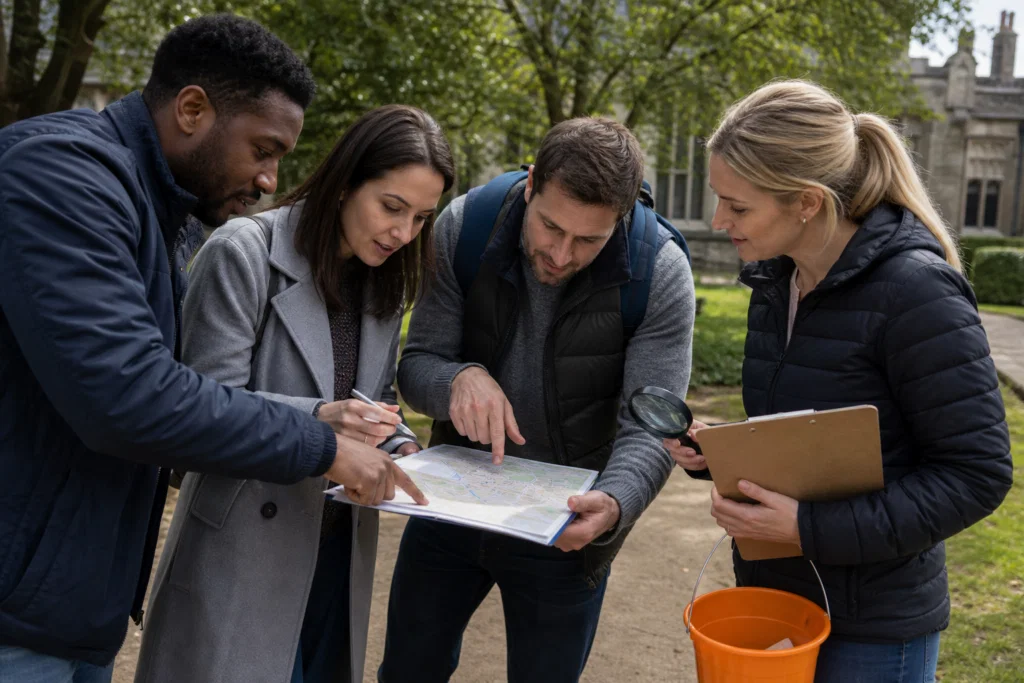
- Venue treasure hunt: Mixed teams follow clues around a hotel, conference venue or city centre route. It encourages people from different departments to share observations, divide tasks and agree decisions without defaulting to job titles.
- Murder mystery information exchange: Participants receive partial information and must piece together a shared account. This format is useful for showing how hidden knowledge, assumptions and selective listening affect group decisions.
- Charity challenge task board: Teams complete practical tasks for a charitable outcome while managing a shared task board. It encourages transparent ownership, visible progress and useful check-ins rather than scattered updates.
- Build the brief, not the thing: Instead of building a model, teams create the clearest possible brief for another group to execute. The second group then tests whether the brief was usable. This shifts attention from output to instruction quality.
- Meeting reset sprint: Groups redesign a recurring meeting using a strict template: purpose, decisions needed, attendees, information required and follow-up owner. It turns a common frustration into a practical communication improvement.
- Prioritisation auction: Teams bid limited tokens on competing tasks or project features, then explain their choices. The activity brings hidden priorities into the open and shows where departments define urgency differently.
- Customer journey relay: Each group owns one stage of a customer or employee journey, then passes the case to the next stage. It shows how internal communication shapes the experience of the person outside the team.
- Listening pairs: One person speaks for two minutes about a work challenge while the other can only summarise and ask clarifying questions. It slows the urge to fix, defend or interrupt.
- Assumption swap: Teams write down assumptions they think other departments make about them, then compare with what those departments actually say. It needs careful facilitation, but it can clear long-standing misunderstandings.
- Feedback lab: Participants practise giving feedback on a low-risk task using specific observations, impact and a next step. This supports the regular, timely performance conversations recommended in current performance management guidance.
- Leadership cascade simulation: Senior or middle managers receive a strategic decision and must cascade it through several layers while keeping the message consistent. It is useful when employees hear different versions of the same update from different managers.

Turn the activity into a working habit
The debrief is where the activity becomes useful. Without it, people may enjoy the session and then return to the same communication habits the next day. Build in time after each major exercise to ask what happened, what made communication harder and what the team wants to do differently.
A practical debrief should cover four areas:
- what information people had at the start
- what information was missing or unclear
- how decisions were made
- what the team would change if the same task happened at work
Keep the discussion specific. Instead of asking whether communication was good or bad, ask where the first misunderstanding happened. Ask who had information that others needed. Ask what would have made the brief shorter, clearer or easier to act on.
It also helps to turn one learning point into a working agreement. That could be a handover checklist, a rule for project updates, a clearer meeting purpose or a shared phrase that allows people to pause and check understanding. CIPD performance guidance places regular, timely feedback at the centre of good performance management, and team building gives managers a practical way to rehearse that habit before applying it to live work.
Make the learning stick after the activity
NewWave can build the debrief into the activity design, so the team leaves with practical agreements rather than a vague sense that communication should improve.
Adapt the format for hybrid, senior and large groups
Communication activities need careful design when a group includes senior leaders, new starters, remote workers, frontline teams or people who rarely meet. A single format can still work, but the brief, group mix and facilitation style may need adjusting.
For hybrid teams, avoid treating the event as a reward only for office-based employees. Bring remote colleagues into the planning conversation, choose a date that makes travel realistic and consider whether the day should include a hybrid-friendly follow-up. Microsoft’s 2026 Work Trend Index included UK respondents in a wider survey of knowledge workers using AI and argued that organisations need to redesign work patterns, not just add tools. That is a useful principle for communication events too. The event should support better working patterns after the day, not sit apart from them.
For senior teams, choose exercises that mirror real ambiguity. Leadership groups rarely need icebreakers for their own sake. They usually need to practise giving consistent messages, making decisions with incomplete information and listening before they broadcast.
For large groups, make the structure visible. Use zones, timed rotations, clear scoring and facilitators who can keep energy steady without rushing the learning. If the venue is still undecided, NewWave’s guide to choosing team building venues explains how space, access and wet-weather plans affect the day.
When to use a facilitator
Bring in a facilitator when the group is large, the objectives are sensitive or the team needs more than light entertainment. Communication issues can involve status, workload, personality clashes or historic frustration. A neutral facilitator can keep the session fair, prevent dominant voices taking over and help the group discuss behaviour without turning the day into a grievance meeting.
There are limits. If the issue is an active employment dispute, bullying allegation or serious breakdown in working relationships, do not use a team building activity as a substitute for the proper process. Current Acas guidance on mediation describes a more formal route involving separate meetings and a joint meeting, with mediation remaining voluntary. CIPD guidance also notes that mediation is not suitable for every situation, including serious harassment complaints.
For most teams, though, a well-designed communication event can reset habits before issues harden. The best results come when HR, managers and the event provider agree the objective early, choose exercises that match the real communication problem and leave the team with a small number of practical actions.
NewWave Events designs and delivers team building activities for UK workplaces, including indoor, outdoor, conference and away day formats. If silos are slowing your team down, start with the communication problem and build the event around it.
How NewWave shapes a communication team building event
A good communication event is designed backwards from the behaviour you want to improve. NewWave plans the activity, facilitation and debrief as one joined-up session.
Define the communication issue
We start by clarifying whether the team needs better handovers, stronger listening, clearer leadership messages, improved feedback or more trust across departments.
Choose the right format
Indoor, outdoor, conference and away day formats are selected around the group size, venue, accessibility needs and the level of challenge the team can handle well.
Mix teams with purpose
Groups are mixed carefully so people work with colleagues they need to understand better, rather than staying in familiar departmental clusters.
Build in a useful debrief
Facilitators connect the activity back to real work, asking precise questions about information flow, assumptions, decision-making and ownership.
Agree the next habit
The session ends with clear, manageable actions such as a handover checklist, meeting reset, escalation rule or cross-team check-in rhythm.
Plan a communication team building event
NewWave Events can design a communication-focused team building session around your team size, venue, objectives and working style. Tell us where silos are showing up, and we will shape an event that gives people practical ways to work better together.