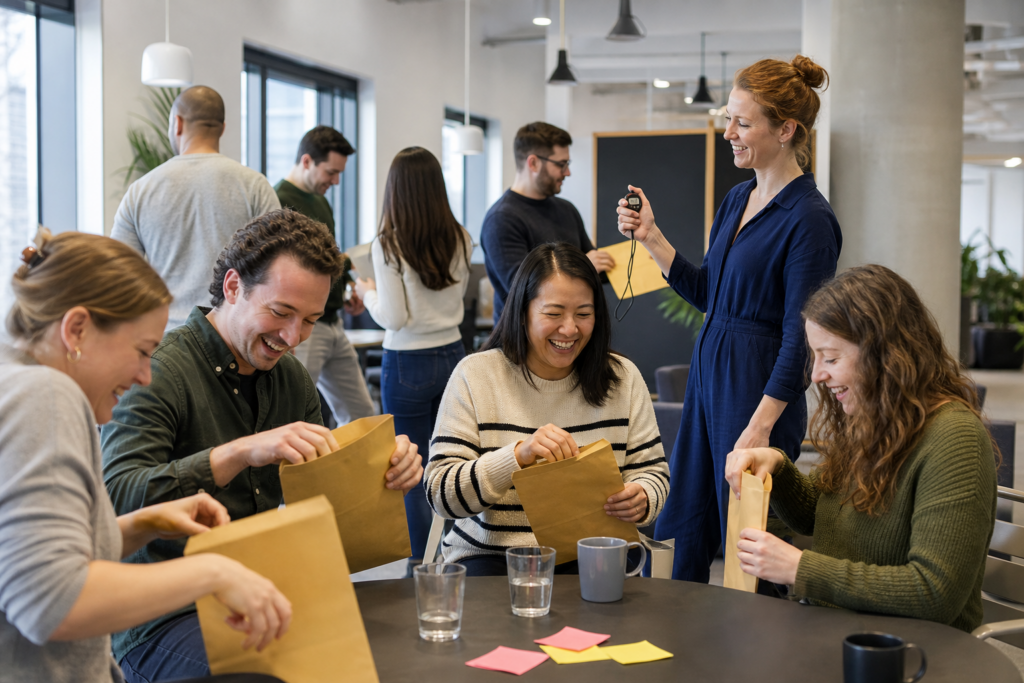
Taskmaster office games are short, odd and playful challenges that ask teams to solve a problem under time pressure. For UK companies, they work well as a meeting energiser, away day activity or informal team building session because they reward lateral thinking rather than job title, seniority or specialist knowledge.
This guide gives you a practical way to run a Taskmaster-style event at work, including safe setup advice, scoring tips and 25 original task ideas for your team. The format is inspired by the spirit of comic challenge shows, but the activities below are designed for workplace use and should be run as an unofficial office game.
What taskmaster office games are and why they suit work teams
Taskmaster office games work because the rules are simple, the answers are rarely obvious and the room gets to enjoy different kinds of cleverness. A finance colleague might win the logic task. A quiet designer might win the persuasion task. A senior leader might be hopeless at building a paper hat under pressure, which can be rather useful for the atmosphere.
For a workplace version, keep the idea but make the tasks your own. Avoid copying tasks directly from the programme, and do not present the event as official or affiliated. Think of it as a light, challenge-led team building format: a host sets strange but safe tasks, teams interpret the wording, and points are awarded for success, creativity, speed or good judgement.
The best office version is not about embarrassing people. It gives colleagues permission to be inventive without making anyone feel exposed. That means clear boundaries, sensible materials and a host who can keep the humour kind.
How to set up the format without overcomplicating it
Start with the event length. A short meeting energiser can run for 20 to 30 minutes with three quick tasks. A fuller team session usually needs 60 to 90 minutes, including briefing, task time, judging and a short wrap-up. If you want it to sit inside a larger away day, use it as the high-energy part after lunch or before an informal social finish.
Split people into teams of five to eight where possible. This is small enough for everyone to speak and large enough for a mix of practical, creative and analytical thinking. For larger groups, run heats with the same tasks across multiple tables or zones, then bring the highest-scoring teams together for a final task.
Choose one confident host and one assistant. The host reads each task card, keeps the scoring consistent and makes the room feel safe. The assistant manages timing, materials, photos for judging if needed and any reset between rounds. If your senior leaders are taking part, put them in mixed teams rather than making leadership one team and everyone else another.
Prepare sealed task envelopes, a visible timer, a simple scoreboard and a box of everyday materials. Paper, tape, string, cups, balloons, sticky notes, pens, foil, elastic bands, blindfolds and ping pong balls cover most office-safe tasks. Check the venue rules before using food, liquids or anything that could mark walls, carpets or furniture.
If you are planning a wider staff day, it may help to match this format with broader office team building activities so the games support the aim of the event rather than feeling bolted on.
Turn the format into a proper team session
If you want the format to feel polished rather than homemade, NewWave Events can design the task cards, timings, materials and hosting plan around your group size and venue.
Task ideas you can run in a normal office
Use these tasks as a menu, not a script you must run in full. Pick six to ten for a standard office session, with a mix of individual, team, creative and timed rounds. Write each task on a separate card and read the judging rule before the team starts, unless secrecy is part of the challenge.
- Make the best trophy: Give each team paper, foil, tape and one mystery object. They have seven minutes to create a trophy for the event. Award points for design, stability and the short acceptance speech that comes with it.
- Draw the invisible manager: One person describes a simple image without naming any shapes. The rest of the team draw what they hear. Closest match wins, with bonus points for calm communication.
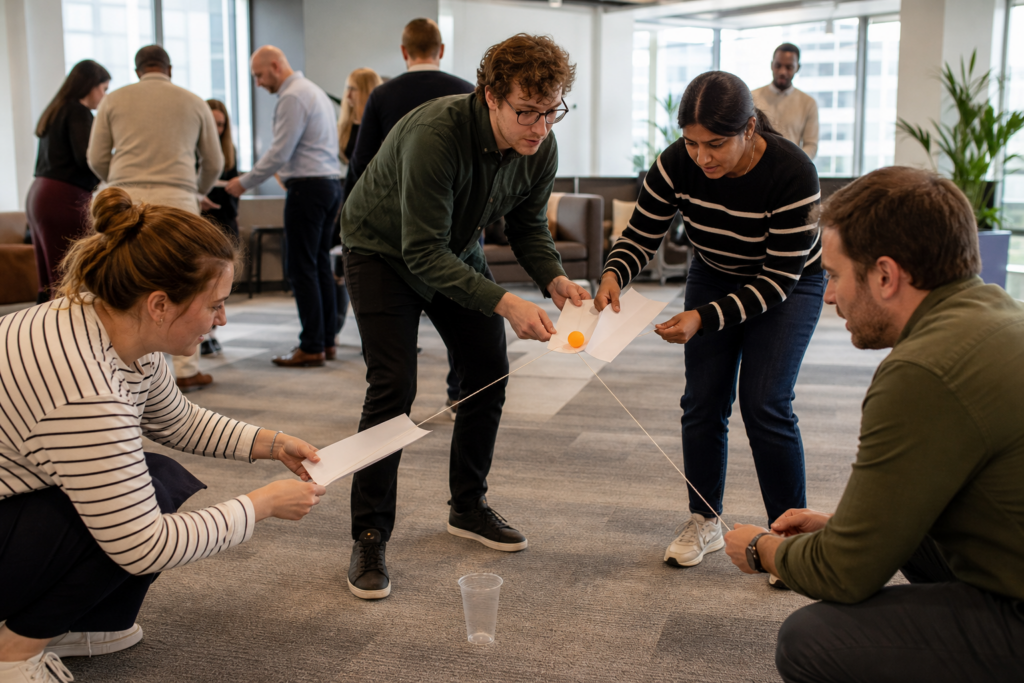
- Move the ball without touching it: Teams must move a ping pong ball from one side of the room to a cup using only paper, air, string or improvised tools. No hands on the ball. Fastest clean attempt wins.
- Build the most convincing office mascot: Use stationery and recyclable materials to create a mascot for the team. The mascot must have a name, one workplace skill and one serious flaw.
- Write the shortest useful policy: Teams have five minutes to write a one-sentence policy for a ridiculous workplace problem, such as disappearing biscuits or meeting-room chair theft. The host scores clarity and wit.
- Estimate the impossible number: Ask teams to estimate something in the room: ceiling tiles, steps to reception, pens in a jar or words on a printed page. Closest answer wins, but teams must explain their method.
- Silent sorting: Without speaking, teams must arrange themselves by birthday month, commute length or number of letters in their middle name. Time the attempt and add penalties for accidental talking.
- Create a new handshake without handshakes: Teams invent a greeting that uses no hand contact and can be done in less than five seconds. Judge on clarity, repeatability and whether it would survive a Monday morning.
- Sell the useless object: Give each team a dull item such as a paperclip, empty box or spoon. They have three minutes to prepare a 30-second sales pitch. Best believable pitch wins.
- Balance the budget tower: Teams build the tallest freestanding tower using paper cups and a fixed number of coins or counters as their budget. Unused budget is worth bonus points, so the tallest tower does not always win.
- Rename the departments: Teams create more accurate, friendly or absurd names for five business departments. The host gives points for names that make the room laugh without picking on individuals.
- One-minute portrait gallery: Each person draws a teammate in 60 seconds with their non-dominant hand. The team chooses one portrait to submit. Judge on likeness, effort and charm.
- Make the longest paper chain: Teams receive one sheet of paper and a small amount of tape. They have five minutes to make the longest unbroken chain. It must survive being lifted by the host.
- Office sound effects: Teams perform a 20-second soundscape of a workplace scenario using only voices and desk-safe objects. The host guesses the scenario. Points for recognisable detail.
- Find the odd instruction: Give teams a sheet of ten instructions, one of which quietly changes the goal. The winning team is the first to spot the twist and follow the correct instruction, not simply finish fastest.
- Design the best warning sign: Teams design a safety sign for a harmless fictional hazard, such as aggressive biscuits or emotionally unstable printers. Judge on instant understanding and originality.
- Pass the message badly: One teammate reads a short message, whispers it down the line, and the final person writes what they heard. Points go to the closest version, with a small bonus for the funniest accidental change.
- Make a meeting more efficient: Teams have four minutes to invent one prop, rule or ritual that would improve a fictional meeting. They must demonstrate it in 30 seconds.
- Paper aeroplane accuracy: Everyone makes one paper aeroplane. Teams score by landing closest to a target, not by distance. This keeps the task controlled in smaller indoor spaces.
- Alphabet scavenger: Teams find or point to items in the room beginning with consecutive letters. They cannot move personal belongings or open drawers. The highest verified run wins.
- Recreate the logo without seeing it: Pick a well-known non-client logo or simple public symbol. One person views it for ten seconds, then describes it from memory while teammates recreate it with paper shapes.
- Most dramatic instruction reading: Each team chooses one person to read a plain office instruction as if it belongs in a film trailer, weather warning or awards ceremony. Judge performance and commitment, not acting skill.
- Protect the biscuit: Teams build packaging that protects a biscuit from a small drop onto a clean tray. Check allergies first and offer a non-food version using a cardboard token if needed.
- Five-word team motto: Teams create a motto of exactly five words for the day. It must be positive, specific and usable by the group, not a generic slogan.
- The final impossible choice: Give teams three mini-tasks and only enough time to complete one properly. They must choose, complete it and explain their decision. Award points for judgement as well as outcome.
How to keep the games inclusive and safe
Good taskmaster-style games should feel mischievous, not risky. Before the event, remove tasks that involve running indoors, eating under pressure, blindfolded movement near obstacles, throwing hard objects, standing on furniture or singling people out for personal traits. If a task depends on physical ability, offer an equal alternative so nobody has to disclose a condition to avoid taking part.
HSE guidance on work-related stress risk assessment is a useful reminder that employers should think about risks to mental as well as physical health. For office games, that means watching the social pressure around performance, public judging and humour. Keep judging focused on the task, not the person. Do not use tasks that invite comments about appearance, confidence, accent, age, disability, culture or caring responsibilities.
Use opt-in roles. Some colleagues will enjoy performing to the room. Others will prefer building, planning, timing, recording evidence or presenting on behalf of the team. A well-designed task lets people contribute in more than one way.
For groups of five or more workers, employers are required to write down significant findings from workplace risk assessments. For an office games session, a short event risk assessment can cover room layout, slips and trips, manual handling, food allergens, accessibility, first aid arrangements and emergency exits. The HSE stress risk assessment guidance is a sensible official starting point when planning activities that involve time pressure and group participation.
Make the games work for the whole team
Planning for mixed abilities, different confidence levels or a large staff group? We can shape the tasks so the event stays fair, safe and enjoyable for everyone in the room.
How to adapt the format for office days, away days and hybrid teams
Taskmaster office games can sit in several types of corporate event. In the office, they work well for a team reset, end-of-quarter social or conference energiser. In an away day venue, they can become a fuller challenge with staging, music, team zones, props, a host and a final showpiece task. Outdoors, choose tasks that suit the ground conditions and have a wet-weather plan.
The venue changes the task list. A boardroom needs compact tasks with quiet resets. A hotel function room can handle movement, displays and bigger team builds. A large conference space may need several assistants so every team gets the same materials and time limit. If you are comparing venue options, a short planning check on team building venues can stop practical issues becoming event-day problems.
For hybrid teams, avoid making remote colleagues watch office colleagues have all the fun. Either run a fully remote version with identical home-safe materials, or design a linked format where remote and in-room teams receive equivalent tasks and judging criteria. Mixed hybrid teams can work, but only if the technology is tested and the task does not depend on people physically sharing materials.
If the event has a business aim, state it lightly at the start. For example: practise fast collaboration, build confidence across departments, welcome new starters or give people a shared experience before a planning session. Do not over-explain every lesson. The debrief can draw out what happened without turning a funny task into a lecture.
Scoring, debriefing and knowing when to bring in support
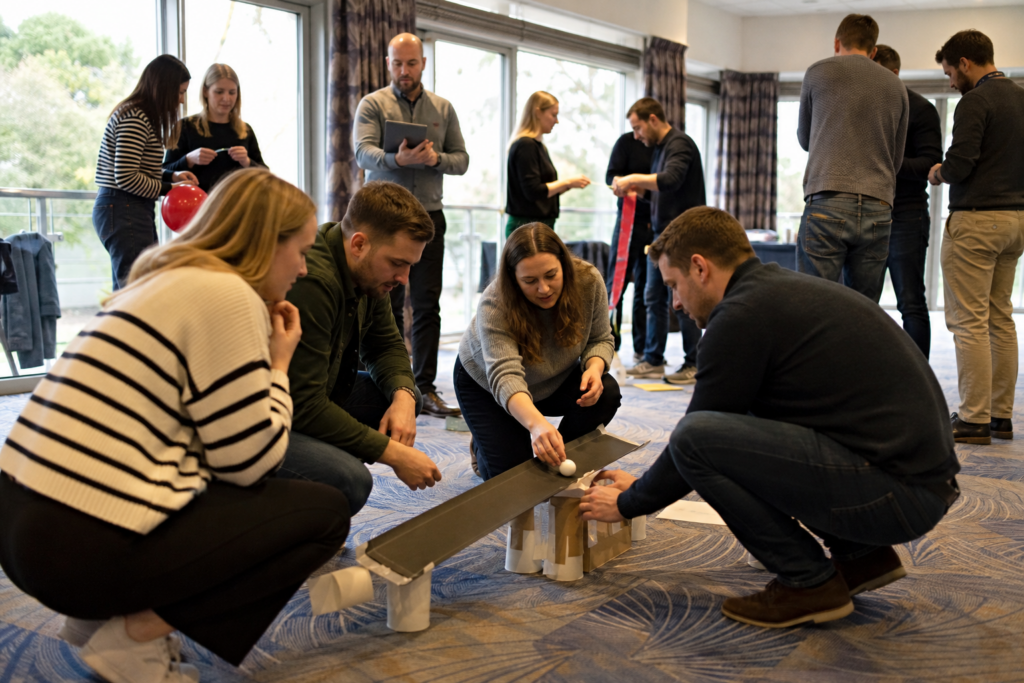
Scoring shapes the tone. If you reward only speed, the loudest and most competitive people will often dominate. Mix the criteria so teams can win through planning, accuracy, creativity, teamwork and restraint. A task where the best decision is to stop, read the card again and choose the lower-risk route can be as useful as a frantic build challenge.
A simple five-point scoring system is enough. Give five points to the winner, then work down. Add occasional bonus points for a smart interpretation, a generous team behaviour or a neat recovery from a mistake. Avoid negative scores unless the group already knows each other well and the host can keep it friendly.
Finish with a short debrief, not a long workshop. Ask what helped teams move quickly, where they misunderstood the task, who took on an unexpected role and what they would do differently next time. These questions keep the learning practical for managers and HR teams.
If you are running this for a larger audience, a leadership group or a high-profile away day, professional facilitation can make a noticeable difference. NewWave Events can build the tasks, source the kit, brief the venue, host the session and manage scoring so your team can take part rather than run around fixing the logistics. For broader planning, our guide to corporate away day ideas for UK teams may help you shape the rest of the day.
A simple format for a taskmaster-style team event
A good session needs enough structure to run smoothly and enough looseness for teams to surprise themselves. This five-part format keeps the planning manageable.
Set the aim
Choose whether the session is a quick energiser, a social activity or the main team building element of an away day. The purpose should guide the task mix.
Create balanced teams
Keep teams small enough for everyone to contribute. Mix departments, roles and seniority so the event encourages new working relationships.
Prepare the tasks
Use clear task cards, safe materials and a visible timer. Test any task that involves movement, food, liquids or fragile materials before the event.
Judge consistently
Award points for different strengths, including accuracy, creativity, teamwork and decision-making. Keep the humour on the task rather than the person.
Close with a debrief
End by asking what helped each team work well. Keep the debrief short, practical and linked to how people collaborate back at work.
Plan taskmaster-style team building with NewWave Events
NewWave Events designs and delivers team building activities and corporate events across the UK, including hosted challenge formats for offices, conferences and away days. If you want taskmaster-style games that feel organised, inclusive and properly hosted, we can shape the session around your group, venue and event aims.