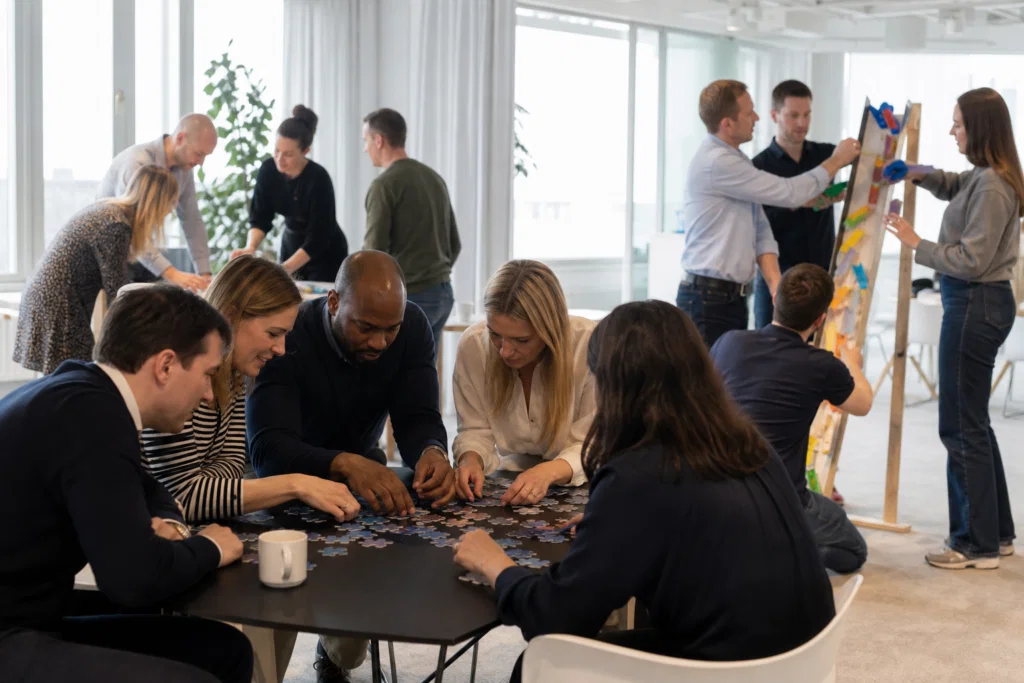
The best team building games for work are chosen for the number of people taking part, not just the theme. A game that feels lively with eight people can fall flat in a room of 80, while a large group activity can overwhelm a small team if there is too much kit, too many rules or too much waiting around.
This guide sorts 100 workplace games by group size, then explains how to plan the format around time, venue, accessibility and the outcome you want. Use it to shortlist ideas for an away day, conference breakout, office social, summer event or full company team building day.
Start with group size, then choose the game
Group size changes almost everything: pace, staffing, space, scoring, briefing style and how confident people feel about joining in. For small teams, the best games usually give every person a visible role. For medium groups, team rotation and clear time limits help. For large groups, you need hosted stations, simple rules and a structure that keeps people moving.
Before picking a game, decide four things:
- Numbers: use your expected attendance, then allow for late joiners and dropouts.
- Energy level: choose whether the session should wake people up, help them think, reward them after a busy period or give them time to relax.
- Venue fit: check ceiling height, outdoor access, noise limits, catering timings, power points, wet weather space and furniture turnaround.
- Participation style: include roles for people who prefer solving, building, presenting, scoring, observing, planning or performing quietly rather than being pushed into the spotlight.
If you are planning a full day rather than a single session, it helps to pair activity choice with venue choice. NewWave Events has a separate guide to choosing the right team building venue if your space is not fixed yet.
Shortlist by numbers, not guesswork
If your group size is still changing, NewWave Events can suggest flexible formats that work with late sign ups, mixed abilities and different venue layouts.
100 team building games sorted by group size
Use the group size notes as a starting point. Most games can be adapted, but the strongest formats keep everyone active without creating long queues, awkward silences or confusing rules.
- Small groups: two truths and a work tale: Each person shares two true facts and one invented work related story. The group guesses the false one, which opens easy conversation without needing props.
- Small groups: personal user manuals: Colleagues write short notes on how they like to communicate, receive feedback and plan work. The group compares notes and spots practical working preferences.
- Small groups: blind drawing: One person describes a simple image while another draws it without seeing the original. It is a quick way to practise precise communication and patient listening.
- Small groups: desk object pitch: Each person picks an ordinary object and pitches a new business use for it. The game suits creative teams and helps quieter people contribute through a simple prompt.
- Small groups: role swap interview: Pairs interview each other about a typical workday, then introduce the other person’s pressures and priorities to the group. It builds empathy across roles.
- Small groups: five minute problem clinic: One person brings a real low risk work problem. The rest ask clarifying questions before suggesting options, so the team practises useful challenge rather than jumping straight to fixes.
- Small groups: values cards: The group sorts cards or written words into what matters most when working together. The discussion works well for new teams setting expectations.
- Small groups: shared playlist: Everyone nominates one song for a team playlist and explains the reason. Keep it optional and light, especially where people do not know each other well.
- Small groups: memory map: Draw a rough map of the office, project journey or customer process from memory. Compare versions to reveal what different people notice.
- Small groups: silent line up: Without speaking, the group lines up by birthday, commute time or years in the sector. It is simple, physical and useful as a short energiser.
- Small groups: three object story: Give each group three random objects and ask them to create a short story linked to a work theme. It encourages quick collaboration without a long setup.
- Small groups: reverse brainstorming: Ask how the team could make a project fail, then reverse the answers into prevention ideas. It makes risk spotting less defensive.
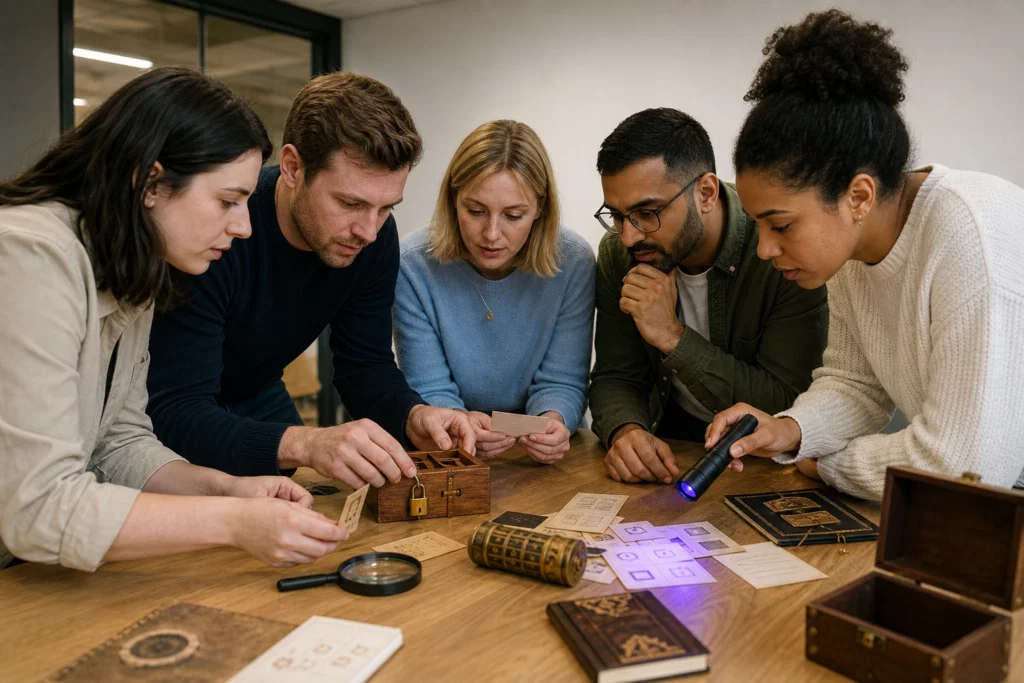
- Small groups: mini escape puzzle: Use a set of clues, locks or envelopes that must be solved in sequence. Small teams suit this format because everyone can see the clues and contribute.
- Small groups: skill share roulette: Each person teaches the group one work or non work skill in three minutes. It gives the team a better sense of hidden strengths.
- Small groups: coffee tasting challenge: Run a blind tasting with simple scorecards. It is sociable, low pressure and easy to adapt for tea, soft drinks or snacks.
- Small groups: photo prompt discussion: Place a set of images on a table and ask people to choose one that reflects their current team mood. The visual prompt helps avoid stiff status updates.
- Small groups: decision debate: Give the group a fictional workplace scenario with limited information. They must agree a response and explain the trade offs.
- Small groups: appreciation circle: Each person names a recent helpful action from someone else. Keep it specific and brief so it feels grounded rather than sentimental.
- Small groups: micro scavenger hunt: Send pairs to find items or facts around the office or venue. It works well when people need to move after a meeting heavy morning.
- Small groups: Lego brief build: Give each team a small kit and a short brief, such as build a future customer desk or ideal project launch. The value comes from explaining design choices.
- Small to medium groups: office bingo: Players complete bingo cards by finding colleagues who match each square. It suits networking at the start of an away day.
- Small to medium groups: pub quiz teams: Run mixed team rounds with general knowledge, company trivia and picture questions. A hosted scoreboard keeps the pace lively.
- Small to medium groups: murder mystery briefing: Give each person a character or clue and ask teams to solve the case. It works best when the host controls timing and reveals.
- Small to medium groups: quick fire charades: Teams act out phrases, products or workplace terms against the clock. Use inclusive prompts and allow people to pass.
- Small to medium groups: Pictionary relay: One person draws, the team guesses, then the next person takes over. Short rounds keep the room moving.
- Small to medium groups: paper tower challenge: Teams build the tallest freestanding tower from limited materials. Add a planning phase so the game tests more than speed.
- Small to medium groups: bridge build: Teams build a bridge that can hold a small weight. It suits mixed roles because people can plan, build, test and present.
- Small to medium groups: egg drop: Teams design protective packaging for an egg or fragile object before a drop test. Use safe drop heights and a tidy testing area.
- Small to medium groups: marshmallow tower: Teams build with spaghetti, tape, string and one marshmallow at the top. It is a well known rapid prototyping exercise when the debrief focuses on testing early.
- Small to medium groups: problem solving envelopes: Each team receives a different puzzle envelope, solves it, then passes it on. It creates movement without needing a large venue.
- Small to medium groups: team timeline: People place team milestones on a wall or board. The activity helps new starters understand the team’s history.
- Small to medium groups: customer journey race: Teams arrange customer journey cards in the right order, then identify one improvement. It links team building to real service thinking.
- Small to medium groups: sales pitch swap: Teams receive an unusual product and prepare a short pitch. Judges score clarity, humour and teamwork rather than acting skill alone.
- Small to medium groups: code word hunt: Hide clues around a room that reveal a final code word. It is easier to manage than a full treasure hunt when time is short.
- Small to medium groups: build the brand mascot: Teams create a mascot from craft materials and explain its personality. It is useful for creative sessions and company celebrations.
- Small to medium groups: negotiation game: Teams receive different information and must trade resources to reach a shared goal. The debrief can cover assumptions and transparency.
- Small to medium groups: desert island decisions: Teams rank items for survival and compare their logic. It works because people must justify choices and listen to alternatives.
- Small to medium groups: silent strategy puzzle: Teams solve a task without speaking for the first few minutes. It shows how quickly groups create non verbal systems.
- Small to medium groups: team logo design: Groups design a logo for their team day or project. Keep the judging kind and focused on the explanation.
- Small to medium groups: mini apprentice challenge: Teams create, price and promote a fictional product in a short window. It suits confident groups that enjoy a little performance.
- Small to medium groups: cocktail or mocktail making: Teams learn a simple technique, then create a signature drink. Include alcohol free ingredients as the default rather than an afterthought.
- Small to medium groups: chocolate making: Teams decorate or create chocolate items against a theme. It is sociable, creative and suitable for indoor venues.
- Small to medium groups: pizza making: Groups design and make pizzas, then score taste and presentation. It pairs well with an informal lunch or evening social.
- Small to medium groups: magic workshop: A host teaches simple tricks that rely on practice and presentation. It gives people a shared skill to try in pairs.
- Small to medium groups: team news bulletin: Groups create a short news report about a fictional company milestone. It works well for communications, leadership and conference themes.
- Medium groups: crystal style challenge: Teams rotate through physical, mental, skill and mystery zones. The structure keeps groups active and gives different strengths a chance to show.
- Medium groups: indoor gameshow: A host runs buzzers, music rounds and team challenges. This format works well after a conference because rules are simple and the energy is high.
- Medium groups: race night: Teams back runners with fun money and compete across several filmed or simulated races. It suits evening events and mixed departments.
- Medium groups: casino night: Professional style tables teach roulette, blackjack or casino games for fun money only. It works as relaxed networking because people can move between tables.
- Medium groups: corporate Scalextric: Teams race miniature cars and manage pit style roles. It is competitive without needing much physical exertion.
- Medium groups: target sports: Teams rotate through safe supervised activities such as archery, laser clay or axe throwing alternatives where suitable. Clear safety briefing and trained supervision matter.
- Medium groups: treasure hunt: Teams follow clues around a town, venue or estate. It encourages movement, planning and observation, especially when teams must submit answers or photos.
- Medium groups: GPS city challenge: Teams use devices or phones to complete location based tasks. It suits city centre away days where groups can spread out safely.
- Medium groups: charity bike build: Teams assemble children’s bikes or similar items for donation, with checks handled by qualified people. It adds a practical purpose to the activity.
- Medium groups: care kit assembly: Teams complete challenges to earn items for care kits. It is a calmer format that still gives people a shared output.
- Medium groups: bee hotel build: Groups build simple wildlife habitats from prepared materials. It suits sustainability themes and indoor or sheltered spaces.
- Medium groups: clean water filter build: Teams learn about water access and assemble educational filter models or donation linked kits. Use a specialist provider so the message is accurate.
- Medium groups: film making challenge: Teams script, shoot and screen short films on a theme. Give strict time limits so editing does not swallow the day.
- Medium groups: advert challenge: Teams create a short advert for a product, service or fictional invention. It gives space for writers, presenters, camera operators and organisers.
- Medium groups: drumming workshop: A facilitator teaches rhythms and builds the group towards a shared performance. It is energetic but does not rely on sporting ability.
- Medium groups: haka workshop: A cultural specialist leads a respectful, structured session on movement, voice and unity. Choose providers who handle context properly.
- Medium groups: choir in an hour: Teams learn parts of a song and perform together. It can be powerful for confidence, but make participation supportive rather than exposing.
- Medium groups: boomwhacker orchestra: Participants use tuned percussion tubes to create a group track. The quick learning curve suits conference rooms.
- Medium groups: office Olympics: Teams compete in light events such as beanbag toss, paper plane distance and desk chair slalom where safe. Keep events inclusive and low risk.
- Medium groups: school sports day: Classic races, relays and novelty events create a familiar outdoor format. Offer non running roles such as scoring, cheering and judging.
- Medium groups: rounders match: Divide the group into teams and rotate fielding roles. It works for summer socials where competition should stay friendly.
- Medium groups: five a side tournament: Teams play short matches with substitutes and clear rules. It suits active groups but should not be the only option for a mixed ability day.
- Medium groups: frisbee golf: Teams complete a course by throwing discs towards targets. It is outdoor, easy to learn and less intense than many sports.
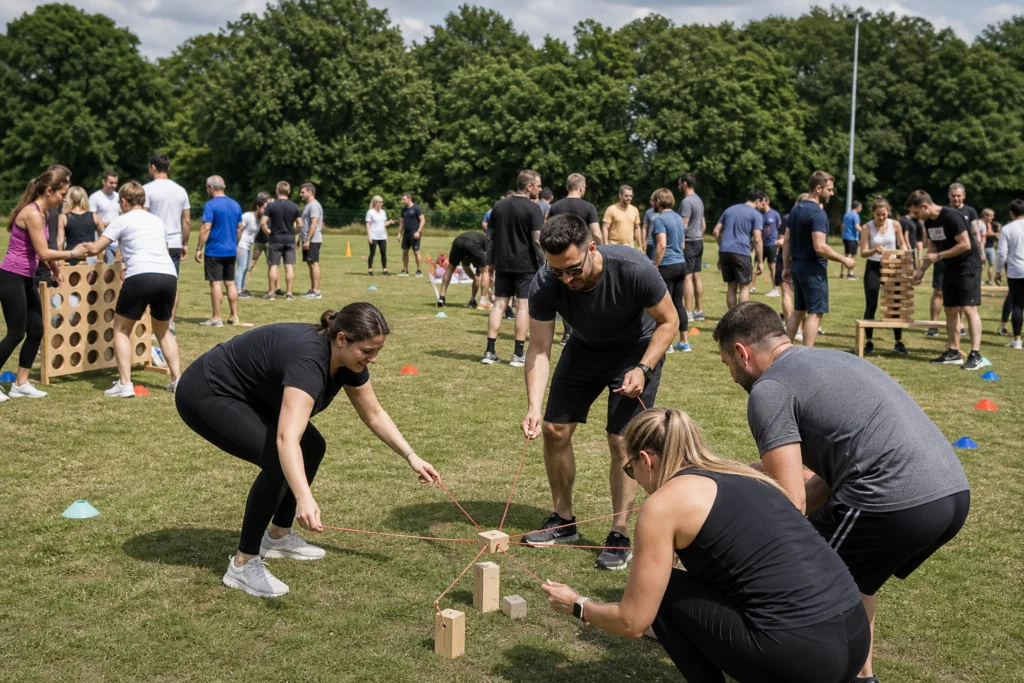
- Medium groups: giant board games: Set up giant Jenga, Connect Four, chess or garden games as rotating stations. This works well as a relaxed social layer.
- Medium groups: mindfulness reset: A guided breathing, stretching or reflection session helps teams decompress. It is best framed as a reset rather than a forced wellbeing fix.
- Large groups: company fun day zones: Split the event into activity zones so guests can choose games at their own pace. This reduces queues and suits mixed ages or abilities.
- Large groups: multi activity rotations: Teams move through timed stations with a central scoreboard. A clear running order keeps large groups from clustering in one place.
- Large groups: it’s a knockout: Inflatable and novelty challenges work for high energy outdoor days. The best versions use heats, safety briefings and plenty of marshals.
- Large groups: total wipeout style course: Teams tackle big inflatable obstacles in waves. It needs proper space, supervision and a wet weather or lower impact alternative.
- Large groups: dragon boat racing: Crews race on water with trained helms and safety cover. It is a strong option for larger active groups when the venue and season fit.
- Large groups: corporate regatta: Teams take part in sailing or rowing style races with professional instruction. It suits leadership groups or client hosting when water safety is built in.
- Large groups: festival field games: Combine lawn games, music, food stalls and light competition. The format lets people dip in without feeling trapped in one activity.
- Large groups: colour team challenge: Assign guests to colour teams for points across the day. It gives a whole company event a simple identity and scoring system.
- Large groups: conference energiser quiz: Run a fast quiz from the stage using teams or app based answers. It wakes up the room without moving everyone around.
- Large groups: clap and rhythm energiser: A facilitator leads simple rhythm patterns from the front. It works when space is tight and the session must be short.
- Large groups: human bingo networking: Guests complete cards by meeting people from other departments. Use prompts that are work safe and not too personal.
- Large groups: speed networking circles: Two circles rotate after short conversations. Give prompts so people do not spend every round asking what team someone is in.
- Large groups: charity packing line: Teams create an efficient assembly line for donation packs. It suits large rooms because roles can be split cleanly.
- Large groups: giant mural project: Each team creates one section of a larger artwork. When assembled, the final piece gives the group a shared result.
- Large groups: mass treasure hunt: Dozens of teams follow different routes or staggered starts. This keeps pavements, lifts and checkpoints from becoming blocked.
- Large groups: outdoor orienteering: Teams navigate between marked points on a safe site. It rewards planning and observation more than speed alone.
- Large groups: corporate carnival stalls: Side stalls such as hook a duck, hoopla and reaction games give flexible drop in entertainment. It works well alongside catering.
- Large groups: team bake off showcase: Teams decorate cakes or biscuits, then present them for judging. Use prepared items if the venue cannot support cooking.
- Large groups: awards night games: Short table challenges between courses keep an evening event sociable. The games should be easy to explain over room noise.
- Large groups: murder mystery dinner: Actors or hosts guide the plot while tables solve clues. It scales well because each table works as its own detective team.
- Very large groups: whole company gameshow: A stage host, screens and audience response tools let hundreds play together. Keep questions short and scoring transparent.
- Very large groups: department tournament: Departments compete across several activity stations, with finals at the end. It gives big numbers a reason to follow the full event.
- Very large groups: rotating challenge village: Build a village of hosted zones such as puzzles, target games, creative tasks and photo challenges. Guests rotate in waves to control flow.
- Very large groups: mass participation quiz trail: Teams complete quiz checkpoints around a venue. It suits large conference centres where people need movement between sessions.
- Very large groups: company sports day finals: Run heats in smaller groups, then bring everyone together for finals. It gives spectators a shared moment without making everyone compete all day.
- Very large groups: charity mega build: Many teams build parts of a larger donation project, such as bikes, care packs or furniture kits. Professional checking and charity coordination are essential.
- Very large groups: evening entertainment arcade: Set up simulators, pub games and competitive machines across a large room. It works for informal networking because people can join and leave easily.
- Very large groups: hybrid photo challenge: Office and remote teams complete the same themed photo tasks, then submit entries to a central host. It gives dispersed teams one shared format.
- Very large groups: virtual quiz broadcast: A live host runs rounds for teams across sites or home offices. It needs clear joining instructions and a simple backup if someone loses connection.
- Very large groups: all hands recognition game: Teams solve clues based on company achievements, customer stories or colleague nominations. It turns recognition into an active session rather than a long speech.
How to make small group games feel worthwhile
Small groups can feel exposed if the activity asks people to perform before they are comfortable. They also notice weak facilitation quickly because there is nowhere to hide. Choose games where everyone has a purpose, but avoid turning the session into a therapy exercise or a forced confession.
Good small group games usually need one clear task, a short time limit and a short debrief. Ask what helped the group work well, what slowed decisions down and what they would repeat back at work. That is enough. You do not need to extract a life lesson from every activity.
For teams under 12, hosted creative workshops, puzzle games, tasting experiences and light problem solving sessions often work better than big physical challenges. If the group is senior, newly merged or dealing with change, choose a format that lets people talk while doing something with their hands.
How to run medium group games without losing pace
Medium groups can handle more structure, but they still need pace. The common mistake is to brief 30 people as if they are eight people, then wonder why the first ten minutes feel messy. Divide guests into teams before the activity starts, display the running order and keep rules short enough for people to remember.
A good medium group format gives teams regular moments of progress. That might be a scoreboard update, a clue reveal, a station change or a host checking in. Long stretches without feedback can make people drift back to work chat or their phones.
If you are planning a half day or full day, mix competition with choice. For example, combine a hosted challenge with a calmer creative station, a food based activity or a short wellness reset. NewWave Events has more ideas in its guide to corporate away day ideas for UK teams.
Planning for 30 to 60 people?
Medium sized teams often need the right mix of structure and choice. NewWave Events can build a hosted activity plan that keeps the pace moving.
How to scale games for large groups and conferences
Large group team building needs production thinking. The game itself matters, but the flow of people matters more. You need enough stations, hosts, signage, sound and scoring support to stop the activity becoming a queue.
For conferences, shorter games often work better than one long activity. A 20 minute energiser before lunch, a 45 minute team challenge after presentations or a relaxed evening games zone can fit the day without overwhelming the agenda. For company fun days, build the plan around rotations, weather cover and different energy levels.
Large groups also need clear joining instructions. Tell people what to wear, whether they will be indoors or outdoors, how physical the activity is and whether they can opt for a lower impact role. If you are weighing up formats, this guide to indoor vs outdoor team building activities can help narrow the choice.
Safety, inclusion and event planning basics
Workplace team building should feel easy for guests, but it still needs proper planning behind the scenes. For larger or higher risk events, organisers should have proportionate plans for incidents, emergencies, first aid, evacuation and communication. The Health and Safety Executive publishes event emergency planning guidance that is useful when checking responsibilities with a venue or supplier.
For physical, outdoor, water based, motorised or equipment led games, ask suppliers how they manage risk, brief participants, supervise the activity and handle weather changes. If a risk assessment shows personal protective equipment is needed, it must be suitable, explained properly and used correctly.
Inclusion starts before the event. Ask about access needs, mobility concerns, neurodiversity, dietary requirements, caring responsibilities, religious considerations and comfort with physical or performance based tasks. Then choose a format with varied roles so people can contribute without being singled out.
The best team building games for work are not the loudest or most complicated. They are the ones that fit the group, use the time well and give colleagues a reason to interact in a way they would not during an ordinary working day.
A simple planning process for choosing the right game
Use this five point check before you confirm an activity, venue or supplier.
Set the purpose
Decide whether the event is for connection, celebration, communication, leadership, wellbeing, reward or conference energy. The purpose should narrow the shortlist.
Match the format to the numbers
Check whether the game still works at your expected group size. Look for rotations, team splits, drop in stations or stage led formats when numbers rise.
Test the venue fit
Confirm space, access, sound limits, weather cover, power, furniture, loading, parking and timings. A good activity can struggle in the wrong room.
Plan for mixed confidence levels
Choose games with different roles. Not everyone wants to run, perform or speak from the front, but most people will join in when there are several ways to help.
Brief people properly
Send clothing guidance, timings, location details and accessibility notes in advance. On the day, keep rules short and make it clear where guests should go next.
Need help choosing the right team building games?
NewWave Events designs and delivers team building activities and corporate events across the UK. Tell us your group size, venue, timings and goals, and we’ll recommend a format that fits your people properly.