Team challenges for adults should feel competitive without turning the day into a test of who is loudest, fastest or already friends with the boss. The best games give people a clear goal, simple rules and enough variety for different strengths to show.
For UK companies planning an away day, staff reward event or team building session, the choice of challenge matters. A good format can help colleagues practise communication, trust, delegation and problem solving in a setting that feels different from normal work. A poor format can feel awkward, unfair or too physically demanding.
The ideas below are designed for adult workplace groups. Some suit offices and conference venues, while others need outdoor space, water access or a larger event site. If you want a wider view of formats, NewWave Events also has a guide to team building activities across indoor, outdoor, creative, charity and evening options.
What makes a team challenge work for adults?
Adults usually respond better to a challenge when it respects their time, their role and their comfort level. That means the activity needs a point beyond filling a slot in the agenda.
Competition helps when it gives people a shared target. It becomes a problem when it rewards only one type of person. A relay race might energise one team and exclude another. A puzzle challenge might suit analytical thinkers but frustrate people who prefer movement. The strongest event formats use mixed rounds, so teams need planners, communicators, practical doers and calm decision makers.
Clear briefing also matters. People should know how scoring works, how long each round lasts, what equipment is involved and what level of physical effort is expected. If the group includes remote colleagues, new starters or senior leaders, the facilitator may need to break up familiar clusters so the event does not simply reinforce existing circles.
The aim is not to manufacture friendship in an afternoon. A good challenge creates a shared experience that people can refer back to at work, such as the moment a quiet colleague organised the team under pressure or a department learned that planning beats speed.
20 competitive team challenges for adults
Use this list as a starting point, then match the format to your group size, venue, timings and appetite for competition.
- Crystal maze style challenge. Teams rotate through physical, mental, skill and mystery zones, collecting points or tokens as they go. It works well for mixed groups because no single strength dominates the whole event.
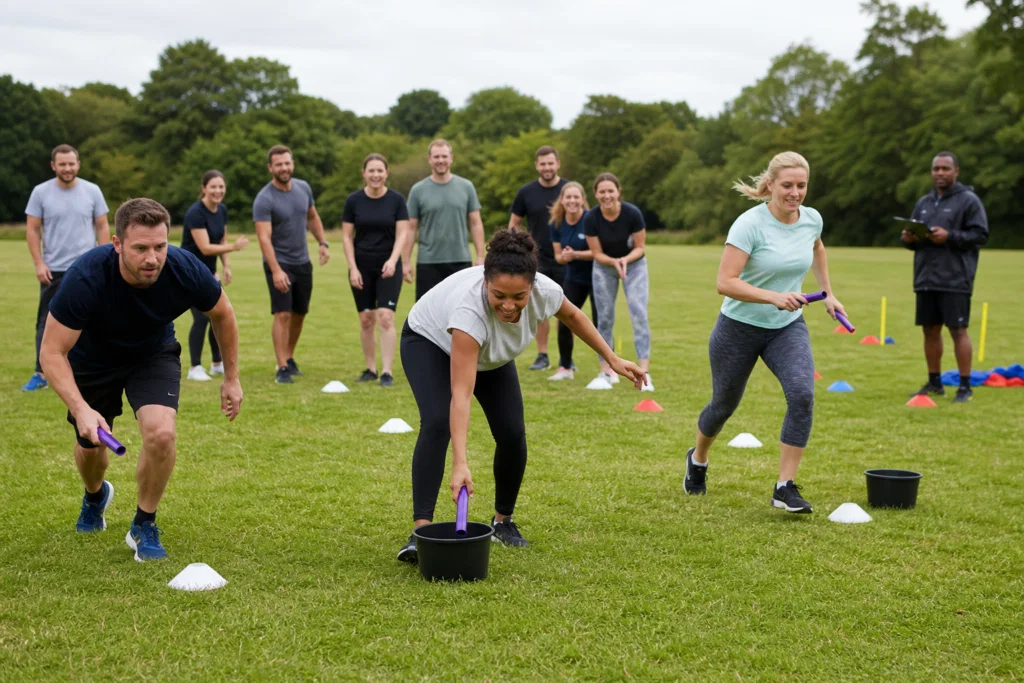
- Corporate sports day. Classic races, relays and novelty rounds bring a relaxed school sports day feel to an adult workplace event. Keep the tone light, offer low-impact options and score teamwork as well as finishing position.
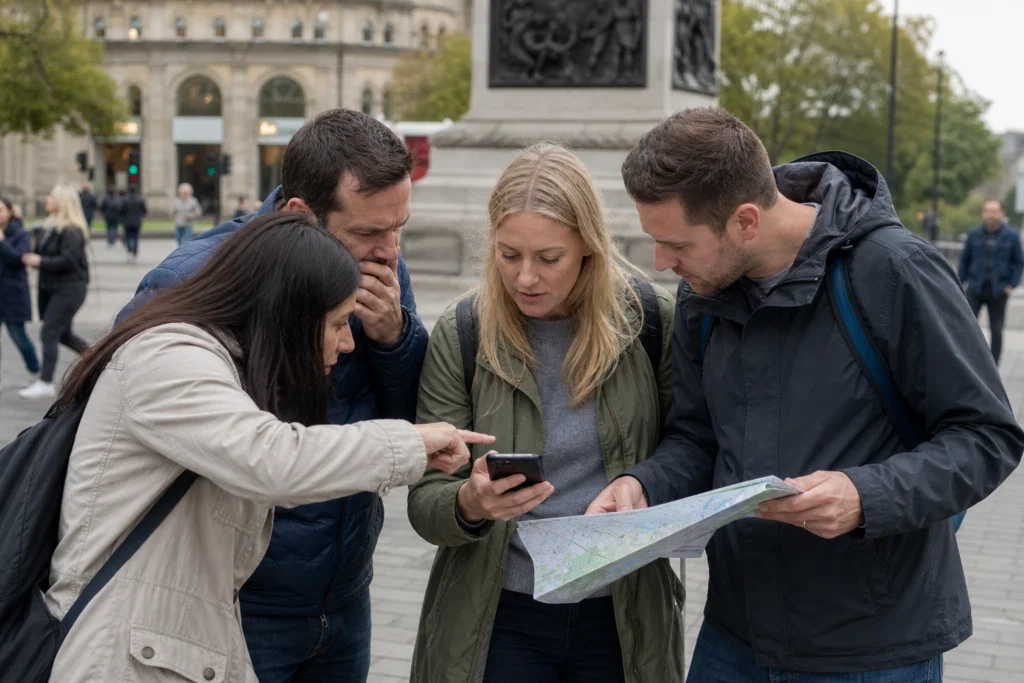
- Scavenger hunt. Teams follow clues, complete tasks and collect evidence within a defined area. This suits city centres, resort venues, campuses and large office sites, especially when you want people moving and talking.
- Escape room challenge. Small teams solve linked puzzles against the clock. It is useful for observing communication, leadership and information sharing because teams must listen carefully and avoid working in silos.
- Soapbox derby. Teams design, decorate and race a simple gravity-powered kart. The challenge combines practical building, design decisions, presentation and a final race, so it suits away days with a longer activity window.
- Dragon boat racing. Crews paddle in rhythm and compete in timed heats on the water. It demands coordination rather than individual athletic ability, but it needs a suitable location, safety planning and a clear bad-weather option.
- It’s a Knockout style inflatables. Teams tackle large inflatable obstacles, foam, water features and novelty games. This is best for summer fun days, large groups and teams that want laughter more than a polished business exercise.
- Apprentice style pitch challenge. Teams create a product, campaign or event concept, then pitch it to judges. It suits commercial teams, leadership groups and mixed departments because it needs research, creativity, time management and confident presenting.
- Murder mystery investigation. Teams examine clues, question characters and work out the culprit. It is a strong evening or indoor option because people can compete without needing sportswear, outdoor space or high physical energy.
- Casino tournament. Teams start with equal fun money and move between casino tables, with prizes based on points rather than real gambling. It works well after dinner, particularly when you want light competition and social mixing.
- Race night syndicates. Teams study runners, place fun bets and compete across several filmed races. The format is easy to understand, gives everyone a reason to talk and can suit charity fundraising when planned properly.
- Pub quiz with joker rounds. A structured quiz remains popular because it is familiar and easy to run indoors. Add picture rounds, music rounds, practical tasks and a joker round so teams can choose where to double their points.
- GPS treasure hunt. Teams use GPS-enabled devices or phones to unlock location-based questions and missions. It suits cities and large outdoor venues, but it needs sensible route planning, accessibility checks and a clear finish point.
- Cooking challenge. Teams prepare dishes within a time limit, often with mystery ingredients or a theme. It works best when the task is achievable for non-cooks and the scoring includes hygiene, teamwork, presentation and taste.
- Cocktail or mocktail challenge. Teams design a drink, name it and present it to judges. Offering non-alcoholic routes as standard keeps the activity inclusive and makes it easier to run during working hours.
- Charity build challenge. Teams assemble bikes, care packages, school supplies or other useful items for donation, subject to the charity partner’s needs. Competition can come through speed, quality checks, creativity and presentation.
- Outdoor survival task. Teams complete practical tasks such as shelter building, navigation and resource planning. Keep the emphasis on decision making and collaboration rather than endurance, especially for corporate groups with mixed fitness levels.
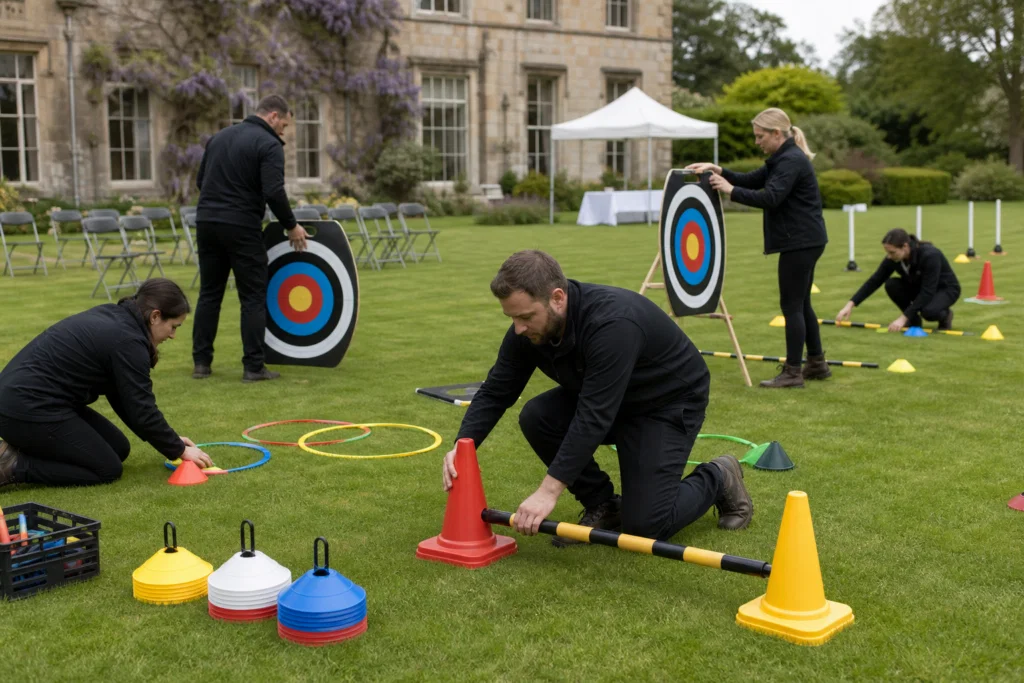
- Archery or target tournament. Teams rotate through coached target sports such as archery, laser clay shooting or axe throwing where suitable. Professional supervision, safety zones and clear instructions are essential.
- Office Olympics. A series of office-safe mini games can work well when travel is limited. Choose challenges that use space sensibly, avoid trip hazards and do not rely on messy or disruptive props.
- Multi-activity challenge zones. Teams move between several stations, such as puzzles, sports, creative tasks and timed coordination games. This format is often the safest choice for larger groups because people experience variety and the scoring stays balanced.
Need help narrowing the 20 options?
If several challenges could suit your group, NewWave Events can help compare indoor, outdoor, active and evening formats against your timings, venue and team profile.
How to choose the right format for your group
Start with the outcome rather than the activity name. If the brief is to help new starters mix with established staff, choose rotating teams, scavenger hunts or multi-activity zones. If the aim is leadership development, use formats where planning, delegation and decision making are visible, such as soapbox derby, escape challenges or pitch tasks.
Group size should narrow the list quickly. A team of 12 can work well in an escape room, cooking challenge or murder mystery. A group of 120 needs timed rotations, multiple facilitators and a scoring system that keeps people moving. For very large groups, a multi activity fun day is often more practical than one single game.
Venue also shapes the decision. Conference hotels suit indoor zones, quizzes, casino tables, creative challenges and evening formats. Outdoor sites suit sports days, GPS hunts, inflatable games and target tournaments. If you are still comparing settings, this guide to choosing team building venues can help you think through access, layout and weather cover.
Be honest about the group’s energy. A team coming out of a long conference may need a fast, social activity rather than a three-hour strategic challenge. A leadership cohort may welcome a more demanding format with a debrief. The same game can succeed or fail depending on when it appears in the day.
Keeping competition inclusive and fair
Fair competition starts before the event. Ask about access needs, dietary requirements, mobility considerations, sensory preferences and any activities people may not be able to do. Do this privately and early enough to change the format if needed.
Employers have duties around reasonable adjustments for disabled workers, and Access to Work may provide support or adaptations beyond adjustments that an employer is legally required to make. For event planning, the practical point is simple: do not wait until the day to discover that a challenge excludes someone.
Balanced scoring helps. Combine speed with accuracy, creativity, teamwork or bonus rounds, so one athletic team does not dominate every station. Avoid elimination formats where people stand around watching after one mistake. Adults are more likely to stay engaged when every round offers a route back into the competition.
Language matters too. Brief the event as a shared challenge, not a public test of confidence. Avoid activities that rely on embarrassment, forced performance or singling people out. A good facilitator can keep the pace lively while making it clear that opting for a lower-impact role is acceptable.
Make the competition work for everyone
Share your group size, access needs and comfort levels early, and NewWave Events can shape the scoring, roles and rotations so more people can take part confidently.
Practical planning for workplace challenge events
For HR teams and team leaders, the planning details often decide whether the activity feels smooth or stressful. Confirm the group size, arrival pattern, start time, finish time, clothing advice and wet-weather plan before you commit to the format.
For larger or more active events, ask how risk assessments, emergency plans, first aid, staffing ratios and equipment checks will be handled. HSE event guidance places emphasis on proportionate emergency planning, clear roles and keeping routes and exits usable. For summer outdoor events, hot weather planning should cover water, shade, timings and communication with attendees.
Timings need some slack. A 90-minute activity rarely means 90 minutes from guests arriving to guests leaving. Build in registration, briefing, team allocation, movement between zones, scoring and prizes. If the event follows a company update or town hall, allow people a short break before asking them to compete.
Think about the finish as carefully as the start. A clear scoreboard, short prize moment and quick thank you can give the challenge a satisfying close. Dragging out results or over-explaining the scores usually drains the energy from the room.
Turning the energy into a useful outcome
A competitive team challenge does not need a heavy debrief to be useful. A short, well-handled reflection is usually enough. Ask teams what helped them improve, what slowed them down and what they would do differently if they had the first round again.
Managers should listen for practical lessons rather than forcing a metaphor. If a team won because someone clarified the plan before starting, that is worth noting. If another team lost time because everyone worked separately, that is a useful workplace link. Keep it specific.
After the event, share photos where consent allows, announce winners and thank participants. If the aim was staff engagement, gather quick feedback while the experience is fresh. Ask what people enjoyed, what felt awkward and what would make the next team day easier to join.
The best next step is to choose a format that fits the people in front of you. NewWave Events can help shape competitive team challenges for adults across indoor, outdoor, creative, charity and evening formats, with the right level of structure for your group.
A simple way to design a competitive team event
Use these five planning checks before choosing the activity. They help keep the event enjoyable, fair and relevant to the workplace.
Define the purpose
Decide whether the event is for reward, communication, leadership, morale, onboarding or cross-department mixing. The purpose should rule out formats that do not fit.
Map the people
Check group size, seniority mix, access needs, fitness levels, confidence levels and whether people already know each other. This prevents the loudest voices from shaping the whole event.
Choose the setting
Match the challenge to the venue, weather, travel time and available space. A brilliant outdoor format can fail if there is no shelter, storage or sensible movement plan.
Balance the scoring
Use a mix of speed, accuracy, creativity and teamwork points. Balanced scoring keeps more teams in contention and reduces the risk of one group running away with every round.
Plan the finish
Decide how results, prizes, photos and feedback will be handled. A clear ending helps the event feel complete and gives managers something useful to take back to work.
Plan a competitive team challenge that fits your group
NewWave Events designs and delivers team building activities and corporate events across the UK. If you know the group size, location and rough objective, our team can recommend competitive challenges that suit your people, timings and venue.