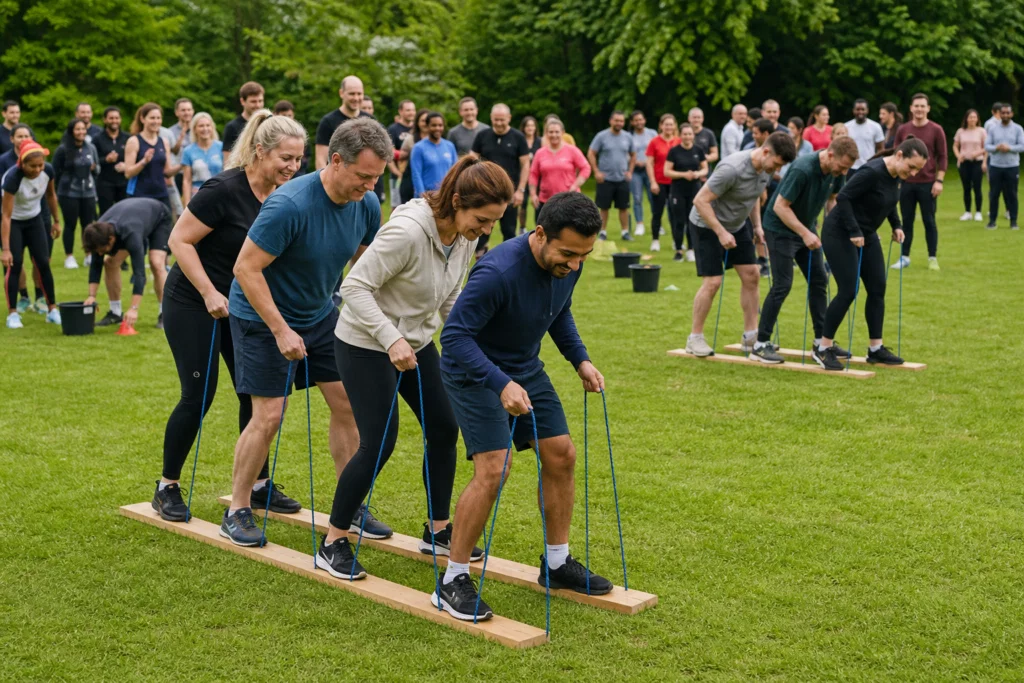
Team building activities for large groups work best when they are easy to brief, simple to rotate and varied enough for different personalities, fitness levels and working styles. For 50+ people, the activity matters, but the event structure matters just as much.
A large group can lose energy quickly if people queue, wait for instructions or feel pushed into something uncomfortable. The strongest formats split people into manageable teams, give everyone a clear role and build in natural movement between challenges.
This guide gives you 30 practical ideas for large corporate groups, plus planning advice for HR teams, office managers and team leaders organising away days, conferences, summer parties and company events across the UK.
What makes a large-group team building activity work
For 50+ people, a good activity has to scale without becoming chaotic. That usually means short instructions, visible facilitation, enough equipment for each sub-group and a format that keeps people active rather than watching from the side.
Large groups also need a clear reason to take part. That reason does not have to be complicated. It might be helping new starters meet people, reconnecting hybrid teams, giving departments a shared win after a busy quarter or adding energy to a conference day. If the purpose is clear, the activity choice becomes easier.
Hybrid working is now a normal planning factor for many UK employers, so in-person events often carry more weight than they used to. They may be one of the few times a whole department or regional team is in the same place. That means the event needs space for informal conversation as well as organised tasks.
Think about group size in practical blocks. A team of eight to ten is usually easier to brief, score and support than a team of 20. If you have 100 people, ten teams of ten will normally work better than five teams of 20, especially for challenge-based formats.
If you are still shaping the wider brief, NewWave Events has a broader guide to team building activities that can help you compare formats before narrowing the options for a larger audience.
Need an activity that will scale cleanly?
If you are planning for 50+ people, NewWave Events can help you choose a format with the right team sizes, rotation plan and facilitator support.
30 team building activities for large groups
These ideas are designed for groups of 50 or more. Some suit indoor conference spaces, some need outdoor space and some work well as part of a wider away day. The best choice depends on your venue, timings, budget, team profile and how much physical activity people will be comfortable with.
- Company sports day. Split the group into coloured teams and run a series of light-hearted races and field games. It works well for summer away days because people can rotate between activities and support their team even when they are not competing.
- Crystal-style challenge zone. Teams move between timed mental, physical, skill and mystery challenges. This format scales well because every station can run at the same time, which keeps waiting time low.
- Inflatable obstacle course. A large inflatable course gives the event a focal point and suits groups that want a lively, physical activity. Build in opt-in roles such as team captain, timekeeper and cheer squad so nobody feels forced to race.
- Corporate scavenger hunt. Teams follow clues, complete photo tasks and answer location-based questions. It works for city centres, campuses, resorts and large hotels, provided routes are planned with accessibility and safety in mind.
- GPS treasure hunt. A technology-led hunt uses tablets or phones to guide teams between checkpoints. It is useful for larger groups because scoring can be managed live and teams can start from different points.
- Charity bike build. Teams assemble children’s bikes or similar items for donation through an agreed charity partner. The activity combines teamwork, practical problem-solving and a clear social purpose.
- Big quiz tournament. A hosted quiz with picture rounds, music rounds and company-safe general knowledge suits indoor venues and mixed confidence levels. Use table teams and quick scoring to keep the pace moving.
- Murder mystery event. A facilitated mystery gives people roles, clues and shared objectives. It works particularly well as an evening team building activity after a conference or dinner.
- Casino night team challenge. Fun casino tables can be used as a social team activity rather than a gambling event. Give teams play money, rotate them around tables and finish with prizes for teamwork or best strategy.
- Race night. Teams study form guides, place fun bets with pretend money and compete across a series of filmed races. It suits large groups because everyone can join from their table without complex movement around the room.
- Drumming workshop. A facilitated rhythm session gets a large room working together quickly. It is useful for conference energisers because the result depends on listening and timing rather than musical experience.
- Choir or vocal workshop. A vocal coach teaches the group simple parts and brings them together for a final performance. It can work well for teams that want something creative without turning it into a talent show.
- Commercial advert challenge. Teams create a short advert for a fictional product or a light internal theme. It gives people roles in scripting, directing, acting, filming and presenting, which helps quieter colleagues contribute without being centre stage.
- Film-making challenge. Teams plan and film a short scene, trailer or news report. For large groups, set tight rules on length and equipment so the focus stays on ideas, teamwork and time management.
- Company festival games. Create zones with garden games, mini challenges, food stations and hosted competitions. This format suits very large groups because people can move freely while still feeling part of one shared event.
- Human bingo networking game. People find colleagues who match prompts, such as working in another region or having a certain skill. It is a low-pressure way to mix departments at the start of a large event.
- Conference energiser relay. Short challenges are run between agenda sessions to reset attention. Keep each task under ten minutes and make the instructions visible so late arrivals can join quickly.
- Escape room in a box. Teams solve puzzles at their tables, with identical kits and a shared countdown. It is a strong option when you need an indoor activity that works in a ballroom or conference suite.
- Outdoor survival challenge. Teams complete navigation, shelter-building, communication and problem-solving tasks. Use professional facilitation and choose a difficulty level that fits the whole group, not just the sportiest people.
- Soapbox derby. Teams design, decorate and race simple soapbox-style carts in a controlled area. It creates plenty of roles, including design, build, safety checks, driver support and presentation.
- Dragon boat racing. Where a suitable venue and safety provision are available, dragon boat racing gives large teams a shared rhythm and clear competitive structure. It is best for groups comfortable with water-based activity and a longer lead time.
- Team Olympics. Run a mix of accessible team challenges rather than serious sport. Include accuracy, memory, balance and collaboration tasks so success is not only about speed or fitness.
- Creative mural challenge. Teams paint sections of a larger artwork that comes together at the end. It suits office launches, values days and events where the finished piece can be displayed afterwards.
- Cook-off challenge. Teams prepare dishes or decorate bakes within a set time. For larger groups, use a venue with suitable catering space or bring in a mobile format with clear hygiene controls.
- Cocktail or mocktail lab. Teams design a drink, name it and pitch it to the room. A mocktail-first version keeps the activity inclusive for daytime events and mixed drinking preferences.
- Chain reaction challenge. Teams build sections of a larger mechanical sequence, then connect them for a final run. It tests communication between groups because each section has to work with the next.
- Bridge build challenge. Teams create bridges from supplied event materials and test them against the same criteria. It is easy to score and works well indoors when space is limited.
- Wellbeing rotation. Set up stations such as mindfulness, stretching, breathwork, nutrition and light movement. This is useful after intense work periods, but it still needs structure so it does not feel like a loose drop-in session.
- Community impact challenge. Teams pack care kits, sort donations or complete practical tasks for a chosen cause. Make sure the charity need is agreed before the event so the activity creates something genuinely useful.
- Multi-activity away day. Combine several formats, such as quiz rounds, outdoor games, creative tasks and food-led challenges. This is often the safest option for very large or mixed groups because people experience variety without one activity carrying the whole day.
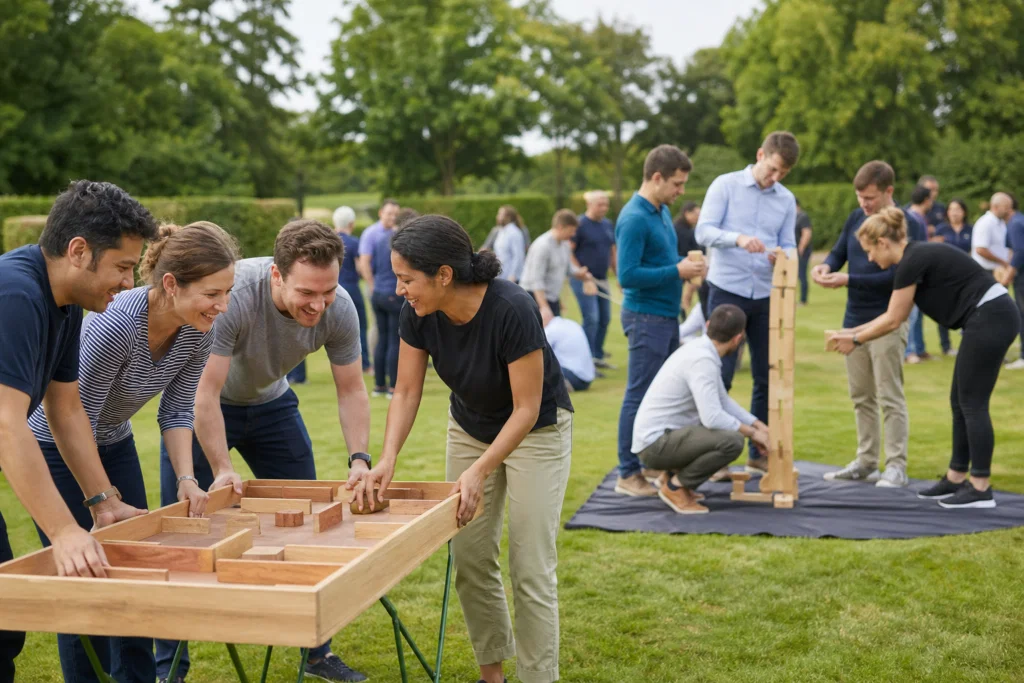
How to choose the right activity for 50+ people
Start with the constraints before the ideas. How long do you have? Is the group arriving together or in waves? Are there senior leaders in the room? Will people be dressed for a conference, a summer party or outdoor activity? These details decide what will feel natural on the day.
For a conference, choose activities that start and finish cleanly. A table-based puzzle challenge, drumming workshop, quiz or short energiser can fit between sessions without moving everyone across a venue. For an away day, you can use wider grounds, longer rotations and more physical options.
For mixed groups, variety is safer than intensity. A large team can include people with injuries, disabilities, caring responsibilities, neurodivergent needs, different faith requirements and different comfort levels with performance. The activity should give people ways to contribute that are not all loud, fast or public.
Indoor and outdoor formats both have strengths. Outdoor activities give space and energy, but they need wet-weather planning. Indoor activities are easier to control, but they need enough room between tables and stations. If you are weighing up venue type, this guide to indoor vs outdoor team building activities can help you think through the trade-offs.
Planning the timings, teams and flow
A large-group event needs a clear run sheet. Build it around arrival, briefing, activity time, rotation time, breaks, scoring and a short close. The gaps matter. If 100 people need to collect drinks, move between rooms or find toilets, five minutes will not be enough.
Team allocation also needs care. Random teams help people meet new colleagues, but they can separate people who need support. Department teams can strengthen working relationships, but they may reinforce existing silos. A planned mix often works best, especially when the goal is cross-business connection.
Briefing should be short and repeated in more than one way. Use a spoken introduction, visible instructions and facilitators at each station. For big rooms, microphones and clear signage are not extras. They are part of the activity working properly.
Venue choice has a direct effect on the event. You need enough usable space, not just enough listed capacity. Check ceiling heights for inflatables, outdoor access for field games, power points for AV, unloading access for equipment, wet-weather options and whether other events will be taking place nearby. NewWave Events has a separate guide on choosing team building venues if you are comparing options.
Want help turning the brief into a run sheet?
Share your timings, venue and group profile, and NewWave Events can suggest a practical flow for arrivals, activities, breaks and the final close.
Safety, accessibility and inclusion for large groups
Large-group team building should feel organised from the first email. Ask for access requirements early, explain the type of activity clearly and give people a contact route if they need to discuss adjustments. Accessibility is much harder to fix at the last minute.
For UK events, venue and activity planning should include risk assessment, emergency arrangements and clear responsibilities between the organiser, venue and suppliers. The Health and Safety Executive says event emergency plans should be proportionate to the risk of the activities and the possible severity of an incident. For larger or more complex events, review the relevant HSE event emergency guidance as part of planning.
Accessibility is wider than step-free access. Consider hearing support, lighting, quiet space, clear joining instructions, dietary information, accessible toilets, seating, travel distances between activity zones and whether instructions are available in a format people can use. GOV.UK guidance on accessible events advises planning access from the start rather than treating it as a late-stage adjustment.
Inclusion also affects activity tone. Avoid formats that embarrass individuals, single people out without warning or rely on alcohol. If an activity includes performance, make sure there are behind-the-scenes roles. If it includes physical movement, offer alternative scoring roles that still matter to the team.
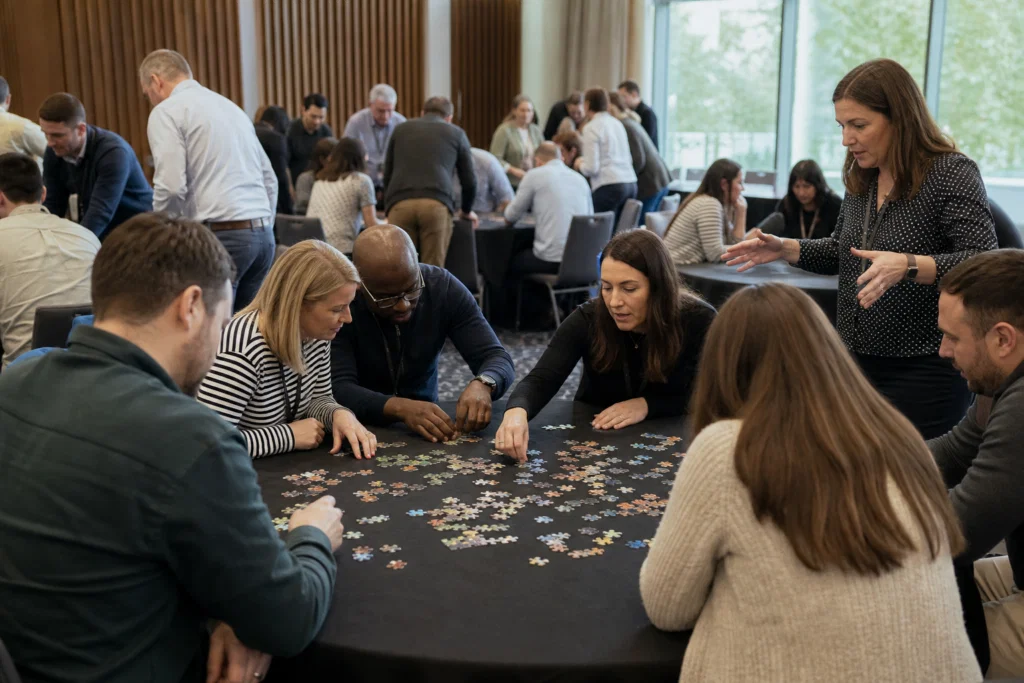
Turning 30 ideas into a workable event brief
Once you have a shortlist, write a simple brief before asking for proposals. Include the date, location, group size, timings, audience profile, aims, budget range, venue status and any non-negotiables such as indoor-only, low physical activity, charity focus or evening format.
For 50 to 80 people, one main activity may be enough if it has team rotations and a shared finale. For 100 to 250 people, a multi-zone format is often easier to manage. For very large groups, think in waves or zones so people do not all need the same space, equipment or facilitator at once.
The final decision should balance energy with confidence. If the team has been through a demanding period, a relaxed format may work better than a high-pressure competition. If the event follows a long conference agenda, choose something active enough to lift the room but simple enough to brief quickly.
A good large-group event ends with a clear finish. Announce results, thank people, link the activity back to the reason for the day and leave time for informal conversation before departures. That final breathing space often gives people the part of the event they remember most: talking to colleagues they rarely see.
A simple planning process for large-group team building
Use this five-part process to turn a long list of activity ideas into a practical event plan.
Set the purpose
Decide whether the event is about connection, reward, collaboration, leadership, wellbeing or conference energy. The purpose should shape the format.
Map the group
Look at numbers, locations, departments, seniority, access needs and confidence levels. A 60-person leadership group needs a different approach from a 250-person all-company day.
Choose the format
Pick one main activity, a rotation of zones or a full away day structure. For large groups, variety often reduces pressure and keeps energy steadier.
Plan the flow
Allow realistic time for arrivals, briefing, rotations, comfort breaks, scoring, food, photos and departures. Movement time is often where large events fall behind.
Confirm the detail
Check venue access, equipment, weather plans, risk assessments, dietary needs, AV, facilitator numbers and the final joining instructions before the event day.
Plan team building for 50+ people with NewWave Events
NewWave Events designs and delivers large-group team building activities and corporate events across the UK. Share your group size, venue plans and event goals, and the team can help you shape an activity that fits the people in the room.