Hard riddles for adults work well in team building because they ask people to slow down, listen properly and test assumptions before jumping to an answer. Used well, they create a focused challenge without needing a large venue, specialist equipment or a full afternoon.
This guide gives you 40 workplace-friendly riddles with answers, plus practical advice on how to use them in meetings, away days and corporate events. The aim is not to catch people out. The aim is to create useful discussion, shared problem solving and a short activity that feels adult, not childish.
Why hard riddles work for adult teams
Hard riddles are useful because they make thinking visible. One person may spot a wording clue, another may draw a diagram, and someone else may challenge the first assumption the group made. That is the part that matters for a workplace audience.
For HR teams and managers, the benefit is less about the riddle itself and more about the conversation around it. A well-run riddle round can show how a team handles ambiguity, how quickly quieter people get space to speak and whether the group listens before deciding.
There is also a practical reason to use short thinking tasks. UK engagement data remains a concern, and workplace stress is still a serious issue for employers. A riddle activity will not fix either problem on its own, but it can give teams a low-pressure way to reconnect, especially when people usually meet only for updates, deadlines and decisions.
Riddles are best used as part of a wider plan, not as a token warm-up. If you are planning a fuller away day, pair them with activities that require movement, creativity or collaboration. NewWave Events has more ideas for team building brain teasers if you want to build a thinking-themed session.
Make the warm-up fit the room
If your team needs more than a quick riddle round, NewWave Events can help build a problem-solving activity that suits the group size, confidence level and event setting.
40 hard riddles for adults with answers
These riddles are designed for adults, so some rely on careful wording rather than simple jokes. Read each one aloud once, show it on screen if possible, then give teams a fixed time to discuss before answers are shared.
- Riddle: I get sharper the more I am used, but I am not a knife. I can split a room without touching anyone. What am I? Answer: A question.
- Riddle: I have cities but no houses, forests but no trees, and rivers but no water. What am I? Answer: A map.
- Riddle: The more of me you take, the more you leave behind. What am I? Answer: Footsteps.
- Riddle: I can be cracked, made, told and played, but I am not always funny. What am I? Answer: A joke.
- Riddle: I move around an office all day but never leave the wall. What am I? Answer: A clock hand.
- Riddle: I am full of holes but can still hold water. What am I? Answer: A sponge.
- Riddle: I speak every language but never learned one. I only answer when spoken to. What am I? Answer: An echo.
- Riddle: I become smaller every time I take a bath. What am I? Answer: A bar of soap.
- Riddle: I can travel around the world while staying in one corner. What am I? Answer: A stamp.
- Riddle: What has one eye, cannot see and is often found in a storm? Answer: A hurricane.
- Riddle: I am always in front of you, but you will never catch me. What am I? Answer: The future.
- Riddle: I am bought by the yard, worn by the foot and sold in pairs. What am I? Answer: Shoelaces.
- Riddle: I have a head and a tail but no body. What am I? Answer: A coin.
- Riddle: I am easy to lift but hard to throw. What am I? Answer: A feather.
- Riddle: What breaks before you use it? Answer: An egg.
- Riddle: I have keys but no locks, space but no room, and you can enter but not go in. What am I? Answer: A keyboard.
- Riddle: What has many words but never speaks? Answer: A book.
- Riddle: I can fill a room but take up no space. What am I? Answer: Light.
- Riddle: The person who makes me does not need me. The person who buys me does not use me. The person who uses me does not know it. What am I? Answer: A coffin.
- Riddle: What disappears as soon as you say its name? Answer: Silence.
- Riddle: I have branches but no fruit, trunk or leaves. What am I? Answer: A bank.
- Riddle: What can run but never walks, has a mouth but never talks, has a bed but never sleeps? Answer: A river.
- Riddle: I am light as air, but the strongest person cannot hold me for long. What am I? Answer: Breath.
- Riddle: What goes up but never comes down? Answer: Age.
- Riddle: I am not alive, but I grow. I do not have lungs, but I need air. What am I? Answer: Fire.
- Riddle: What gets wetter the more it dries? Answer: A towel.
- Riddle: I have no voice, but I can tell you when to start, stop or wait. What am I? Answer: A traffic light.
- Riddle: What comes once in a minute, twice in a moment, but never in a thousand years? Answer: The letter M.
- Riddle: I can be opened but not closed, and closed but not opened, depending on how you use me. What am I? Answer: A deal.
- Riddle: What has a neck but no head, and wears a cap but has no face? Answer: A bottle.
- Riddle: I can be passed around a room without moving. What am I? Answer: A rumour.
- Riddle: I am taken from a mine and shut in a wooden case, but nearly everyone uses me to make marks. What am I? Answer: Pencil lead, which is graphite.
- Riddle: What has 13 hearts but no other organs? Answer: A pack of playing cards.
- Riddle: I am a word of five letters. Remove my first letter and I sound the same. Remove my last letter and I still sound the same. What am I? Answer: Queue.
- Riddle: I can be right, I can be left, and I can be wrong. What am I? Answer: A turn.
- Riddle: What starts with T, ends with T and has T inside? Answer: A teapot.
- Riddle: I am seen in the middle of March and April, but never at the beginning or end of either month. What am I? Answer: The letter R.
- Riddle: If two is company and three is a crowd, what are four and five? Answer: Nine.
- Riddle: A team has five people. Each person shakes hands with every other person once. How many handshakes are there? Answer: Ten.
- Riddle: I have no beginning, end or middle, but people still try to get around me. What am I? Answer: A circle.

Choosing the right riddle style for your team
The right difficulty depends on the room. A senior leadership group may enjoy a harder logic question, while a mixed department may respond better to riddles that reward careful reading rather than specialist knowledge. Avoid anything that relies on cultural references, advanced maths or niche trivia unless you know the group well.
For most workplace sessions, mix three types of riddle. Use quick wins at the start so people feel comfortable. Add wording-based riddles once the group is warmed up. Save the hardest lateral-thinking questions for small teams, where people can talk through ideas rather than sit silently in front of a large room.
Think about confidence as well as ability. Some people dislike being put on the spot, particularly in front of colleagues they do not know well. Team answers are usually better than individual answers, because they shift the focus from being clever to building on each other’s clues.
If your group includes remote or hybrid workers, share the riddles visually as well as verbally. This gives people time to process the wording and reduces the chance that a missed word decides the outcome.
Keep the challenge fair and inclusive
A facilitated format helps stop the loudest voices taking over. NewWave Events can structure mixed-team challenges so everyone has a useful role.
How to run a riddle round without awkward silence
A riddle round works best when it has a simple structure. Explain the rules, set the time limit and tell people whether they are allowed to ask clarifying questions. If the activity feels vague, confident voices will fill the space and quieter colleagues may hold back.
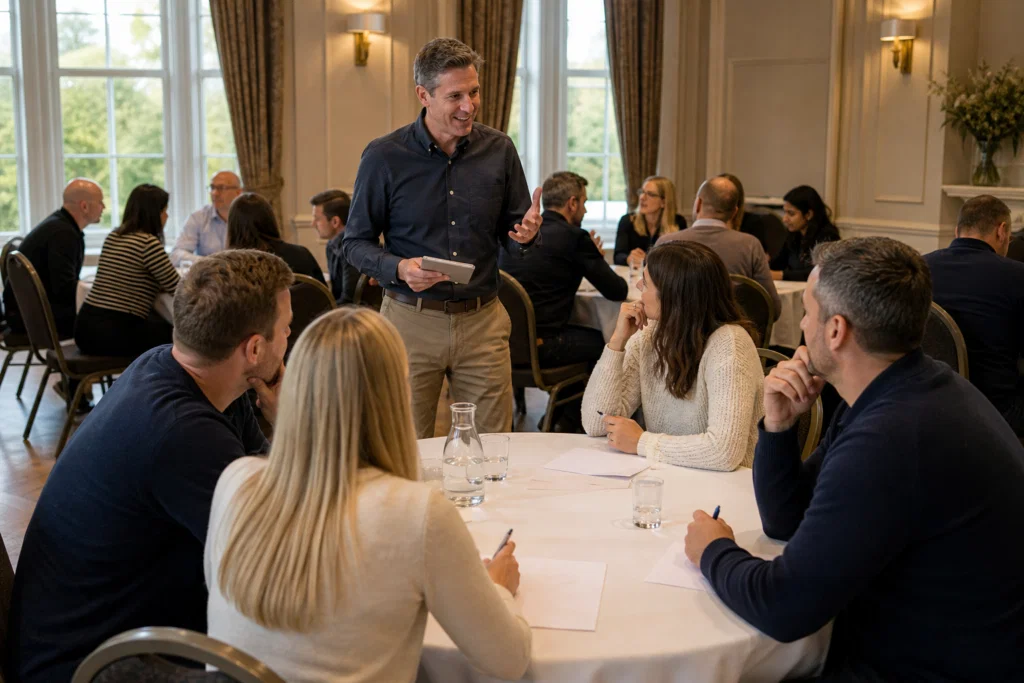
Use small groups of four to six where possible. Give each group a way to record answers, then ask for one response per team. This keeps the pace moving and avoids a room where the quickest person answers everything.
Do not make the first question too hard. Start with something people can solve in under a minute, then raise the difficulty. You want the first response in the room to be laughter or recognition, not embarrassment.
When sharing answers, ask one or two teams how they reached their conclusion. This is where the activity becomes useful for team development. You may hear who spotted patterns, who challenged assumptions and who helped the group recover when it went down the wrong path.
Turning riddles into a corporate event format
Riddles can stand alone as a meeting energiser, but they are stronger when built into a proper event format. For example, a conference host can use riddles between agenda blocks to reset attention, while an away day can turn them into a timed team challenge with bonus points for reasoning.
For larger groups, use rounds with different styles. One round might focus on logic, another on wordplay and another on visual clues shown on screen. This stops the same type of thinker from dominating and gives each team more than one route to success.
Riddles can also support themed events. A detective-themed evening, escape-room style session or problem-solving challenge can use riddles as clues rather than as isolated questions. If you want a fuller format, explore NewWave Events’ guide to team challenges for adults or use riddles as a lighter addition to a broader corporate away day.
For a professional event, plan the reveal carefully. Answers should be clear, fair and quick to understand. If you need a long explanation, the riddle may be too obscure for a mixed workplace audience.
When riddles are useful and when to choose a bigger activity
Riddles are useful when you need a short, low-cost activity that encourages discussion. They are a good fit for meeting openers, conference breaks, team lunches, learning sessions and hybrid catch-ups where you want people to think together.
They are not enough when the aim is to rebuild trust, tackle difficult team dynamics or deliver a full away day. In those cases, use riddles as one element within a designed programme, supported by activities that give people time to collaborate, move around and reflect on how they work together.
For HR teams, the main test is whether the activity matches the objective. If the objective is energy, a 10-minute riddle round may be enough. If the objective is connection across departments, plan a longer format with mixed teams, clear facilitation and a shared outcome at the end.
The best riddle sessions feel adult because they respect people’s time. Keep the brief tight, choose fair questions and finish while the room still has energy.
How to turn riddles into a sharper team activity
A few riddles can fill a spare 10 minutes. A better session has a clear purpose, a fair structure and a short debrief that connects the activity back to how the team works.
Set the purpose
Decide whether the session is for energy, problem solving, communication or cross-team mixing. The purpose should shape the questions and the scoring.
Choose difficulty bands
Use easier riddles first, then move into harder ones. This helps the room warm up before the questions demand more patience and discussion.
Use small teams
Groups of four to six usually work well. They are large enough for different ideas, but small enough for everyone to contribute.
Score the reasoning
Award points for correct answers, but also ask teams to explain their route. This rewards listening and logic, not just speed.
Debrief briefly
End with one practical question, such as what helped the group solve problems faster. Keep it short so the activity stays lively.
Plan a team building session that fits your people
If you want riddles, brain teasers or problem-solving challenges built into a wider corporate event, NewWave Events can help shape the format around your group size, venue, timings and goals. We design and deliver team building activities and corporate events across the UK.