Good icebreakers for large groups need structure. Once you have 80, 100 or 200 people in a room, casual introductions can become noisy, awkward or slow. The best games give people a clear task, a short time limit and an easy way to take part without feeling put on the spot.
For company conferences, away days and team building events, an icebreaker should do more than fill ten minutes. It should help people meet colleagues outside their usual circle, lift the room before the main activity and make the day feel easier to join. The 15 games below are designed for large UK workplace groups and can be adapted for indoor venues, outdoor away days, mixed departments and hybrid teams meeting in person.
Why large group icebreakers need a different approach
A small team can sit in a circle and answer a question one by one. A large group cannot. With 100 or more people, the format has to manage movement, sound, timing and confidence.
The safest starting point is to avoid anything that asks individuals to perform alone in front of the whole room. Most people will relax faster when the first task happens in pairs, tables, rows or small clusters. That gives quieter colleagues a way in, while still creating energy across the room.
Large group icebreakers work best when everyone understands three things: what to do, how long they have and what happens when the time is up. If those points are vague, people drift, talk over the briefing or stay with colleagues they already know.
At a corporate event, the icebreaker also has to match the purpose of the day. A leadership away day may need a reflective opener. A sales conference may need speed and movement. A company celebration may need something lighter. The format should support the event, not compete with it.
15 icebreaker games that scale to 100+ people
These games are built for large rooms, mixed teams and short facilitation windows. For most of them, you can run one version with 40 people and the same version with 400 by using tables, zones, colour groups or rows.
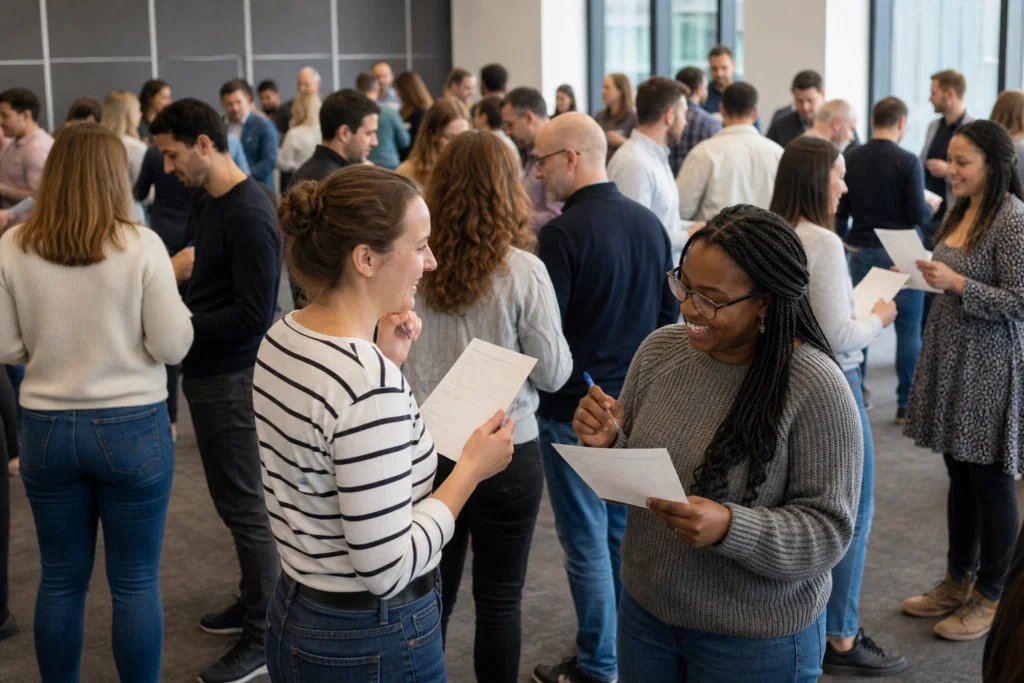
- Human bingo. Give each person a bingo card with workplace-safe prompts, such as “has worked in another department”, “speaks more than one language” or “has attended a NewWave-style team event before”. People move around the room to find colleagues who match each square. Keep it to 10 minutes and ask for a few quick shout-outs at the end rather than checking every card.
- Find your match. Hand out cards that belong in pairs or sets, such as famous duos, project stages, values and behaviours, or customer types and needs. People have to find their match, then answer one simple question together. It scales well because the search creates natural movement without needing a long explanation.
- Common ground circles. Ask people to stand in loose circles of six to eight. Give them two minutes to find three things everyone in the circle has in common, with work and non-work options allowed. Rotate one or two people after each round so the group keeps mixing.
- Speed introductions by row. Each person turns to someone near them and has 60 seconds each to answer a prompt. After two minutes, one row moves along by one seat or one standing place. This is useful in theatre-style conference rooms where you cannot move tables.
- Department map. Mark areas of the room by team, site, function or region. Ask people to stand where they belong, then give each area a quick task, such as finding the newest starter, the longest-serving colleague or one thing other teams often misunderstand about their work. It helps large groups see the organisation in the room.
- Two-question swap. Give everyone two simple questions, one work-related and one light personal question. They ask both questions to a partner, swap one piece of information they are comfortable sharing, then move to someone new. Use prompts that do not require personal disclosure, such as “What helps you have a productive meeting?”
- This or that live poll. The facilitator reads paired choices and people move to one side of the room, raise a coloured card or stand up depending on their answer. Keep the choices quick and relevant. For example, “early agenda or flexible discussion?”, “phone call or message?”, “indoor challenge or outdoor challenge?”
- Table team name in five minutes. Each table creates a temporary team name and one short reason behind it. The aim is not comedy under pressure. It is a low-risk way for strangers to talk before a wider activity begins. Ask only a handful of tables to share if the group is very large.
- Pass the object story. Each table receives a simple object connected to the event theme, such as a puzzle piece, ball or prop. The first person gives one sentence about what the object could represent for the team, then passes it on. After three minutes, each table chooses one idea to keep.
- Networking line-up. Ask people to form a line by a neutral category, such as distance travelled, month of birthday or time with the organisation. Once the line is formed, split it into pairs or small groups from different points in the line. This creates quick mixing without needing personal questions.
- Postcard from the team. Each table writes or draws a “postcard” from the end of a successful year, noting what the team has achieved and what helped. For large groups, collect a few themes rather than every postcard. It works well at strategy days and annual meetings.
- Silent sorting. Ask people to arrange themselves into groups without speaking, using a simple category such as birthday month, preferred working style or years in the sector. The silence keeps the noise level down and makes the task more playful without becoming embarrassing.
- Question stations. Put large question prompts around the room and ask people to visit two or three stations in small groups. Prompts might cover customer experience, team habits, event expectations or learning goals. This works well when you want the icebreaker to feed into the rest of the agenda.
- Would you rather, work edition. Read out practical workplace choices and ask people to discuss their answer with the nearest two or three colleagues. Keep the questions constructive, such as “Would you rather have fewer meetings or clearer meeting actions?” It opens discussion without drifting into sensitive topics.
- One-word weather report. Ask people to describe how they are arriving today in one word, then share it with a partner or table. For a large room, use a show of hands for broad categories afterwards, such as focused, curious, busy or ready for a change. It gives the facilitator a quick read of the room without asking anyone to explain more than they want to.
Make the opener fit the room
If you are choosing between table games, movement games and conference energisers, NewWave can help match the format to your group size, timings and venue layout.
How to choose the right game for your audience
Start with the room, not the game. A hotel ballroom with round tables suits table-based tasks. A lecture theatre needs seat-based pairs, rows or live polling. An outdoor away day can use line-ups, zones and movement, provided the surface and weather are suitable.
Then think about the relationship between attendees. If people already know each other, you can use more playful formats. If the group includes senior leaders, new starters, external guests or merged teams, keep the first task simple and low-pressure.
The timing matters too. At 9am, people may need a gentle opener that helps them settle. After lunch, a movement-based activity can raise energy. Near the end of the day, a reflective game can help people turn the event into practical next steps.
If the icebreaker is part of a bigger away day, connect it to the event aim. For wider planning ideas, NewWave has a guide to corporate away day ideas for UK teams that can help you shape the full agenda around the same objective.
Facilitation rules for groups of 100+
Large groups need a confident briefing. Keep the instruction short, demonstrate the first step and put the time limit where everyone can see or hear it. If you need more than a minute to explain the game, the format may be too complex for an opener.
Use microphones, visible facilitators and simple signals. A raised hand, music cue or countdown can bring the room back more effectively than shouting over 150 conversations. For very large groups, brief table hosts or zone leaders before the session so they can help with movement and questions.
Build in realistic timings. A five-minute game often needs ten minutes once you include briefing, movement, settling and closing. If the room layout is tight, allow extra time for people to move safely.
For bigger event spaces, planning should include more than the activity itself. Crowd flow, exits, first aid arrangements and emergency procedures need to be clear before the day starts. The Health and Safety Executive has event guidance on incidents and emergencies, which is a useful reference when responsibilities need to be agreed with venues and suppliers.
Plan the facilitation before the day
For 100+ guests, the details matter: briefing, microphones, movement routes, helpers and timing. NewWave can build those details into the event plan.
Making icebreakers inclusive and low-pressure
A good icebreaker should not reward the loudest person in the room. It should let different personalities take part comfortably. Offer ways to join in while seated, avoid forced physical contact and make personal disclosure optional.
Choose prompts that are easy to answer without revealing sensitive information. Questions about hobbies, preferred working habits, travel distance or event expectations are usually safer than questions about family, health, finances or personal history.
Think about accessibility before choosing a movement-heavy game. Some colleagues may have mobility, hearing, sight, neurodiversity, anxiety or fatigue considerations that are not visible. If movement is involved, make the route clear and allow people to take part from their table or with a partner.
For mixed-language or international teams, avoid wordplay that depends on local references. Use visual instructions, examples and plain English. If the group is hybrid in the broader working week, an in-person icebreaker can also help rebuild informal links between colleagues who rarely share the same space.
Turning an icebreaker into a stronger team event
The best icebreaker creates momentum for what follows. It gives people a reason to speak to someone new, then hands them into an activity where that connection can continue.
That might be a collaborative challenge, problem-solving activity, charity build, creative session, indoor team building game or outdoor company challenge. The icebreaker does not have to carry the whole event. Its job is to make the first step easier.
Close the icebreaker properly. Summarise one or two observations, explain why the exercise was chosen and connect it to the next part of the day. For example, after “Common ground circles”, you might point out that teams found unexpected overlaps across departments, then move into a cross-functional challenge.
If you are planning a bigger audience, it is worth reading NewWave’s guide to team building for large groups. For conference settings, the guide to conference icebreakers and energisers for big rooms covers formats that suit formal agendas and large venues.
A simple planning process for a large-group icebreaker
Use this five-part check before choosing a game. It keeps the activity practical, proportionate and easier to deliver on the day.
Define the purpose
Decide whether the icebreaker should help people meet, raise energy, introduce a theme or prepare for a team challenge. One clear purpose is enough.
Map the room
Check seating, sightlines, microphones, exits, outdoor surfaces and movement space before choosing a format. The best idea on paper can fail in the wrong layout.
Split the group sensibly
Use tables, rows, zones, coloured cards or pre-set groups so 100 people never have to wait for one long queue or one central instruction point.
Brief helpers early
For larger events, give facilitators, table hosts and venue contacts the timings, signals and safety notes before guests arrive.
Close with a handover
End the icebreaker by linking it to the next activity. People should understand why they did it and what they are moving into next.
Need an icebreaker that fits your event?
NewWave Events designs and delivers team building activities and corporate events across the UK, including large-group formats for conferences, away days and company celebrations. If you need an opener that suits your venue, audience size and wider agenda, our team can help plan the right format.