Minute to Win It Games for Adults: 30 Office-Ready Challenges
Minute to win it games are 60-second office challenges that use simple props, clear rules and a little time pressure to get adults working together. They are popular for workplace team building because they are quick to set up, easy to explain and suitable for mixed groups when planned properly.
This guide gives UK HR teams and team leaders a practical way to choose, run and adapt minute to win it games for adults at work. The focus is on games that feel suitable for an office, away day or corporate event, rather than party games that rely on mess, drinking rules or embarrassment.
What minute to win it games are
Minute to win it games are short challenges where individuals or teams try to complete a simple task in 60 seconds. For office groups, the best versions use familiar items such as cups, paper, ping pong balls, balloons and sticky notes. They should be quick to explain, fair to judge and easy to reset.
The format works well for workplace events because nobody needs specialist knowledge. A finance manager, apprentice, remote team lead and sales director can all play the same round without anyone feeling out of place. That makes the games useful for away days, conference energisers, team socials, Christmas parties and short breaks between business sessions.
The difference between a good session and a chaotic one is planning. Choose challenges that suit the room, the group size and the tone of the day. Keep the rules visible, test each challenge before people arrive and avoid anything messy, embarrassing or physically risky. The aim is shared energy, not forced silliness.
When this format works best at work
These games are at their best when you need a quick lift in the room. They suit teams that want something more active than a quiz but less formal than a full training exercise. They also work when you have a mixed group where some people know each other well and others are meeting for the first time.
Use the format when you need:
- a short icebreaker before a meeting or workshop
- a light competition during an away day
- an indoor fallback for poor weather
- a fast-paced station activity at a company fun day
- a simple way to mix departments without long introductions
For a longer programme, minute to win it games can sit alongside broader team building activities. They are especially useful as an opening block because people start talking quickly and the pressure stays low.
Set a purpose before choosing the games. If the event is mainly social, lean into funny visual challenges. If the event is about communication, choose team relays and paired tasks. If the audience is senior or mixed across levels, use a game show style with a confident host so nobody has to perform alone unless they choose to.
Make the energiser fit the day
If you want quick games to sit naturally inside a wider away day, NewWave Events can help you choose the right format, timings and level of competition for your team.
30 office-ready minute to win it games
Use this list as a menu rather than a fixed running order. For a 45-minute session, choose six to eight challenges. For a 90-minute event, choose ten to twelve and add a short final. Test each game with the actual props before the event starts, as a small change in cup size, table height or distance can make a challenge too easy or too slow.
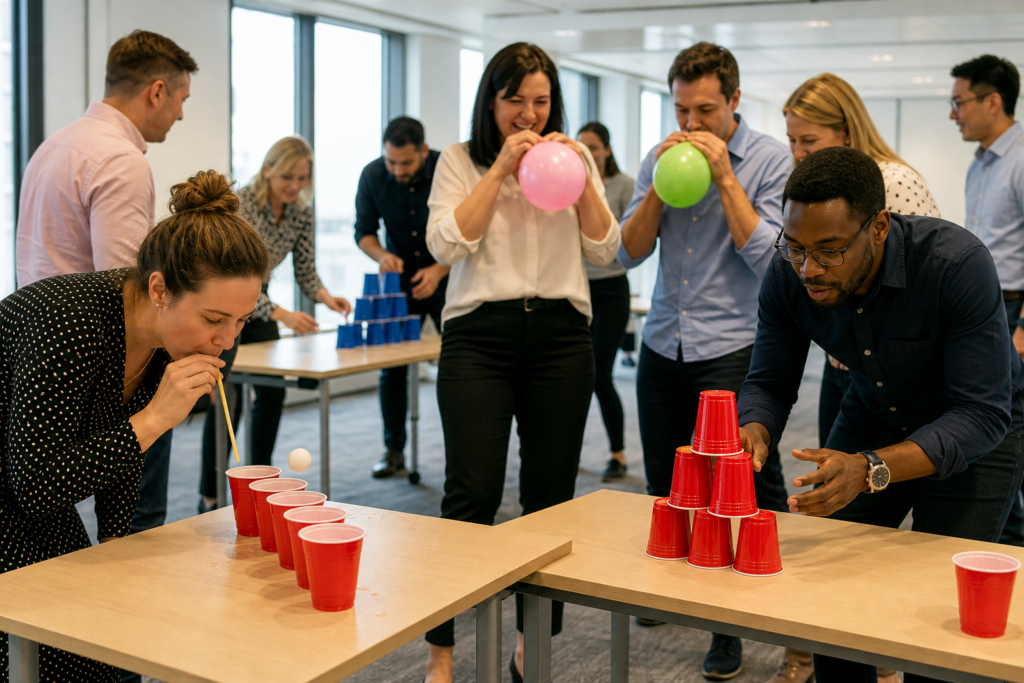
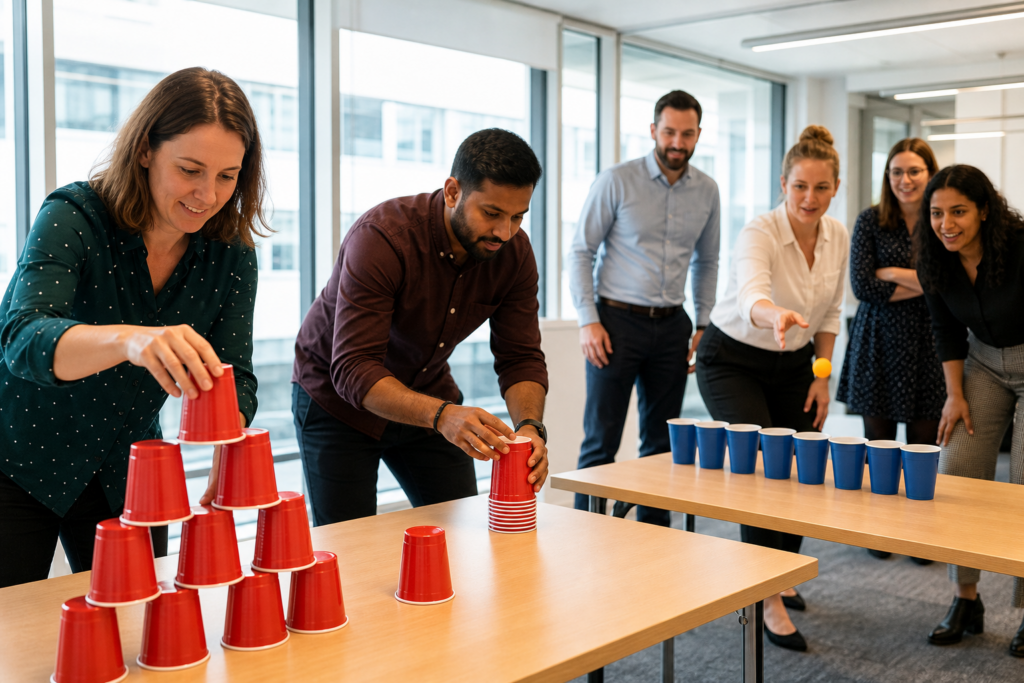
- Cup stack sprint: Each player builds a cup pyramid and returns it to a single stack within 60 seconds. It is easy to understand and works well as the first round because the room can see progress immediately.
- Ping pong landing zone: Players bounce ping pong balls across a table and try to land them in cups. Adjust the distance for different ability levels and use team totals to keep the scoring simple.
- Balloon balance: A player keeps two balloons in the air for a minute without holding them. For teams, allow one player to tap while colleagues call out positioning and timing.
- Paper plane runway: Teams have one minute to fold and fly paper planes towards a marked landing zone. Award points for distance and accuracy rather than only the longest throw.
- Sticky note dash: One player has 60 seconds to place as many sticky notes as possible onto a designated board or wall area. Use a standing-height surface and check the venue allows low-tack notes.
- Desk tidy relay: Teams sort mixed office items into labelled containers, such as clips, pens and note cards. It rewards organisation and communication rather than speed alone.
- Chopstick transfer: Players move small objects such as foam pieces or wrapped sweets from one bowl to another using chopsticks. Offer tongs as an accessible alternative.
- Elastic band target: Players flick elastic bands towards plastic cups or light targets from a safe, marked line. Keep everyone behind the line and avoid aiming at people.
- Index card tower: Teams build the tallest freestanding tower from index cards. The tower must stand unaided for three seconds when the timer ends.
- Post-it colour sort: Teams sort mixed sticky notes into colour groups or a simple pattern. It is a useful option for quieter groups because it is collaborative without being loud.
- Office basketball: Players throw soft paper balls into a wastepaper basket from a set distance. Use clean paper and a lightweight bin so the challenge stays simple and safe.
- Pencil roll: Players roll pencils across a table and try to stop them inside a taped scoring zone. It looks easy, but it needs control and patience.
- Button drop: Players stand over a cup and drop buttons, counters or tokens from chest height. The winner is the person or team with the most items in the cup after a minute.
- Card flick goal: Players flick playing cards towards a tray or box. This suits small teams and gives spectators a clear target to follow.
- Paperclip chain: Teams make the longest paperclip chain in 60 seconds. It is compact, low-mess and good for rooms where movement is limited.
- Cup flip line: Players flip lightweight cups so they land upright along a table edge. Use sturdy tables and keep drinks well away from the playing area.
- Balloon cup push: A player inflates a balloon and uses the released air to move cups across a table. Provide fresh balloons for each player and make this optional for anyone who would rather not use breath-based props.
- Domino paper line: Teams stand folded index cards in a line and knock them down at the end. Score by the number that fall cleanly, not by speed only.
- Coin slide: Players slide coins or tokens towards a target zone on a table. Use tokens if you want to avoid handling coins.
- Speed sketch: One player draws simple workplace-friendly prompts while their team guesses. Keep the prompts neutral and easy, such as kettle, laptop, umbrella or train ticket.
- Alphabet hunt: Teams write one office-safe item, place or work phrase for as many letters of the alphabet as possible. It gives less physical players a strong scoring route.
- Memory tray: Show a tray of small items for ten seconds, cover it, then give teams the remaining time to write down what they remember. This works well in conference rooms.
- Pom-pom spoon run: Players move soft pom-poms from one bowl to another using a spoon. Keep it walking pace and use a short route to avoid collisions.
- Rubber duck shuffle: Teams move small lightweight objects along a table using only a folded card as a fan. The first to cross the finish line, or the furthest after 60 seconds, scores.
- Badge lanyard loop: Players toss lanyards or soft loops onto cone markers or bottles. Use light props and enough spacing between stations.
- Desk bingo sprint: Teams race to find harmless desk items from a short list, such as a blue pen, paperclip, sticky note and notebook. Do not include personal or private items.
- Silent order: Teams line themselves up by birthday month, shoe size or commute length without speaking. It is quick, funny and useful for groups that need to practise non-verbal communication.
- One-word story: Teams build a story one word at a time for 60 seconds without breaking the flow. Award points for continuity, teamwork and staying workplace-appropriate.
- Balloon waddle pairs: Pairs move a balloon between them over a short course without using hands. Keep the route short, offer a seated alternative and avoid this with groups that dislike close-contact tasks.
- Finale cup relay: Teams combine several simple actions, such as stack five cups, land one ping pong ball and make a three-link paperclip chain. This makes a strong final because different people can take different roles.
How to score the games without slowing the room down
A clear scoring system stops friendly competition turning into confusion. Decide before the first round whether you are scoring completion, speed, quantity, accuracy or team points. Announce the method once, demonstrate the challenge and let teams ask questions before the timer starts.
For most office groups, team scoring works better than individual elimination. It keeps more people involved, reduces embarrassment and lets quieter colleagues contribute as organisers, scorers, timekeepers or coaches. A simple approach is to award five points for first place, three for second and one for third. For larger events, run several stations at once and rotate teams every few minutes.
Keep the event moving with a host, a visible timer and one referee per busy station. Build in reset time between rounds. If you are running games at a conference or away day, link the challenges to the room layout and agenda rather than squeezing them into a space that was not designed for movement. Our guide to choosing team building venues covers the practical venue checks that often decide whether an activity feels relaxed or cramped.
Keep the pace without running it yourself
A hosted format keeps scoring fair and avoids awkward pauses between rounds. We can supply the structure, props and facilitation so your team can take part rather than manage the room.
Safety and inclusion checks before you play
Office-ready does not mean risk-free. It means the activity has been thought through for the people, venue and business setting. Use light props, clear walkways and simple rules. Avoid sharp objects, slippery floors, food challenges that create allergy concerns, and tasks that rely on speed over awareness.
For UK workplace events, safety planning should be proportionate to the activity. A meeting-room energiser needs a different level of planning from a large off-site event with multiple stations, AV, catering and external suppliers. The Health and Safety Executive has useful event guidance on incident and emergency planning, including the need for plans that match the level of risk.
Inclusion matters just as much as safety. Offer seated versions, non-physical roles and alternative tools such as tongs instead of chopsticks. Avoid games that require people to disclose personal information or take part in close physical contact. Employers also need to consider reasonable adjustments for disabled workers and workers with health conditions, so it is sensible to ask about access needs before the event and design the format with options from the start.
If you know the session needs to stay indoors, choose compact challenges that work well around tables and clear floor space. For more ideas that suit bad weather, limited travel and office-based teams, see our guide to indoor team building activities.

Turning a quick game list into a proper team event
Minute to win it games can be a quick office energiser, but they can also become a polished team event with the right structure. The difference is facilitation. A good host keeps the pace up, explains rules without over-talking, reads the room and makes sure the competition stays good-natured.
For company away days and corporate events, think beyond the list of games. Decide how guests will arrive, how teams will be formed, how scores will be shown, what happens if a round overruns and where people go after the activity. Small details, such as pre-set stations and spare props, make the experience feel organised rather than improvised.
NewWave Events designs and delivers team building activities and corporate events across the UK. If you want the energy of minute to win it games without the planning, sourcing, scoring and hosting landing on your HR team, we can shape the format around your group size, venue and event objectives.
A simple format for running the session
The structure matters as much as the games. A well-run session feels quick, fair and easy to join, even for people who would not normally volunteer for workplace activities.
Set the aim
Choose one purpose for the session, such as breaking the ice, mixing departments, adding energy after lunch or creating a light competitive finale.
Choose the rounds
Pick challenges that match the room, group size and culture. Test the props, distances and timing before people arrive.
Build fair teams
Put people into balanced teams and give each team a mix of physical, creative and thinking-based tasks so different strengths matter.
Run with pace
Use one host, a visible timer and clear scoring rules. Demonstrate each game briefly, then start the clock.
Close the loop
End with a short reset. Announce the winners, thank the scorers and draw out one or two practical observations about communication or teamwork.
Bring the games to your next team event
Planning a team day, conference energiser or office social? NewWave Events can design and host a minute to win it style activity that fits your venue, group size and objectives.