Office games can make work more fun when they are simple, inclusive and suited to the moment. The best office games give colleagues a reason to talk, solve something together or reset their energy without making anyone feel put on the spot.
This guide gives you 35 practical office games for UK workplaces, plus advice on choosing the right format for quick team moments, hybrid meetings, away days and managed corporate events.
What office games are useful for
Office games work best when they have a clear purpose. A five-minute icebreaker before a workshop is different from a half-day team event, and a Friday quiz is different again from an activity designed to help a newly merged team work together.
The aim is not to make everyone perform on command. Good office games give people a low-pressure way to talk, laugh, solve problems and see colleagues outside their normal roles. They can help with energy in meetings, connection in hybrid teams, onboarding, away days and company celebrations.
They also need to be planned with care. Recent workplace data shows why the small details matter: only 10% of UK employees are classed as engaged at work, while 46% reported experiencing a lot of stress the previous day. Games will not fix workload, management or culture issues on their own, but well-run activities can give teams a useful break and a better reason to spend time together.
If you are planning something larger than a quick desk-based game, it is worth looking at structured office team building activities so the format, group size and facilitation match the outcome you want.
How to choose the right office games
Start with the team, not the game. A loud, competitive activity might suit a sales conference after lunch, but it can be the wrong choice for a mixed department meeting where people do not know each other well. The best office games feel easy to join, simple to understand and fair for people with different confidence levels, mobility needs, neurodivergent preferences and working patterns.
Hybrid working also changes the brief. In October 2025, 27% of workers in Great Britain were working in some form of hybrid arrangement, with a further 13% working fully remotely. That means office games often need a remote-friendly version, or at least a way for home-based colleagues to take part without feeling like an afterthought.
Use these checks before choosing an activity:
- Purpose: decide whether the game is for energy, introductions, problem solving, celebration or team reflection.
- Time: be honest about how long the game needs, including set-up, explanation and reset time.
- Space: check walkways, noise, furniture, access, fire routes and nearby teams who still need to work.
- Inclusion: avoid games that rely on physical speed, drinking culture, personal disclosure or public embarrassment.
- Choice: give people a role they can play comfortably, such as scorer, clue reader, photographer, captain or timekeeper.
For indoor sessions, especially during winter or in city offices with limited outside space, this guide to indoor team building activities can help you think beyond the usual quiz.
Choose games your whole team can join
If your team needs activities that suit mixed confidence levels, hybrid workers or limited office space, NewWave can help shape a format that feels natural for the group.
35 office games to try at work
Use this list as a menu. Some ideas suit a normal working day, while others are better for an away day, conference or social event with a host. Mix short, low-commitment games with occasional bigger activities so office fun does not become another demand on the diary.
- Two truths and one work win: Each person shares two true facts and one recent work win, then the group guesses which detail belongs to which colleague. It is warmer than a standard introduction because it lets people talk about something positive without needing a long speech.
- Desk safari: Ask teams to find everyday objects around their desks that match prompts such as “something useful”, “something oddly sentimental” or “something that saves time”. It works well for hybrid teams because remote colleagues can use items from their home workspace.
- Meeting bingo: Create a bingo card with harmless meeting moments, such as “someone mentions a deadline”, “a pet appears on camera” or “the same point is made twice”. Keep it kind and avoid naming people, so the joke sits with office habits rather than individuals.
- 60-second show and tell: Each person has one minute to show an object, app, book or tool that helps them at work. This is good for new starters and cross-functional teams because useful habits surface naturally.
- Office scavenger hunt: Give teams a list of clues to solve around the office, such as finding a hidden symbol, locating a policy folder or spotting a piece of equipment. Keep clues away from confidential material and make sure the route is accessible.
- Team trivia: Build a quiz from company-safe facts, general knowledge, music clips or local references. Rotate the question writers so the same people do not always control the tone.
- Mystery colleague: Collect one work-safe fact from each person before the session, then ask the group to match each fact to the right colleague. It is a simple way to help people learn more about each other without asking personal questions in the room.
- Postcode map: Put a UK map on a screen or wall and invite people to mark where they grew up, studied or had their first job. It starts easy conversations and works well for teams spread across different offices.
- Coffee roulette: Pair people at random for a short coffee chat, either in person or on video. Give each pair two light prompts so the conversation has a starting point.
- Blind ranking: Give teams a theme, such as famous inventions, biscuits, office gadgets or film soundtracks. They receive one item at a time and must place each in a fixed ranking without knowing what is coming next, which creates quick debate without needing specialist knowledge.
- Paper plane accuracy: Teams design a paper plane and aim for a target on the floor. Use clear space, light paper and a short throwing distance so it stays safe and suitable for an office.
- Desk tidy relay: Give small teams a set of mixed stationery, envelopes and harmless desk items to sort into categories against the clock. It is oddly satisfying and can be adapted into a practical reset before a move or office clear-out.
- Emoji project quiz: Write recent projects, products or company milestones as emoji clues and ask teams to decode them. Keep the references broad enough that newer colleagues can join in.
- One-word weather check: At the start of a meeting, ask everyone to describe their working day as a weather word, such as foggy, sunny, windy or calm. It is quick, gentle and can flag whether the room needs energy or focus.
- Silent line-up: Ask the group to line up in order of birthday month, commute length or years with the company without speaking. It is a useful energiser because it needs observation, gestures and cooperation rather than volume.
- Values in action nominations: Turn recognition into a game by asking teams to match examples of good work to company values, then nominate colleagues who showed those behaviours. Keep it specific and voluntary, not forced praise.
- Who said it: Collect anonymous answers to prompts such as “my favourite working lunch is” or “the tool I could not live without is”. Teams guess who gave each answer.
- Pictionary relay: Teams draw work-safe prompts on a whiteboard or flipchart while the next person waits to take over. Use broad categories, not technical terms that only one department understands.
- Office charades: Players act out everyday workplace moments, such as looking for a meeting room, waiting for the kettle or celebrating an inbox clear-out. Keep the prompts light and avoid mimicking real colleagues.
- Photo caption contest: Share a work-safe image, such as a stock office scene or team event photo with permission, and ask teams to write the best caption. Choose categories such as funniest, most accurate and most unexpected rather than one overall winner.
- Lunchtime quiz league: Run a short quiz over several weeks, with teams changing each round so people meet colleagues outside their usual circle. Short rounds keep the commitment manageable.
- Mini office olympics: Set up gentle desk-based rounds such as rubber band archery into cups, paper toss or coaster curling. Check space, trip hazards and materials before play.
- Cup stacking challenge: Teams race to build and dismantle a cup tower, with points for speed and stability. It is cheap, quick and works well as an energiser between conference sessions.
- Balloon keep-up: Teams keep a balloon in the air using agreed rules, such as no hands or one touch per person. Check for latex allergies and choose another prop if needed.
- Puzzle swap: Give each team a small puzzle, but secretly swap a few pieces with another team. They must work out what is missing and negotiate with other groups to finish.
- Mini escape room: Use locked boxes, codes, riddles and clue trails to create a compact office escape challenge. This works best with a facilitator so teams stay moving and nobody gets stuck for too long.
- Murder mystery taster: Give people roles, clues and a timed investigation to solve. It is useful for evening socials or away days because it gives people a shared story rather than relying on small talk.
- Casino chip strategy challenge: Use fun-money chips and simple casino-style games to encourage risk, probability and decision-making discussions. Keep it clearly entertainment-led and avoid real gambling.
- Charity challenge: Teams compete to assemble care packs, design fundraising ideas or complete sponsored mini-tasks for a chosen charity. It gives the game a practical outcome and can suit CSR days.
- Apprentice pitch: Give teams a fictional product, a time limit and a simple judging panel. The fun comes from fast decisions, clear roles and a short pitch, not polished presentation skills.
- Budget build: Teams receive a pretend event budget and must plan the best staff celebration within fixed constraints. It suits HR and leadership groups because it opens discussion about priorities.
- Wellbeing bingo: Create a card with small, healthy actions such as taking a screen break, walking at lunch, checking in with a colleague or refilling a water bottle. Keep it optional and avoid tracking personal health data.
- Gratitude wall: Ask colleagues to write anonymous thanks for specific helpful actions, then turn the notes into a guessing or matching game. It works best when the examples are concrete, such as “helped me prepare for a client call”.
- Hybrid treasure hunt: Give office-based and remote colleagues parallel clues so both groups can take part. For example, office teams might find a physical clue while remote colleagues solve a digital clue that unlocks the next stage.
- Office awards wheel: Create light award categories such as “best calendar save”, “kindest handover” or “calmest under pressure”. Let teams nominate examples and use the game to end a project, quarter or away day on a positive note.

How to run office games without annoying the team
Even the best activity can fall flat if it interrupts a busy day or feels imposed. Make the game easy to understand, give people enough notice and keep the tone adult. Workplaces do not need school-style instruction or forced enthusiasm.
A short script helps: explain why the game is happening, how long it will take, what people need to do and how they can opt into a lower-profile role. If you are using prizes, keep them modest. Small team rewards, charity donations or extra coffee vouchers are usually better than anything that makes the result feel too serious.
For regular office games, set a rhythm people can trust. A 10-minute Friday quiz, a monthly team challenge or a quarterly social is easier to support than random interruptions. For bigger activities, treat the session as an event: book the space, check equipment, brief managers and give people time to get back to work afterwards.
Safety and wellbeing still matter, even for light games. Work-related stress, depression or anxiety accounted for an estimated 16.4 million working days lost in Great Britain in 2023/24. That is a reminder to avoid activities that add pressure, single people out or reward overwork disguised as fun.
Turn a quick game into a well-run session
For away days, conferences or larger office socials, NewWave can handle the structure, kit and facilitation so managers can take part rather than run the room.
When office games should become a planned team event
Office games are useful in small doses, but some goals need a more designed format. If you want to bring several departments together, support a leadership message, welcome new starters or create a memorable away day, a facilitated team event usually works better than a DIY activity squeezed between meetings.
A managed event can give you a clearer structure, better pacing and activities suited to your numbers. It also takes pressure off HR teams and managers, who often end up explaining rules, fixing equipment and judging scores while trying to take part.
Think about the wider event shape. A morning conference may need a short energiser and a collaborative challenge after lunch. A summer away day may need a mix of active, creative and relaxed options. A large group may need parallel zones so people are not waiting for their turn. If scale is a concern, this guide to team building for large groups explains what changes when numbers rise.
The most useful events do not rely on one big moment. They give people several ways to join in, enough time to talk and a finish that connects the activity back to work in a practical way.
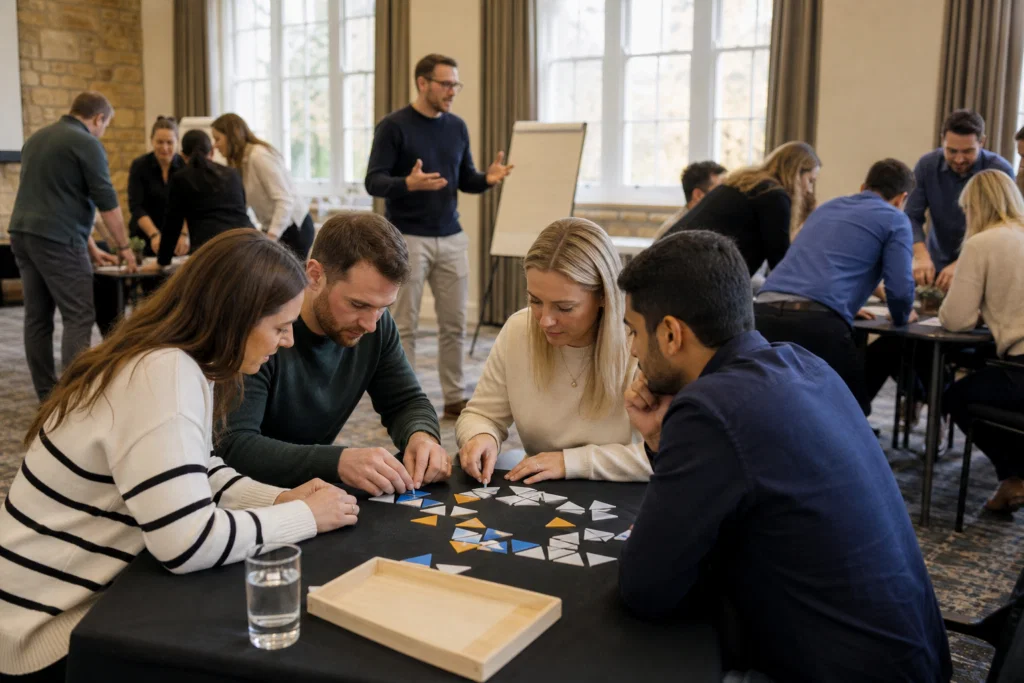
Planning office games with NewWave Events
NewWave Events designs and delivers team building activities and corporate events across the UK, including indoor office sessions, conference energisers, away day activities, evening entertainment and large group formats. That means your team can have something more considered than a downloaded quiz or a last-minute activity from the stationery cupboard.
The right format depends on your people, timings, venue and purpose. A team that needs to relax after a demanding quarter may need a different event from a leadership group working on collaboration. A hybrid workforce may need activities that make office attendance feel worthwhile without excluding remote colleagues.
If you already have a brief, NewWave can help turn it into a workable plan. If you are still choosing between office games, team building and a full corporate event, start with the outcome you want and build the activity around that.
A simple plan for choosing office games
Use this five-step check before adding a game to a meeting, social or away day.
Set the purpose
Decide whether the activity is there to energise the room, help people meet, celebrate a milestone, support collaboration or add structure to a social event.
Match the team
Check group size, confidence levels, accessibility, hybrid attendance, time of day and whether people already know each other well.
Pick the format
Choose a quick desk game, facilitated challenge, conference energiser or full team building event based on the time and outcome available.
Plan the details
Review space, movement, noise, materials, allergies, reasonable adjustments and any pressure points that could make the activity uncomfortable.
Review and improve
Ask what worked, what felt awkward and what the team would do again. Use that feedback before planning the next activity.
Plan office games that fit your team
Planning office games for a meeting is one thing. Creating a team event that people remember for the right reasons takes structure, pacing and the right activities for your group.
NewWave Events can help you plan office games, team building sessions and corporate events across the UK, from quick energisers to full away days.