Office Olympics games are short, competitive team challenges inspired by sports day, quiz rounds and problem-solving tasks. They work well for UK workplaces because the format can be scaled for a lunch break, an away day or a full corporate event, as long as the games are safe, inclusive and easy to understand.
This guide explains how to plan the format, choose the right mix of activities and run the scoring, with 20 office Olympics games you can adapt for indoor or outdoor teams.
What an office Olympics should achieve
Office Olympics games work best when they feel competitive without becoming too serious. The aim is not to find the fittest person in the business. It is to give colleagues shared moments, quick wins and a reason to mix with people they may not usually work with.
For HR teams and team leaders, the format is useful because it is flexible. You can run a short indoor session in a meeting room, add it to a summer away day, or build a full company games day around it. The activities can be physical, creative, strategic or mostly silly, which helps different personalities contribute.
The best version has a clear structure: balanced teams, simple rules, visible scoring and a host who keeps the day moving. It should also feel fair to people with different fitness levels, access needs and confidence levels. If every challenge rewards speed or strength, the quieter problem-solvers and less mobile colleagues are left watching rather than taking part.
Turn the idea into a workable event format
If you want the games to fit around a conference, away day or staff celebration, NewWave Events can help shape the running order, timings and team format before you commit to a venue.
How to plan the format
Start with the practical limits. Decide how long you have, where the event will happen, how many people are attending and whether the group will be split into waves. A 45-minute office session needs quick games with minimal reset time. A half-day away day can include opening ceremonies, team flags, hosted heats and a final round.
Choose a venue that suits the season and the type of challenges you want. Indoor formats are easier to control for weather, sound and access. Outdoor formats give you more space for relays and larger props. If you are still deciding between formats, NewWave Events has a guide to indoor vs outdoor team building activities that can help narrow the choice.
Keep the team structure simple. Teams of four to eight usually give everyone something to do without creating long waits. Mix departments, seniority levels and working patterns where possible, especially if the event is part of a wider away day. For a full-day format, build in breaks, food timings and a quieter activity option so the event does not become one long race.
If the event sits within a wider company day, plan the office Olympics around the purpose of that day. A post-conference energiser needs fast rounds and easy laughter. A leadership away day may need challenges that test communication under pressure. For more whole-day planning ideas, see NewWave Events’ guide to corporate away day ideas for UK teams.
20 office Olympics games for work teams
Use this list as a menu rather than a fixed programme. For most office groups, six to ten games are enough for a balanced session. Pick a mix of movement, accuracy, memory, communication and creative tasks so the same people are not winning every round.
- Opening flag design: Give each team paper, pens and a short time limit to design a team flag, name and chant. Score for clarity, humour and team involvement rather than artistic skill.
- Desk chair slalom: One seated participant is guided through a cone course by teammates. Use sturdy chairs, a flat surface and walking pace only. This works best indoors with clear lanes.
- Paper plane distance: Teams design and fly a paper plane, with points for distance and landing accuracy. Add a rule that everyone must contribute one design idea before the plane is built.
- Office supplies tower: Teams build the tallest freestanding tower using approved light office items such as paper cups, card and elastic bands. Ban sharp or heavy objects and give a clear height-check moment.
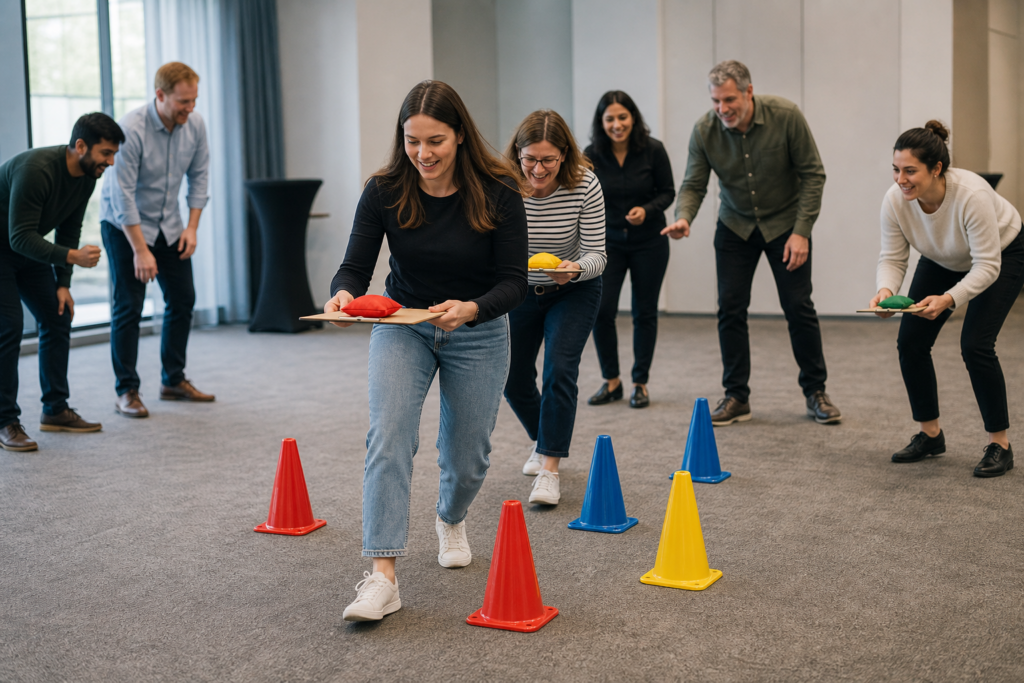
- Relay of random objects: Teams move harmless objects from one station to another using unusual methods, such as balancing a beanbag on a clipboard. Keep the route short and reset each heat quickly.
- Minute-to-win-it stack: Participants stack cups, cards or blocks within 60 seconds. This is a good low-impact option because it rewards control more than speed.
- Team trivia sprint: Ask quick questions about company facts, general knowledge or pop culture. To stop one person dominating, rotate the spokesperson for each answer.
- Balloon keep-up: Teams keep a balloon in the air for as long as possible while following restrictions such as no hands or alternating players. Use enough space and avoid low ceilings with fragile fittings.
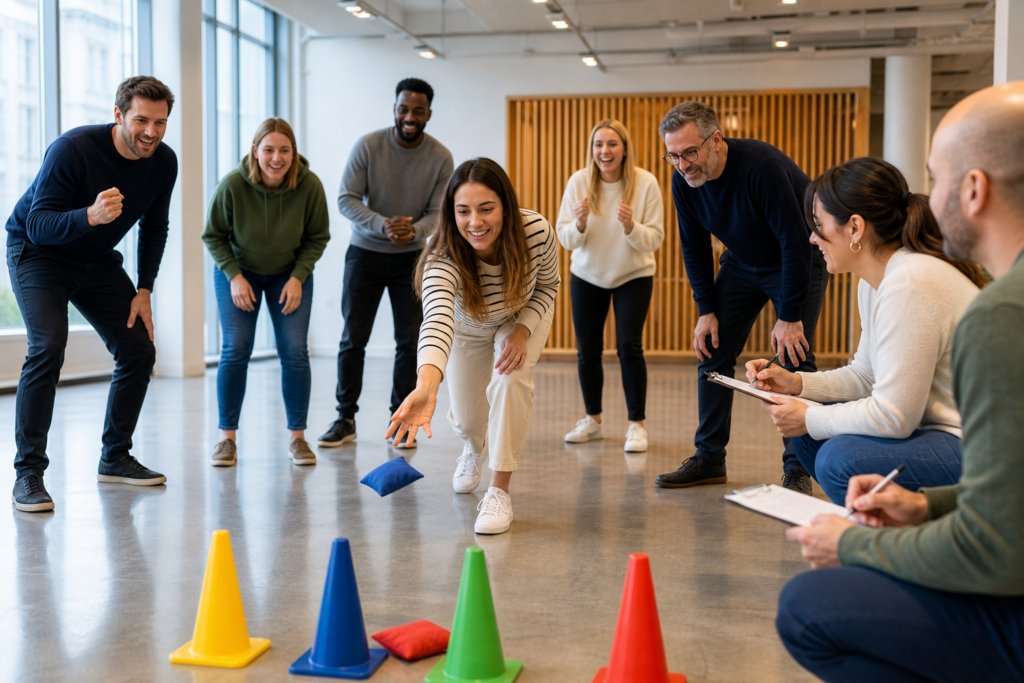
- Beanbag target throw: Players throw beanbags into hoops or buckets at different distances. Offer seated and standing throw lines so more people can take part comfortably.
- Speed puzzle swap: Teams complete a small puzzle, but halfway through they must swap tables and continue another team’s puzzle. It creates a useful communication challenge without heavy physical activity.
- Blindfold directions: One participant follows a simple route while blindfolded, guided only by verbal instructions. Use soft obstacles, a clear area and an option to opt out of the blindfold if anyone is uncomfortable.
- Corporate charades: Teams act out workplace phrases, products, customer scenarios or event themes. Keep the prompts light and avoid anything that could single out individuals.
- Photo finish pose-off: Each team creates a freeze-frame sporting celebration. Score for teamwork, timing and originality. It is a good filler while another station is being reset.
- Memory tray challenge: Show a tray of objects for 30 seconds, cover it, then ask teams to list as many as they can remember. Add a bonus point for recalling the exact position of one item.
- Slow bicycle or scooter balance: If you have a suitable outdoor surface and professional supervision, the winner is the last person to cross the line without putting a foot down. This is not one for cramped offices.
- Pass the baton quiz: A team can only answer after passing a baton between every member. It slows the fastest voices down and makes the whole team part of the round.
- Marble run challenge: Teams create a short track from card, tubes or event kit, then race a marble from start to finish. Score for successful run, neat design and teamwork.
- Human bingo warm-up: Give participants a bingo sheet with workplace-safe prompts, such as someone who has worked in another country or someone who has run a charity race. It helps mixed teams start talking before the competitive rounds.
- Finale obstacle relay: Combine a few simple tasks, such as a beanbag throw, puzzle clue and balance walk, into one final relay. This works well as the last scored event because several strengths matter.
- Medal ceremony vote: End with quick peer-voted awards such as best team spirit, calmest communicator or most inventive solution. This gives recognition beyond first place.
Choose games that suit the whole team
NewWave Events can build a balanced activity mix with hosted stations, clear scoring and options for different energy levels, so the event feels competitive without excluding quieter or less mobile colleagues.
Make it inclusive, fair and safe
Inclusive planning starts before the event. Ask attendees privately if they need adjustments, and make it clear that they do not have to share personal medical details with the wider group. Build the programme so people can contribute in different ways: competing, keeping time, solving clues, scoring, presenting or captaining.
UK employers should consider their duties around discrimination and reasonable adjustments when planning workplace activities. In practice, that means checking access, seating, routes, noise levels, lighting, communication needs and whether each activity has a lower-impact version. It also means avoiding games that shame people for their bodies, confidence, disability, age, pregnancy, caring status, religion or culture.
Health and safety should be proportionate to the activity. A few beanbags in a meeting room do not need the same controls as a large outdoor inflatable course, but you still need clear space, suitable equipment, sensible footwear advice and someone with authority to stop a round. For physical challenges, check the surface, weather, manual handling, first aid arrangements and participant briefing.
Be careful with Olympic-style branding if the event is being promoted outside the business. Keep the theme generic and internal, and avoid official rings, mascots, slogans, host city references or wording that suggests an association with the Olympic or Paralympic movement.
Scoring, hosting and keeping energy up
Good scoring keeps the event moving. Give each station a simple points system, such as 10 points for first place, 8 for second and 6 for third, with bonus points for teamwork or creativity where relevant. Avoid complex spreadsheets unless the group is large enough to need them.
A visible leaderboard can raise the energy, but use it carefully. If one team is far ahead too early, add a bonus round that rewards creativity or accuracy rather than speed. If the group is senior or cross-departmental, avoid public jokes at anyone’s expense. The host should keep the tone warm, brisk and fair.
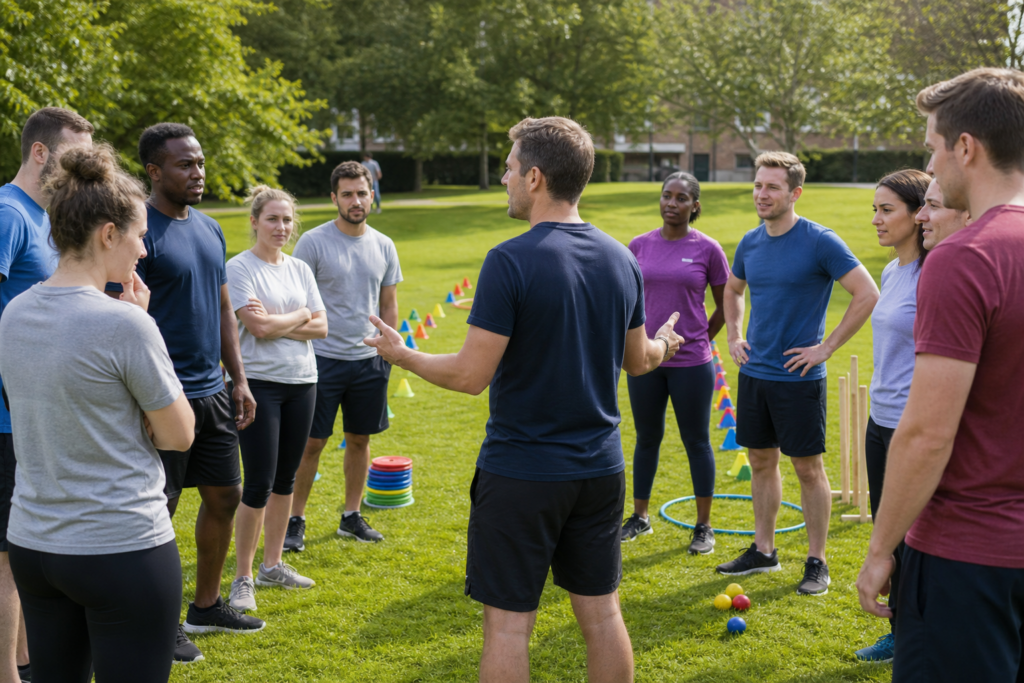
Brief every activity in the same order: objective, time limit, safety point, scoring and start signal. That rhythm reduces confusion, especially in noisy rooms or outdoor settings. For larger groups, station hosts are useful because they can reset equipment, answer questions and keep scores consistent.
Finish with a short ceremony. Give a clear winner, but also recognise team spirit, inventive thinking and communication. Those extra awards matter because office Olympics games are usually about the shared experience, not sporting performance.
When to bring in an event partner
A self-run office Olympics can work well for small teams with a spare meeting room and a short social slot. Once the event becomes larger, public-facing, mixed-site or part of a wider away day, an event partner can save time and reduce the risk of messy logistics.
Professional support is useful when you need hosted stations, outdoor equipment, wet-weather plans, venue coordination, risk documentation, prizes, music, theming or a programme that works for hundreds of people. It also helps when internal organisers want to take part rather than spend the whole afternoon solving timing and scoring issues.
NewWave Events designs and delivers team building activities and corporate events across the UK. For an office Olympics-style event, the team can help shape the format around your group size, venue, timings and company culture, then run the day so your people can focus on taking part.
A simple office Olympics planning process
Office Olympics events are easier to run when the structure is agreed before anyone starts choosing games. Use these five steps to keep the day clear, fair and manageable.
Set the purpose
Decide whether the event is mainly for team bonding, a conference energiser, a summer social or a company-wide away day. The purpose shapes the pace and activity mix.
Fix the format
Choose indoor, outdoor or hybrid delivery, then confirm group size, available time, space, access needs and wet-weather options before selecting games.
Build the game mix
Pick activities that reward different strengths, such as accuracy, creativity, memory, communication and light movement. Avoid a programme built only around speed.
Brief and run
Give every team the same rules, timings and safety points. Use station hosts for larger events so scoring and resets stay consistent.
Score and close
Use a simple points system, announce winners promptly and include recognition for teamwork, problem-solving and spirit as well as first place.
Plan an office Olympics event your team can actually enjoy
Planning office Olympics games for a UK workplace is easier when the format, venue, equipment, scoring and hosting are handled properly. NewWave Events can design a team challenge day that fits your people, timings and objectives.