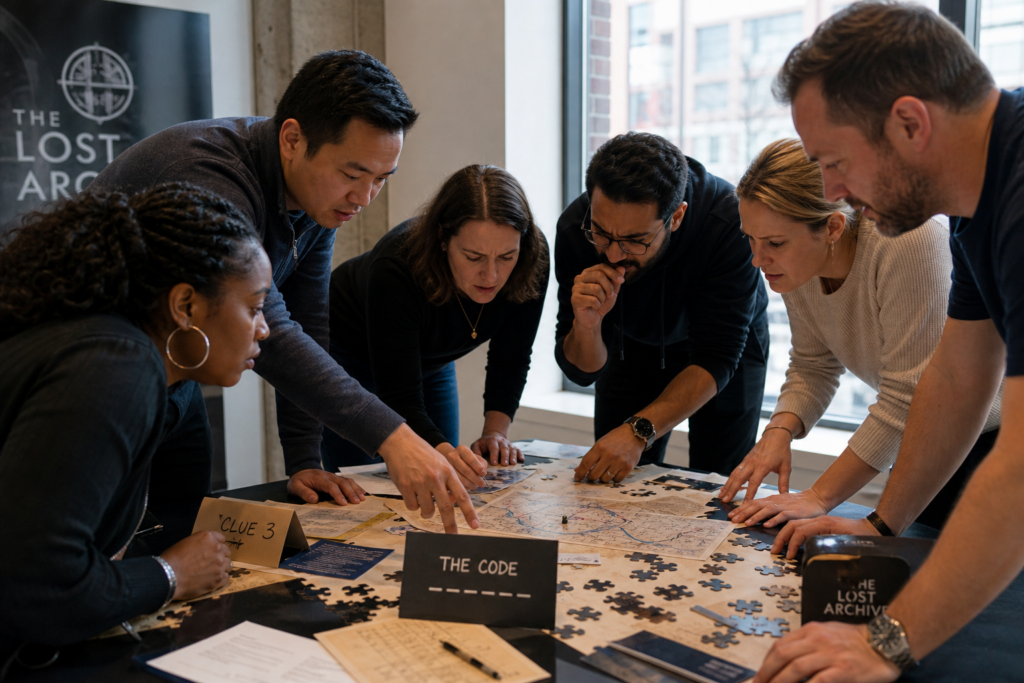
When you put your team under pressure to solve something together, you see how they actually think. Not the polished version they present in meetings, but the real thing: who listens, who rushes, who sits back, who pushes through. Problem solving team building activities work because they strip away the politics and force people to make decisions on the fly, with incomplete information and a ticking clock. That’s closer to real work than most team days get.
Why problem solving activities actually matter
Most team building feels safe. Low stakes, everyone gets a go, nobody fails. Problem solving activities are different because failure is baked in. Some teams will solve the puzzle quickly. Others will hit dead ends, argue, backtrack, and still not make it in time. That’s the point.
When a team faces a real problem together, you learn where the cracks are. Who dominates the conversation? Who has good ideas but doesn’t voice them? Who panics, and who keeps their head? What happens when there’s no clear hierarchy? These are things you can’t find out in a meeting. Once you see them, you can address them.
The second reason they work: they’re not about fitness, sport, or luck. Everyone can participate. No one’s excluded because they didn’t train for it or because they’re not the fastest runner. You either think your way through it or you don’t, and thinking is something every team member can bring to the table.
Types of problem solving activities that work
Escape rooms
An escape room puts your team in a locked space with puzzles, clues and a one-hour timer. You have to find hidden objects, decode messages, unlock boxes and work through logic puzzles to find the exit. The pressure is immediate and clear: you either get out or you don’t.
What makes it valuable is that an escape room forces communication. Someone has to keep track of what’s been tried. Someone else needs to spot patterns in the clues. A third person might solve the logic puzzle but not see how it connects to the physical search. You can’t do it without talking, listening, and trusting that someone else’s approach might work even if you’d have done it differently.
Escape rooms suit teams of 5 to 8. Smaller and everyone crowds the puzzle; larger and people stand around waiting to contribute. Most towns and cities have at least one venue. Difficulty varies widely, so check what level suits your team before you book.
Code breaking and spy challenges
A code breaking challenge splits your team into smaller groups competing to solve a series of ciphers, pattern puzzles and encrypted messages. Spy hunts layer this with a narrative: your team must find hidden clues scattered across a location, decode what they mean, and piece together a solution.
The advantage here is pace. Unlike an escape room, where one unsolved puzzle can grind the whole group to a halt, code challenges let you move on if something’s stuck. Teams often find that the people who excel are not the ones you’d expect. A quiet finance person might crack a lateral thinking puzzle. A junior team member might spot a pattern that the senior people missed. It reshuffles who’s seen as capable.
Treasure hunts and scavenger hunts
A treasure hunt mixes physical movement with puzzles. Your team has a clue sheet with cryptic instructions. Each solved clue leads to a location or the next clue. The challenge is working out what the clue means before you can move on.
Hunts suit larger teams and work well outdoors or across multiple rooms. They’re less intense than escape rooms, which can be good if your team is stressed or if you want the event to feel more like a game than a test. The downside is that a poorly written clue can frustrate people, so the design matters.
Logic puzzles and team challenges
Some venues run structured logic challenges: your team has to solve a puzzle using information that’s been deliberately split between team members. Person A knows something that Person B needs, but they don’t know they have it. The only way to solve it is to compare notes and ask the right questions.
These are pure problem solving without a theme or story. They often run better with smaller groups and can feel quite intense. They’re less fun if your team doesn’t like being put under pressure, but if you want to develop real decision-making skills, this is where you see it happen.

How to choose the right one for your team
Start by thinking about what you’re really trying to address. Do you want to see how your team handles conflict when they disagree? Then an escape room where one person’s solution might not work is a good test. Do you want to break down silos and get people from different departments talking? A spy hunt or treasure hunt spreads people around and forces cross-team conversation.
Consider your team’s tolerance for pressure. Some groups thrive on intensity and competition. Others find it stressful. There’s no shame in picking something less hardcore. A well-run code challenge or treasure hunt still teaches decision-making without the high stakes of an escape room.
Think about group size. Escape rooms work best small and tight. Hunts and spy challenges scale up. If you’ve got a large team, you might split into multiple groups running the same challenge in parallel, so everyone can participate.
Check the location. Some activities need a specific venue (escape rooms are venue-bound). Others can run anywhere. If you want to avoid travel time or keep costs down, that shapes your options. If you’ve got a day to fill and don’t mind moving between locations, you’ve got more flexibility.
Running a problem solving activity yourself vs hiring it in
You can book an escape room directly and turn up with your team. That’s straightforward. The harder part is building a bespoke challenge for your specific group, designing the puzzles, writing the clues, and running it on the day.
If you want a fully produced problem solving event, a specialist provider handles the design, brings all the materials, briefs your team on the day, and manages the timing and scoring. They know what difficulty level works for different groups. They’ve spotted the flaws in their own challenges and fixed them. They can pitch it exactly to your team’s needs.
The DIY route is cheaper upfront but eats time and carries risk: a poorly designed clue kills the mood, the timing runs over, no one knows how to score it fairly. A professional event costs more but you’re not troubleshooting on the day. You get to relax and watch your team work through it.
There’s also a middle ground: book a venue and activity (like an escape room or spy hunt) that’s already designed and run by the venue team. You’ve got a professional event without having to produce it yourself, and it’s cheaper than a bespoke challenge.
Making the most of the debrief
The activity itself is only part of it. The real value is in what you talk about afterwards.
Gather the team together when it’s done and ask what happened. Who stepped up? Who had ideas but didn’t voice them? Where did the group get stuck? Was there a moment someone changed their mind or tried a different approach? Did the team listen to the quieter people?
Connect it back to work. What’s similar about solving a puzzle under time pressure and making a decision on a real project? Where do the same patterns show up? This is where the team building becomes actual skill building. Without the conversation, it’s just a day out.
A good event provider will structure time for this debrief and guide you through the questions. That’s worth paying for because most teams skip it otherwise, which means they miss the point.
The real outcome
Problem solving team building isn’t about winning or solving the puzzle fast. It’s about seeing how your team thinks under pressure, who they turn to, and whether they communicate clearly. If one person dominates and no one else speaks up, you’ve learned something. If someone quiet turns out to have the best idea, the team learns not to overlook them.
These activities work because they’re honest. You can’t fake your way through a puzzle or pretend to be collaborative when you’re not. The mask slips and you see the actual team. Then you know where to focus your attention: on communication skills, on trust, on who’s afraid to speak up, or on how to make space for different thinking styles.
That’s why problem solving team building delivers more than most team days. You’re not just having a fun break from work. You’re learning something real about how your team operates.
Frequently asked questions
An escape room locks your team in one space with puzzles they must solve to get out. It’s intense and high-pressure, best for 5 to 8 people. A spy hunt spreads your team across a larger area searching for clues and solving puzzles to uncover a final answer. It’s less claustrophobic, scales to bigger groups, and usually feels more like a game than a test.
Yes, that’s one of their strengths. Unlike physical team building activities, problem solving is purely mental. Everyone participates equally regardless of fitness, age or ability. The only requirement is the ability to think and communicate, which every team member has.
Most escape rooms run 60 minutes. Code breaking challenges and spy hunts typically take 90 minutes to 2 hours depending on difficulty and group size. If you add a full debrief and discussion afterwards, plan for 2 to 3 hours total.
That’s fine and actually valuable. Not every team solves it, and that’s part of the learning. What matters is what you discover about how your team handles being stuck, whether they panic or stay calm, and if they ask for help or keep struggling. The debrief afterwards is where you talk through what happened and what it reveals about how you work together.
Most escape rooms and physical spy hunts need to be in person because they involve clues and physical puzzles. Some venues and providers do run virtual code breaking challenges and logic puzzles over video call, but the impact is weaker because the pressure isn’t as real. For genuine problem solving team building, in-person is stronger.
Escape rooms work best with 5 to 8 people per team. If you’re larger, you can split into parallel groups. Code breaking and spy hunts scale up to 20 or 30 people, often with teams competing. Logic puzzles suit smaller groups of 6 to 12. If you’re unsure, speak to the provider and describe your team; they can recommend what works at your size.