A good company sports day runs on two things: a solid list of sports day games that suit your group, and a plan that stops the whole thing sliding into chaos by 11am. This guide gives you both. You’ll find more than 30 games sorted by type, plus the practical planning details HR and office managers actually need, from kit lists to wet-weather backups.
Why run a company sports day at all
A sports day gets people out of meeting rooms and into daylight, which sounds small but changes the tone of the whole day. Nobody’s presenting a slide deck. Nobody’s being graded on output. It’s just teams, a scoreboard, and a reason to cheer for the quiet person from accounts who turns out to be brilliant at sack races.
It also works across a mixed office because you don’t need to be sporty to enjoy it. The best sports day games reward effort, teamwork and a bit of luck, not raw athleticism. That’s the whole point.
Classic track and field games
These are the sports day staples people remember from school, and they still land well with adults because there’s nostalgia built in.
- Sprint races over 50m or 100m, run in heats so everyone gets a go
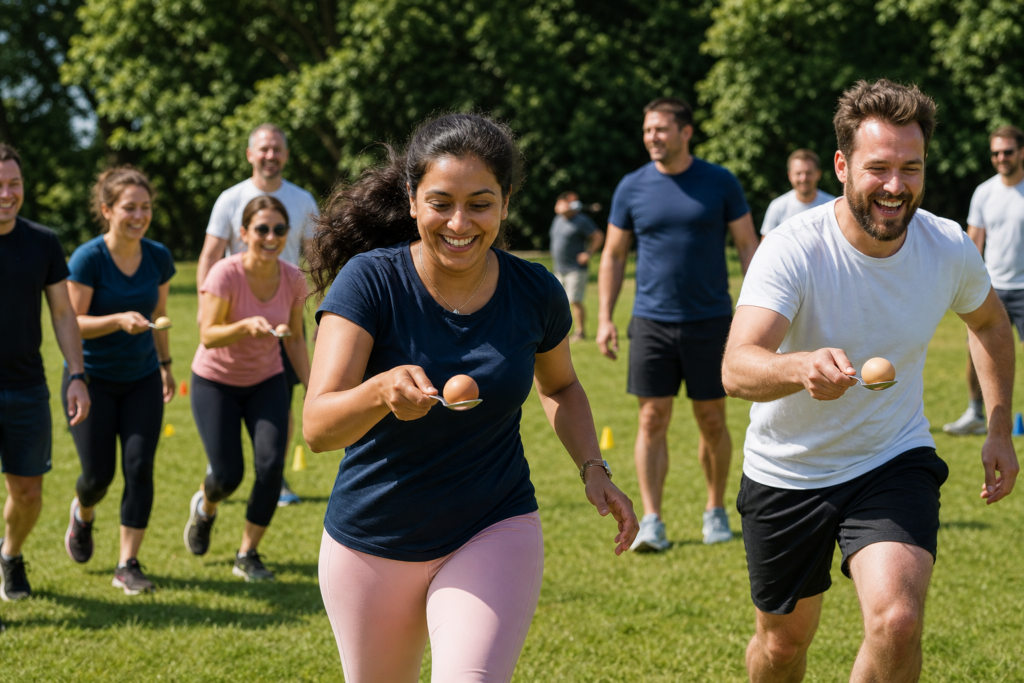
- Egg and spoon race, using a golf ball on a spoon if you want less mess
- Sack race with hessian sacks or pillowcases
- Three legged race in pairs, tied ankle to ankle
- Obstacle course combining cones, hoops and a crawl-under net
- Long jump into a marked sand pit or a chalked grass strip
- Javelin-style foam spear throw for distance
- Wheelbarrow race in pairs
- Hurdles using low cones or soft foam barriers
- Welly wanging for distance, always a crowd favourite
Team relay games
Relays are where the team spirit really shows up, because one person’s slow lap becomes a whole team’s problem to solve together. Keep teams to 5 or 6 people so nobody’s standing around for too long between legs.
- Classic baton relay over 4 x 50m
- Bucket relay, carrying water from one bucket to another without spilling too much
- Balloon relay, held between the knees and waddled across the field
- Skipping rope relay, one skip per person before passing the rope on
- Space hopper relay for pure comedy value
- Tug of war, run as a knockout bracket between teams
- Flip the tyre relay if you’ve got the kit and the space
- Cup stacking relay, building a pyramid before the next teammate goes
- Newspaper stepping stones, moving as a team without touching the grass
- Human wheelbarrow relay, a step up in difficulty from the standard version
No-equipment lawn games
If your budget or your storage cupboard is limited, these games need next to nothing and still get a good reaction. Most only need a bit of open grass and something you can find in an office stationery cupboard.
- Human knot, untangling a circle of joined hands without letting go
- Rock paper scissors tournament, run as a knockout with the whole office
- Grandmother’s footsteps as a team elimination round
- Freeze tag with a twist, frozen players are freed by a teammate crawling through their legs
- Musical chairs, scaled up with two rows facing each other
- Simon says, played as a fast elimination round
- Follow the leader relay through an obstacle path made of jumpers and shoes
- Balloon keepy-uppy in teams of four, last team with an airborne balloon wins
- Tag team charades against the clock
- Grass sledging or rolling races down a gentle slope, if the site has one
Inclusive and low-mobility sports day activities
A sports day only works if everyone can actually take part, not just watch from the sidelines. That means building in games that don’t rely on running, jumping or standing for long periods, because someone on your team will need that option and it shouldn’t be an afterthought.
- Seated bean bag toss into hoops or a target board
- Table-based cup stacking races
- Beanbag horseshoes, tossed at a peg from a seated or standing position
- Quiz relay, running general knowledge or company trivia rounds between teams
- Seated volleyball with a balloon instead of a ball
- Precision bowling towards skittles or empty bottles
- Ring toss onto cones or bottle necks
- Giant Jenga or Connect 4 played as a timed team challenge
- Croquet or a simplified version using cones as hoops
- Beanbag relay, passed hand to hand down a seated line rather than run
Mix these in throughout the day rather than grouping them at the end. That way nobody feels like the inclusive games are an afterthought bolted on to keep everyone happy.
Choosing a venue
Start with the basics: flat, open grass with enough space for at least two activities running side by side, and access to toilets and shelter. School playing fields, sports clubs, parks with event permits and hotel grounds all work, but each comes with its own booking rules.
If you’re booking direct, you’ll need to check a few things before you sign anything. Ask about public liability insurance cover, whether you need your own, and what happens if the ground is waterlogged on the day. Parks usually need a permit applied for months in advance, and hotel grounds often bundle the space with catering, which can push the price up even if you don’t need it.
This is one of the parts of the day that eats the most admin time, because you’re often chasing three or four venues at once for availability, then negotiating rates separately for each. NewWave’s venue finding service is free, and because we already have relationships across venues nationwide, we can often get better rates and dates than you’d get booking direct. That means you get the venue sorted without the back and forth, and you can put your energy into the parts of the day you actually want to plan.
Building your kit list
Once you know your games, work backwards to a full kit list. It’s easy to forget the small stuff until the morning of the event, so write it down properly rather than trusting memory.
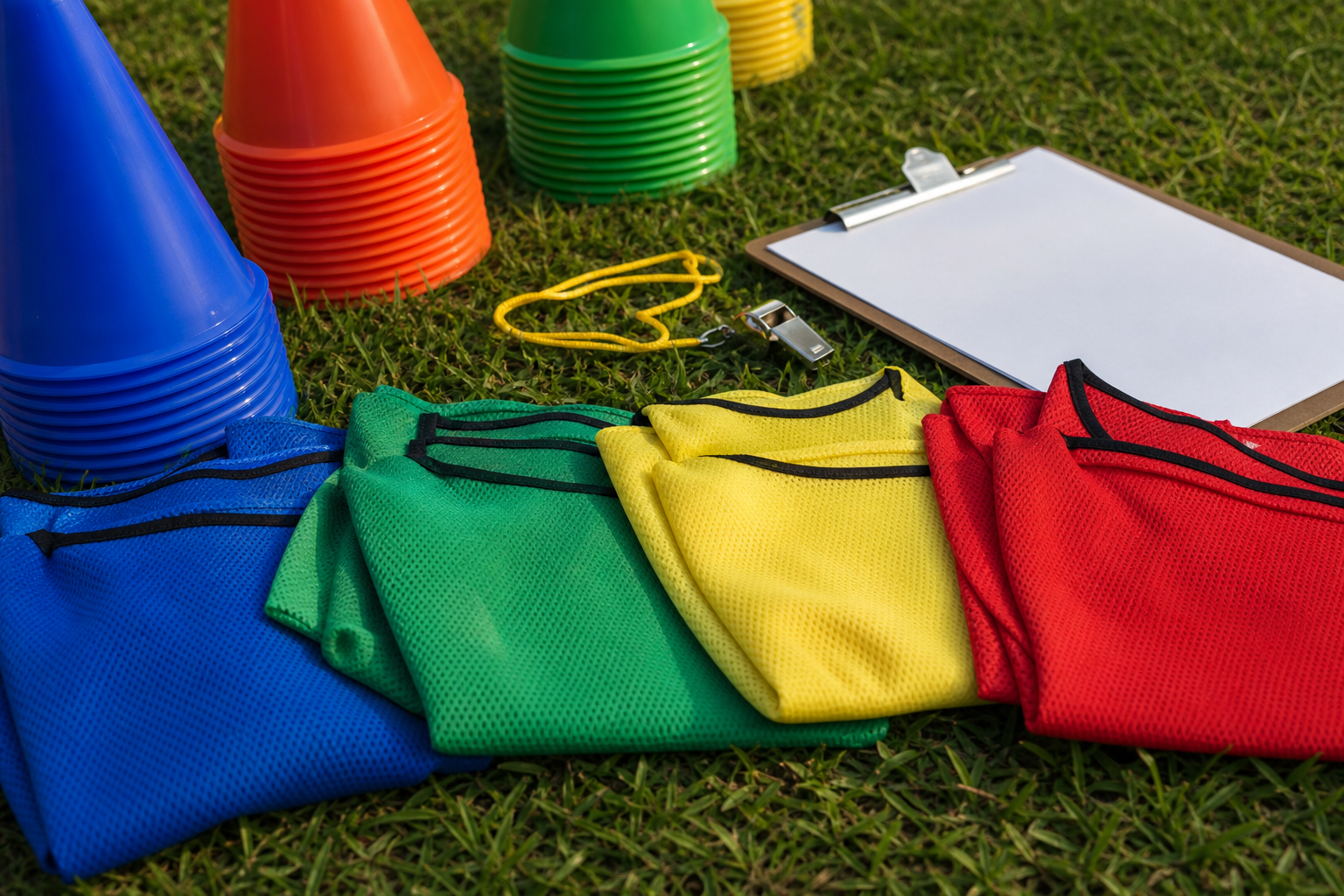
- Cones or markers for lanes and boundaries
- Batons, ropes and sacks for relays and races
- A PA system or whistle so instructions carry across the field
- A first aid kit and someone briefed on where it is
- Water and cups, plus bin bags for rubbish
- A scoreboard, even a simple whiteboard on an easel works
- Bibs or coloured wristbands so teams are easy to spot from a distance
- Gazebos or a shaded area for breaks and equipment storage
- A charged phone or tablet for photos and timing apps
- Spare batteries for anything electronic
Timings that actually work
A common mistake is packing too many games into too little time. Allow 15 to 20 minutes per activity, including the explanation, the actual game and moving people to the next station. For a full day with 40 to 60 people, six to eight games is realistic, not fifteen.
Here’s a rough half-day structure that works for most offices:
- Arrival, team allocation and a quick warm-up, 30 minutes
- Three or four games with short breaks between, 90 minutes
- Lunch, 45 minutes
- Two or three more games plus a final relay, 90 minutes
- Awards and closing, 20 minutes
Build in a 15 minute buffer somewhere in the middle. Something always overruns, whether it’s a tie-break or someone needing a plaster, so give yourself room without it wrecking the rest of the schedule.
Scoring and team allocation
Mix up teams deliberately rather than letting people group by department, because that’s exactly the barrier a sports day is meant to break down. Randomise team allocation before the day using coloured wristbands or lanyards, so people find their team the moment they arrive.
Keep scoring simple. A points system where 1st place gets 5 points, 2nd gets 3 and 3rd gets 1 works fine across most games. Write scores up visibly after each round so momentum builds and teams can see exactly where they stand.
Prizes that don’t feel naff
You don’t need an enormous budget for prizes to land well. A trophy that gets displayed on someone’s desk for a year, or a rolling cup that gets passed on to next year’s winning team, often means more than anything expensive.
- Medals for the winning team, cheap to buy and always well received
- A rolling trophy that gets engraved with the winning team name each year
- An extra half day off booked in for the winning team
- A voucher pooled between the winning team to split
- A joke prize for the team that finishes last, kept light-hearted
Wet-weather backups
UK summer weather is not something you can plan around with any real confidence, so have a backup ready rather than hoping for the best. Check the forecast a few days out and decide early whether you’re moving indoors, postponing or pressing on with adjustments.
- Book a venue with an indoor space or marquee option as standard, not an afterthought
- Swap outdoor games for indoor versions, quizzes, table-based relays and seated challenges
- Keep a stock of ponchos or umbrellas on site for light rain
- Set a clear cut-off point where you’ll call the decision to move indoors
- Communicate the backup plan to everyone in advance so nobody’s caught out on the day
When to bring in professional organisers
Running a sports day yourself is entirely doable for a smaller office with a keen volunteer or two. It gets harder once you’re past 50 people, juggling several suppliers for kit, catering and a venue at the same time, and trying to referee games while also being the person people come to when something goes wrong.
That’s usually the point where it’s worth handing the day over to people who do this for a living. NewWave manages venues, suppliers and entertainment end to end, so you’re not the one chasing equipment hire, briefing referees or working out a scoring system at 9pm the night before. We bring everything, run the day on site, and you get to actually take part instead of managing it from the sidelines with a clipboard.
If your team is spread across a few sites, or you want something bigger than cones and sack races, that’s usually when a fully run event makes the most sense.
Frequently asked questions
For a full day event, six to ten games is realistic once you account for explanations, breaks and moving people between activities. Half day events usually fit comfortably around six games. It’s better to run fewer games well than to rush through a long list.
Teams of five to eight people work best for most relay and group games, since smaller teams mean less standing around waiting for a turn. For a large office, aim for six to eight teams total so there’s a real sense of competition without games taking too long to run.
At minimum you’ll need cones for marking areas, some relay props like batons or sacks, a whistle or PA system, water, a first aid kit and something to track scores on. Most of this can be hired cheaply or borrowed, and a professional organiser will bring it all as standard.
Costs vary widely depending on group size, venue, whether you hire equipment or run it DIY, and if you bring in professional organisers. Rather than guessing, get in touch with the NewWave team for a bespoke quote based on your numbers and location.
Yes. Many lawn games and inclusive activities like ring toss, quiz relays and seated challenges need very little space, so you can run a good chunk of the day in a car park, courtyard or even indoors if needed.
Have a wet-weather plan agreed in advance, ideally a venue with an indoor space or marquee, and a set of indoor-friendly games ready to swap in. Decide your cut-off point for calling the switch so you’re not making the decision on the spot while everyone’s standing in the rain.
Seated bean bag toss, table-based relays, quiz rounds and precision bowling games all work well without requiring anyone to run or stand for long stretches. Mixing these throughout the day, rather than grouping them separately, keeps everyone involved together.
For popular outdoor venues in summer, book at least two to three months ahead, and earlier if you need a specific weekend. Park permits in particular can take weeks to process, so factor that into your timeline.
Most venues will require proof of public liability insurance, either their own policy or one you arrange separately. Always check this with the venue before booking, since the requirements vary depending on the site and the activities planned.
A simple points system, such as five points for first place, three for second and one for third, works well across most games and is easy for everyone to follow. Display scores after each round so teams can see how the day is progressing.
Randomise teams rather than grouping by department, since mixing people up is one of the main points of running a sports day. Coloured wristbands or lanyards handed out on arrival make it easy for people to find their team quickly.
Simple, low cost prizes like medals or a rolling trophy that gets passed to next year’s winners tend to land better than expensive gifts. An extra half day off or a shared voucher for the winning team are also popular options that don’t need a big budget.
If your group is over 50 people, spread across multiple sites, or you’re already juggling several suppliers for venue, kit and catering, it’s usually worth bringing in professional organisers. That’s when the admin tends to outweigh what a small in-house team can manage alongside their normal jobs.
Late spring through early autumn gives you the most reliable outdoor conditions in the UK, with June and July being the most popular months. Booking outside peak summer weekends can also make venues easier to secure and sometimes cheaper.
Yes, a smaller office can run a great sports day with fewer games and simpler logistics, often in a local park or even a large garden. Focus on four or five games that suit your group’s energy rather than trying to replicate a large-scale event.
Allow 15 to 20 minutes per game once you include the explanation, the activity itself and moving everyone to the next station. This pacing keeps energy up without the day dragging on longer than planned.