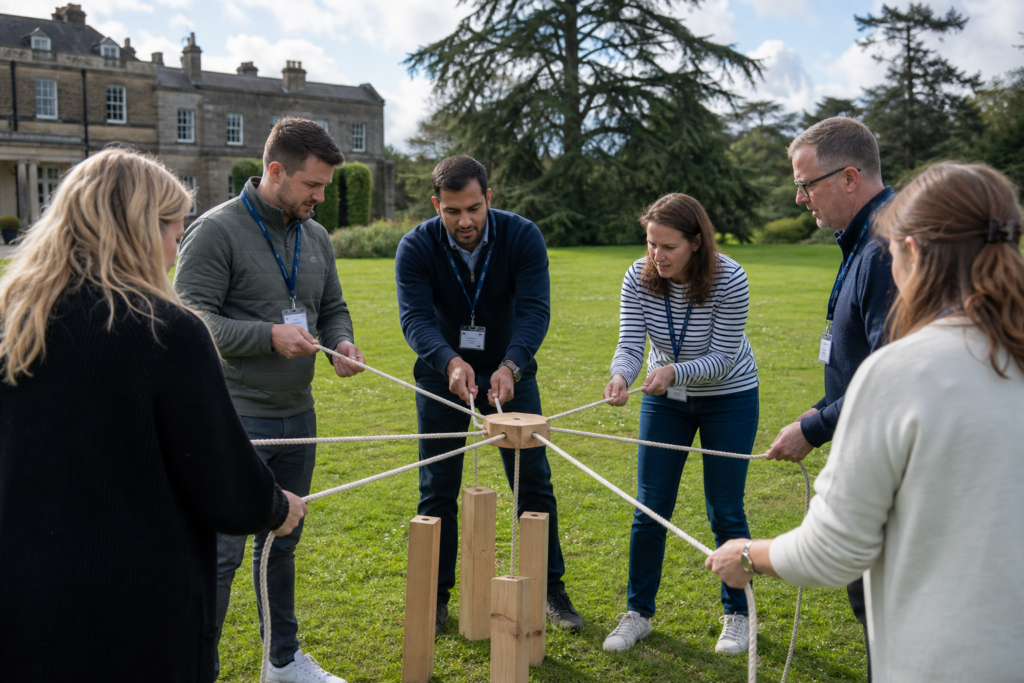
Most people who manage a team never had a single day of training to prepare them for it. That’s not a guess, it’s what the numbers say, and it’s why leadership team building activities have become less of a nice-to-have and more of a fix for a genuine gap. This isn’t about trust falls. It’s about giving managers practice at the things they’re doing badly by accident.
Why leadership teams need something different from general team building
General team building is about bonding. Leadership team building has a sharper job to do: it needs to test delegation, decision-making under pressure and how a group handles conflict when nobody’s told them the right answer. A quiz night builds rapport. A scenario where the team has to allocate scarce resources with incomplete information does something else entirely, because it exposes how people actually behave when the pressure is on.
This matters because of who’s in the room. In the UK, 82% of managers step into the role with no formal leadership training behind them, according to CMI and YouGov research from 2023. That’s roughly 2.4 million people managing others largely on instinct. Leadership-focused activities give them a low-stakes place to practise the skills nobody taught them.
The cost of getting this wrong
Only 27% of UK workers rate their manager as highly effective. Poor management costs UK businesses an estimated £85 billion a year in lost productivity, and CMI research has found that one in three staff have left a job because of a bad manager or a toxic culture. Meanwhile, UK employee engagement sits at just 10%, well below the European average of 12% and the global average of 20%.
Put those numbers side by side and the pattern is obvious. Untrained managers lead to disengaged teams, and disengaged teams cost money. Leadership team building won’t replace a formal qualification, but it’s an accessible way to start closing that gap without waiting for someone to sign off a training budget.
Activities that build specific leadership skills
Pick activities based on the skill you want to see, not just what looks fun on a brochure. Here’s how the popular formats map to real capability.
- The marshmallow challenge (build the tallest structure with spaghetti, tape and a marshmallow on top) tests rapid prototyping and how quickly a group abandons a bad plan.
- Obstacle-style challenges like minefield or crocodile river force clear instruction-giving under time pressure, which exposes weak delegation fast.
- Escape rooms put decision-making under a ticking clock, and someone in the group will naturally start directing traffic, which tells you a lot about who steps up.
- Outdoor pursuits, from navigation tasks to survival-style builds, push strategic thinking because there’s no fallback plan if the first idea doesn’t work.
- Hypothetical scenario exercises (a supplier collapses, a client threatens to walk) are close to free to run and directly rehearse the calls leaders actually have to make.
Emily Zini, Senior Director of Operations at The Escape Game, puts it simply: hosting a team-building session every month keeps a team connected. That’s worth remembering, because a one-off away day won’t undo a year of bad habits on its own.

Outdoor vs indoor for senior teams
Outdoor challenges tend to strip away job titles faster than anything indoors, because nobody’s LinkedIn profile helps them build a raft. That’s often exactly what a senior team needs: a reset where the usual hierarchy doesn’t automatically decide who leads. Outdoor formats also tend to surface clearer strategic thinking and better decision-making under pressure, simply because the stakes feel more real.
Indoor formats, like escape rooms, creative workshops or scenario-based sessions, suit groups with mixed mobility or a shorter window of time. Neither is automatically better. A leadership team recovering from a difficult restructure might get more from a calm, creative session than a physically demanding one, so match the format to what the team’s actually dealing with, not just what’s trending.
Leading a hybrid or remote leadership team
If your leadership group is spread across sites or working from home most of the week, don’t skip this. Gallup’s 2025 data found fully remote workers show higher engagement (31%) than hybrid (23%) or fully on-site staff (19%), which suggests distance alone isn’t the problem, disconnection is. Virtual team building adoption jumped 2,500% after the pandemic, and a lot of that shift has stuck.
For distributed leadership teams, an in-person offsite once or twice a year still earns its place, because video calls don’t replicate the kind of trust that comes from solving a problem in the same room. Bring the team together physically when you can, and use lighter virtual sessions to keep momentum in between.
Planning it yourself: venues, dates and logistics
If you’re organising this in-house, start with the venue. You’ll need somewhere with enough breakout space for small-group exercises, decent weather cover if you’re planning anything outdoors, and catering that can handle a full day without derailing the schedule. Then you’re contacting multiple venues for availability and quotes, comparing what’s actually included, and chasing confirmations while your day job keeps going.
Next comes the activity itself. You’ll need a facilitator who can read the room and adjust on the day, because a scenario exercise that’s too easy for a senior team falls flat fast. Add in equipment, insurance checks and a running order that doesn’t leave people standing around, and a single day off is suddenly a multi-week project.
That’s the bit that eats most organisers’ time: juggling several venues and suppliers at once, then chasing confirmations right up to the week itself. NewWave’s venue finding service is free, and because we’ve got long-standing relationships across the country, we often land better rates and dates than you’d get booking direct. We manage the venue, the facilitator and the whole day end to end, so you get to actually attend your own leadership offsite instead of running it from behind a clipboard.
How often should you actually run these
Once a year isn’t enough on its own, though it’s better than nothing. Companies that invest properly in team building report a 41% drop in absenteeism and a 17% rise in productivity, and 79% of employees say it genuinely strengthens working relationships. Those are the kinds of numbers that build a business case with finance.
A workable rhythm for most leadership teams is one bigger offsite a year, ideally at the start of a financial year or after a restructure, plus shorter sessions every quarter to keep things ticking over. If budget is tight, quarterly hypothetical scenario exercises cost almost nothing to run in-house and still build real muscle.
What it costs
Budgets vary hugely depending on group size, venue and how elaborate the activity is. As a rough industry guide, businesses in more expensive UK cities often allocate somewhere between £500 and £1,000 per person a year across their team building calendar, while larger organisations with 200 or more staff might set aside £25,000 to £100,000 or more overall. Treat those as a starting point for your own planning, not a fixed rate. For an accurate figure based on your group size and what you actually want from the day, it’s worth getting a bespoke quote from the NewWave team.
Frequently asked questions
They’re activities specifically designed to build the skills managers need day to day, such as delegation, decision-making under pressure and handling conflict, rather than just general bonding exercises. Formats include scenario-based challenges, outdoor problem-solving tasks and structured exercises like the marshmallow challenge. The focus is on practising leadership behaviours in a low-stakes setting.
Most UK managers, around 82% according to CMI research, have never had formal leadership training, so they’re learning on the job through trial and error. Structured activities give them a chance to practise things like delegation and decision-making without real business consequences if it goes wrong. It’s also one reason engagement in UK workplaces sits so low, since untrained managers directly affect how connected their teams feel.
There’s no single best option, it depends on what the team needs. Hypothetical scenario exercises work well for testing strategic decision-making, escape rooms suit time-pressured problem-solving, and outdoor challenges strip away hierarchy and force genuinely shared leadership. Match the format to the current state of the team rather than picking whatever’s popular that year.
A single annual away day rarely creates lasting change on its own. A workable pattern is one larger offsite a year alongside shorter quarterly sessions, which keeps momentum going between the big events. Monthly check-in style activities, even short ones, help teams stay connected according to facilitators who run these regularly.
Costs vary widely based on venue, group size and activity complexity. As a rough guide, businesses in pricier UK cities often budget £500 to £1,000 per person annually across multiple sessions, while larger companies might set aside £25,000 upwards for the year overall. For a figure that reflects your actual group and goals, it’s best to ask for a bespoke quote.
Virtual scenario workshops, online problem-solving challenges and structured check-in sessions all work for distributed leadership teams. Virtual team building adoption rose sharply after the pandemic and has largely stuck around, but it works best as a supplement to occasional in-person days rather than a full replacement. Fully remote teams often show higher engagement than hybrid ones, so distance itself isn’t the main barrier, connection is.
It’s a classic exercise where small teams have eighteen minutes to build the tallest freestanding structure from spaghetti, tape and string, with a marshmallow balanced on top. It tests how quickly a group tests ideas and abandons weak plans, which mirrors real decision-making under time pressure. It’s cheap to run and works well as a quick diagnostic for how a leadership team actually collaborates.