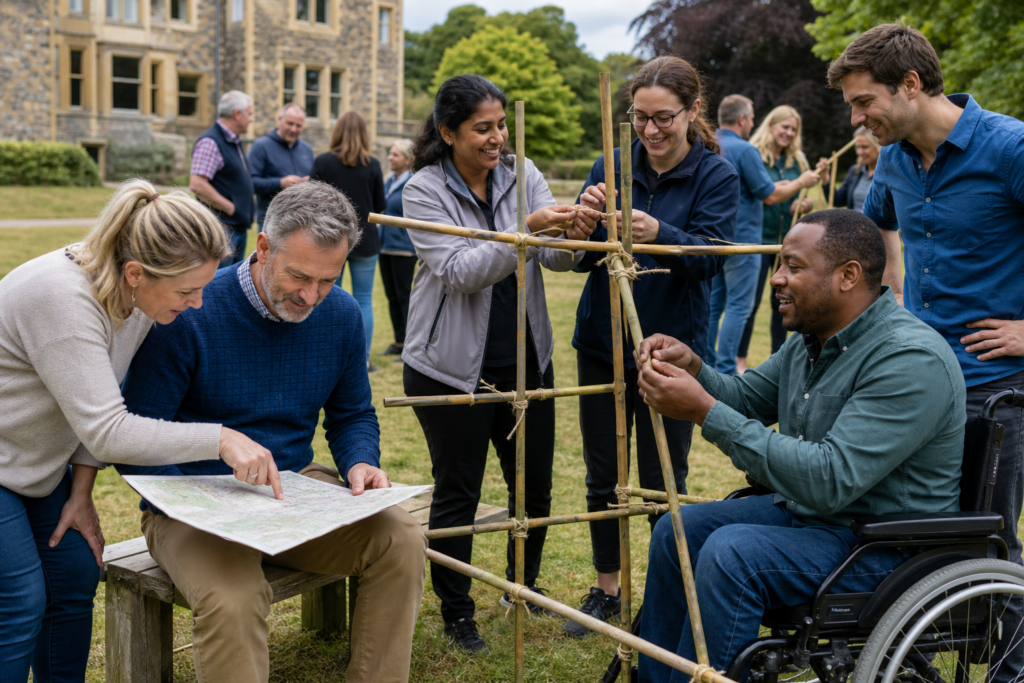
The best team building activities for every team give people a reason to talk, think together and enjoy being in the same place. They don’t fix poor management or an impossible workload, but a well-chosen event can help a new group settle, reconnect a hybrid team or mark a hard-won milestone.
What are team building activities really for?
Team building activities are planned tasks or events that help colleagues work with one another in a different setting. They might involve a timed challenge, a creative workshop, a shared meal or a community project. The activity matters, but the way people communicate and make decisions during it matters more.
Team bonding is often more relaxed. It gives people time to chat and build personal connections. Team building goes a step further by creating a situation where the group must listen, coordinate, share responsibility or solve a problem. Many good events do both, because people are more open to working together when they are enjoying themselves.
Start with the workplace moment
Choose the reason for the event before you choose the activity. A new team may need easy conversation and shared wins. A group after a merger may need mixed-department collaboration. A tired team may simply need a proper thank-you and time away from screens.
- Communication: choose a challenge where people need to exchange clear information.
- Problem-solving: use puzzles, code breaking or a practical build with a clear finish line.
- Leadership: rotate the person making decisions, rather than letting the loudest voice lead every round.
- Relationships: pick a social format with plenty of unhurried conversation.
- Creativity: use film making, collaborative art, cooking or a design task.
- Purpose and social value: work together on a charity, community or environmental project.
Keep the objective modest. One afternoon won’t transform a team with unclear roles or low trust. It can, however, give managers useful observations and give colleagues a shared memory to build on.
The best team building activities by objective
For communication and trust
Choose activities that make listening useful rather than activities that force people to disclose personal information. A spy hunt, code-breaking challenge or structured treasure hunt can do this well. Teams need to pass clues, check assumptions and decide what to do with incomplete information.
A murder mystery can work for groups who enjoy performance and improvisation. It won’t suit everyone, so explain the format beforehand and give people roles that don’t require acting. A quiz or gameshow event is often easier for mixed groups because people can contribute knowledge without being centre stage.
For collaboration and problem-solving
Cooking challenges, collaborative art, a Crystal Maze-style event and practical build tasks give teams a shared result to work towards. Look for formats where different skills help. A good challenge should reward planning, practical thinking and clear communication, not only speed or physical strength.
For competitive teams, sports day games, It’s a Knockout-style challenges, target sports and race nights can bring energy to the day. Add cooperative rounds or rotate roles so the same confident people don’t dominate. Competition is a choice, not a requirement for a memorable event.
For creativity and employee appreciation
Creative formats suit teams who want conversation without a hard score. Try a film making challenge, a magic workshop, sip and paint, candle making, flower arranging or a collaborative design task. These activities work particularly well for an away day where the social side matters as much as the task.
For a celebration, you might add casino tables, pub games, a chocolate workshop or a themed gameshow to dinner and drinks. Build in alcohol-free choices and an easy way to take part without drinking. People should be able to enjoy the event without explaining their decision.
Team building activities for every team size
Group size changes the feel of an activity. A format that works for eight people may become slow or confusing with 80, so check how teams split, how scores are collected and how everyone gets a turn.
- Two to five people: use a cooking session, a short puzzle, an escape room or a guided creative workshop.
- Six to 10 people: most facilitated challenges work well, including quizzes, code breaking and collaborative builds.
- 11 to 25 people: split the group into small teams and use a format with clear rounds, such as a spy hunt or gameshow.
- 26 to 50 people: choose an event with several stations, multiple facilitators or a scoring system that keeps waiting short.
- 50 or more people: use scalable formats such as sports day games, a large treasure hunt, a charity build or a conference gameshow.
For large groups, ask what people do while another team is taking its turn. Long periods of watching can drain the room. Parallel activities, short rounds and visible progress keep more people involved.
Indoor, outdoor, remote or hybrid?
Indoor events give you more control over weather, sound and access. Escape rooms, cooking, quizzes, murder mysteries, creative workshops and problem-solving games work well in hotels, offices and event spaces. Check room layout, lift access, quiet areas, toilets and the distance between the activity and catering before booking.
Outdoor activities suit teams who want fresh air and a change of pace. Scavenger hunts, low-ropes challenges, orienteering, sports tournaments, geocaching and conservation projects are useful options. Have a wet-weather plan, suitable clothing advice and an indoor alternative when the forecast turns.
Remote activities need equal participation
Virtual quizzes, online escape rooms, digital scavenger hunts, remote cooking and drawing games can bring remote colleagues together. Keep sessions shorter than a full in-person event and send instructions early. Offer a chat channel as well as spoken participation, because not everyone thinks best by speaking first.
Hybrid events need more care. Streaming an in-person activity to remote staff often leaves them watching rather than joining. Mix people across locations, give every team the same information and use a shared scoring or contribution system. Local physical tasks can work when they connect clearly to a digital challenge.
These figures explain why purposeful in-person time matters, while also showing why a single format won’t suit every workforce. In Great Britain, 28% of working adults reported hybrid working in early 2025. Employers therefore need events that include people who work in different places, shifts or patterns.
How to choose team building activities that people will actually enjoy
Ask five questions before you shortlist anything. What should people do more effectively after the event? What will they feel comfortable doing? How much time do you have? Where are people travelling from? What needs to happen around the activity, including food, breaks and transport?
- Set a clear brief in one sentence, such as ‘help a newly merged team work across departments’.
- List genuine constraints, including headcount, date, location, mobility, dietary and sensory needs.
- Shortlist three formats with different energy levels, not three versions of the same game.
- Ask suppliers what happens if the weather changes, someone cannot take part or numbers move.
- Check what the organiser must do on the day. A simple event should still have a clear run sheet.
- Compare the whole cost, including venue, catering, travel, equipment, staffing, insurance and VAT where relevant.
Ask for a written inclusivity and risk plan. You should know how the supplier handles first aid, food safety, equipment, safeguarding, alcohol and access. For outdoor or physical activities, check public liability insurance and the process for a dynamic risk assessment.
Budget for the whole day
There isn’t one useful price for team building activities. A self-led office puzzle costs less than a staffed event with a venue, catering and transport, while London and regional locations can differ. Ask for a bespoke quote based on your date, group size and format rather than comparing a headline figure.
Include staff time in your calculation. Booking several suppliers may look cheaper at first, but the organiser still pays through hours spent chasing replies, checking access details and fixing gaps in the schedule. A clear all-in proposal makes the decision easier.
Make team building activities inclusive
Inclusive design starts before the invitation. Give people the date, timings, location, travel details, clothing guidance and activity level early. Ask privately about access, faith, food, caring responsibilities, sensory needs and any other adjustments.
Avoid forced personal disclosure, humiliation-based games and activities where elimination means sitting out for most of the session. Offer non-competitive roles such as navigator, scorekeeper, planner or photographer. Written instructions, predictable rounds and a quieter space can help neurodivergent colleagues take part on their own terms.
Physical ability should not decide who contributes. An outdoor challenge can include accessible routes and practical roles, while a sports day can include accuracy, tactics and creative events alongside running. Make alcohol-free participation normal and provide food that covers dietary and religious requirements.

How to plan the event yourself
Six to eight weeks before
- Agree the purpose, budget owner, headcount and decision date.
- Check working patterns, holidays, religious dates and travel requirements.
- Choose a shortlist of activities and venues with an indoor or weather backup.
- Request written proposals that show inclusions, exclusions, timings and cancellation terms.
- Collect access, dietary and participation information through a private process.
Two to four weeks before
- Confirm final numbers and send a plain-English joining note.
- Share clothing, travel, access and food information.
- Create mixed teams if cross-department contact is part of the aim.
- Check the run sheet, emergency contact, first aid arrangements and weather plan.
- Tell facilitators about any adjustments without naming individuals publicly.
On the day and afterwards
Start with a short welcome that explains the practical details and the point of the activity. Don’t turn it into a speech about company values. Let people get moving, then use a brief debrief to ask what helped the group make decisions and what they might repeat at work.
Send a short pulse survey that evening, then repeat it after 30 days. Ask whether people met someone new, whether communication felt easier and what one behaviour should continue. Compare responses with the objective you set before booking.
This is where organising the day yourself can become a job of its own. You may be chasing a venue, facilitator, caterer and transport provider while small access details wait until the last minute. NewWave’s venue finding service is free, and our long-standing UK venue relationships can often secure dates and rates that are difficult to find by booking direct. We manage venues, suppliers and entertainment end to end, so you can enjoy the run-up and take part on the day.
Do team building activities actually work?
They can, when the format fits the group and the organisation follows through. Research on controlled workplace interventions found a small positive overall effect on work engagement, with an effect size of Hedges’ g = 0.29 across 20 studies. Other research looks at communication, coordination, mutual support, leadership and shared mental models, rather than social enjoyment alone.
That evidence comes with limits. Results vary by activity, team context and duration, and a one-off afternoon cannot repair a culture problem. If workload, role clarity, pay or psychological safety is poor, deal with those issues directly as well.
The event should create a useful conversation, not pretend to solve everything in one afternoon.
Short team building activities between bigger events
A large away day works better when it isn’t carrying the whole weight of team connection. Add small, regular moments that take five to 20 minutes and don’t create another heavy meeting.
- Run a quick collaborative puzzle at the start of a monthly meeting.
- Use peer recognition with a specific example of helpful behaviour.
- Ask pairs to map the skills the team can share with one another.
- Hold a short retrospective after a project, with one action agreed before the next meeting.
- Rotate a virtual coffee pairing across departments.
- Use a team storytelling prompt that relates to a current project, not private life.
Keep these activities optional where possible. Regular contact should feel like part of working well together, not another performance people must put on for their manager.
Sustainable and purpose-led choices
A local venue with public transport access can reduce travel without making the day less enjoyable. Ask about energy use, waste, reusable materials, catering choices and supplier standards. You don’t need a grand claim. A few clear decisions are more useful than a vague sustainability statement.
Charity bike builds, care-kit assembly, food-bank volunteering, habitat restoration and community gardening add a shared purpose to the day. Choose a project that matches your team’s capacity and confirm what the charity actually needs. People should contribute useful time, not create extra work for the organisation.
Questions to ask a team building supplier
- How will you adapt the activity for our group size and objective?
- What is included in the proposal, and what would we need to arrange separately?
- Who manages the venue, catering, equipment and entertainment?
- What happens if the weather changes or our numbers move?
- How do you support mobility, sensory, dietary and faith requirements?
- What risk assessments, insurance and first aid arrangements are in place?
- How much organiser time will you need before and during the event?
- Can you provide a clear schedule and one named contact?
The best answer is specific. If a supplier can’t explain who is responsible for the details, the work may come back to you later. Ask for confirmation in writing before you commit.
You shouldn’t have to juggle several suppliers while also keeping your normal work moving. NewWave can find the venue, coordinate the suppliers and manage entertainment through to the event itself. That leaves you with a clear plan, a confirmed point of contact and time to enjoy the day with your team.
Frequently asked questions
Team building activities are planned tasks or events that help colleagues communicate, coordinate and solve something together. They can be social, competitive, creative, physical or purpose-led, depending on your team and the result you want.
The best option depends on your objective, group size, location and access needs. Popular UK choices include gameshows, cooking challenges, code breaking, creative workshops, treasure hunts, sports day formats and charity projects.
They give colleagues time to work together outside their usual roles and can reveal how the group shares information and makes decisions. They are most useful when managers connect the event to a real workplace need and follow up afterwards.
A suitable activity can improve communication, shared problem-solving and relationships between colleagues. It can also give a new or hybrid team a practical reason to spend time together, although it won’t replace good management or clear roles.
Gameshows, murder mysteries, cooking challenges, casino tables, creative workshops, scavenger hunts and sports day games are all possible choices. Check the energy level and participation style first, because fun is personal and forced entertainment can miss the mark.
Try a five-minute collaborative puzzle, peer recognition, a short team retrospective or a skills swap. Keep the instructions clear and end with one useful action rather than allowing the activity to take over the meeting.
Small groups can take part in escape rooms, cooking sessions, code-breaking challenges, creative workshops and guided problem-solving games. With two to five people, choose an activity where everyone has a meaningful role.
Large groups suit sports day games, gameshows, treasure hunts, charity builds and multi-station challenges. Ask how the event avoids queues, divides teams fairly and keeps people involved when another group is taking its turn.
Online quizzes, virtual escape rooms, digital scavenger hunts, remote cooking sessions and drawing games can work well. Keep the session focused, send instructions early and offer written ways to contribute as well as speaking.
Use mixed-location teams, shared information and a common scoring or contribution system. Local physical tasks can work when they connect to a digital challenge, but simply streaming an in-person event usually leaves remote colleagues watching.
Indoor options include cooking challenges, quizzes, murder mysteries, escape rooms, creative workshops, improvisation and collaborative design tasks. They give you more control over weather and can be easier to adapt for access needs.
Outdoor options include scavenger hunts, orienteering, low-ropes challenges, sports tournaments, geocaching and conservation projects. Always check the route, activity level, weather backup, clothing guidance and access arrangements.
Self-led puzzles, office treasure hunts, team storytelling, values mapping, peer recognition and skills swaps need little equipment. Remember to include staff time, room use, food and travel when comparing the full cost.
Code breaking, spy hunts, treasure hunts and structured problem-solving challenges make clear communication useful. Choose activities where teams must share information and check understanding, rather than rewarding only speed.
Choose cooperative tasks with shared responsibility and several ways to contribute. Avoid forced disclosure and traditional trust exercises that may make people uncomfortable, especially when the group doesn’t know one another well.
Practical builds, collaborative design challenges, Crystal Maze-style games, code breaking and escape rooms all require teams to assess information and choose a response. A short debrief helps people connect the behaviour to work.
Inclusive activities offer multiple roles, clear instructions and alternatives to physical or competitive participation. Share details early, provide alcohol-free and dietary options, and ask privately about mobility, sensory, faith and caring requirements.
Predictable structures, written instructions, quieter spaces and clear timings can make events easier to access. Avoid sensory overload, forced personal disclosure and humiliation-based games, and offer more than one way to take part.
Set the workplace objective first, then confirm group size, date, location, access needs and budget. Compare the full proposal, check risk and weather plans, send practical information early and arrange a follow-up survey.
A short meeting activity may take five to 20 minutes, while a facilitated event often works within a half-day or full-day schedule. Allow time for breaks, food and conversation, rather than filling every minute with tasks.
Use larger events for meaningful moments such as onboarding, planning or appreciation, then add short connection activities between them. The right frequency depends on workload, team changes and whether people find the format useful.
Research suggests a small positive effect on work engagement, while team training research examines communication, coordination, leadership and mutual support. Results vary, so choose a suitable format and support it with management action afterwards.
Set a baseline pulse survey before the event, collect immediate feedback and repeat a short survey after 30 days. Ask about participation, new connections, communication and the specific behaviour you wanted to change.
Creative workshops, cooking, quizzes and problem-solving tasks can suit quieter colleagues when they include small-group roles. Don’t force people to perform, speak first or share personal information in front of everyone.
Choose local venues, public transport access, reusable materials, lower-waste catering and suppliers with clear environmental practices. Conservation, community gardening and clean-up projects can add a practical social-value element.
Teams can build bikes, assemble care kits, support food projects, restore habitats or complete a fundraising challenge. Confirm the charity’s needs and accessibility before booking so the activity creates useful support rather than extra administration.
Away days often work well with a morning meeting, a shared activity, proper breaks and relaxed food. Choose the activity around the purpose of the day, and make sure travel time and the venue layout don’t leave people exhausted before it starts.
Short gameshows, collaborative puzzles, creative tasks and conference energisers can break up a day without taking over the agenda. Use clear timings and formats that work for people who may not know one another.
Costs vary with the activity, venue, headcount, location, catering, travel, staffing and equipment. For an accurate figure, share your date and group details with the NewWave team so they can prepare a bespoke quote.